
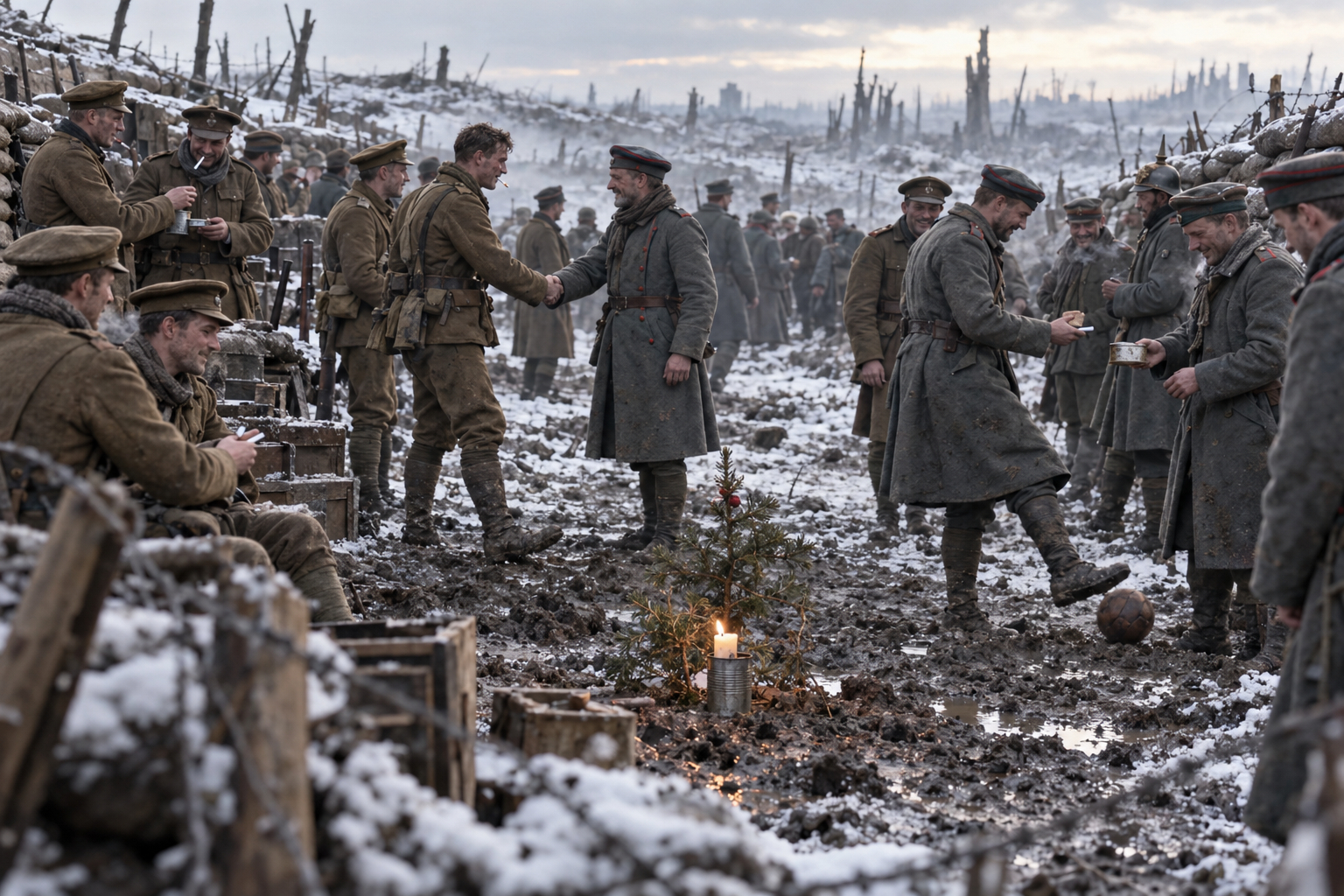
The Western Front in December 1914 was a churn of trenches, barbed wire and a bitter stalemate. After months of open warfare in 1914, lines had hardened into defensive belts running from the North Sea to the Swiss border. Cold and mud made daily life miserable for infantrymen on both sides. Yet along many sectors — from Belgian fields to the Somme — the arrival of Christmas brought a surprising, unofficial thaw between enemy units.
A Christmas Break in the Trenches
Beginning on December 24 and into Christmas Day, British, French and German soldiers in places initiated what later became known as the Christmas Truce. Men left their dugouts and stepped into no man’s land. They called across in each other’s languages, exchanged cigarettes and food, and sometimes helped each other recover the dead and wounded. Numerous personal letters and unit diaries describe shared carols, conversations and, in several accounts, impromptu games of football played on frozen ground.
The truce was not a single coordinated event. It was a patchwork of localized ceasefires and informal agreements, varying from one sector to another. In some places it lasted only hours; in others, a few days. In many parts of the front the guns never fell silent. Where it occurred, though, the truce revealed a blunt reality: ordinary soldiers, separated by identical fears and hardships, could recognize a common humanity even in the midst of war.
Aftermath and Memory
High command on both sides reacted badly. Military leaders worried that fraternization would sap soldiers’ willingness to fight and quickly issued orders forbidding further truces. The officers also feared the propaganda consequences of footage and photos showing enemy troops conversing amicably. As 1915 unfolded, the front line grew more lethal; artillery barrages, mines and tighter discipline made another widespread truce unlikely.
For decades the Christmas Truce was recounted in memoirs, regimental histories and schoolbooks as an emblem of wartime paradox: ordinary men resisting the machinery of industrial war, even briefly. Historians now treat it cautiously, emphasizing its localized nature and reminding readers that it did not signal any shift in strategy or slow the onward march of the conflict. Still, the images of soldiers exchanging small gifts and singing carols remain striking precisely because they are so human.
Conclusion
The 1914 Christmas Truce did not end the First World War; it did something quieter and harder to ignore. For a handful of hours, neighbors in a brutal landscape chose to be neighbors rather than enemies. That small daylight of civility—fleeting, uneven and ultimately suppressed—persists in memory because it exposes a truth wartime rhetoric often conceals: people on opposing sides can sometimes see each other as people first.