
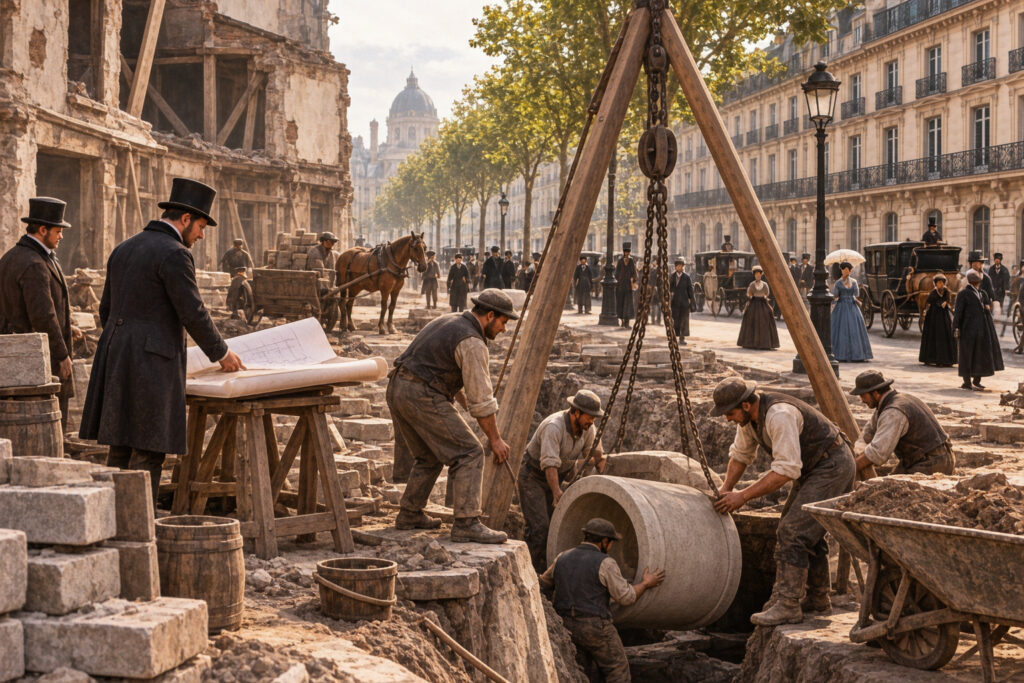
In the 1850s Paris looked like a medieval maze: narrow lanes, tangled alleys, cramped courts. Georges‑Eugène Haussmann, installed by Napoleon III as prefect of the Seine, set out to redraw that map. Between about 1853 and 1870 his teams cut broad, tree‑lined boulevards through older neighborhoods, laid modern sewers, and built parks on the city’s edges. The changes were theatrical — entire blocks of buildings knocked down to open vistas, new junctions designed to reveal monuments and to create promenades where Parisians could walk, window‑shop, and be seen.
The work wasn’t just cosmetic. Beneath those new streets ran masonry sewers and improved water mains; gaslights marched along the boulevards; public gardens and the Bois de Boulogne gave the city green lungs. Uniform stone facades, continuous cornices, and iron balconies created a recognizable Parisian look that endures today: the straight line of a boulevard, the regular rhythm of windows and rooflines.
Who Lived Where — Winners and Losers
Haussmann’s Paris brought benefits and displacement in equal measure. The wealthy and emerging middle classes gained better light, cleaner air, easier carriage routes and, importantly, a city that displayed their status. Property values rose where boulevards appeared. But the work required expropriation and demolition: many working‑class quarters were broken up, families forced to find cheaper housing on the outskirts. Critics at the time — and historians since — have pointed out how top‑down planning cleared slums but also scattered communities and made central Paris less affordable for its poorest residents.
Look, Shop, Move: Streets That Shaped Everyday Life
The new plan altered daily rhythms. Wider sidewalks and long sightlines invited strolling and casual encounters. Cafés and cafés‑terraces found room to expand; carriage traffic flowed along grand diagonals; formal parks gave children space to play and citizens places to gather. Merchants seized the opportunity: where shopfronts once huddled in narrow lanes, larger stores and show windows lined the boulevards, changing how people shopped and how goods were displayed. The city’s circulation — of people, goods, ideas — became legible in a way medieval streets never allowed.
Conclusion
Haussmann’s Paris remains a city you recognize at a glance. His interventions gave the capital modern infrastructure and a dramatically different public life, but they also embodied a kind of power: aesthetic vision enforced by the state, with social costs. Walk the grands boulevards today and you’re tracing the footprint of a single ambitious project — one that reshaped not only buildings and sewers, but how Parisians moved, met, and imagined their city.