Uncover History’s Secrets with Daily Updates!
Daily News Entertainment
  • Home
  • History
  • Biographies
  • Eras
  • Regions
  • Timeline
No Result
View All Result
History Ours
  • Home
  • History
  • Biographies
  • Eras
  • Regions
  • Timeline
No Result
View All Result
History Ours
No Result
View All Result
Home History

The Trent Affair: How a Diplomatic Snag Nearly Brought Britain In

in History
The Trent Affair: How a Diplomatic Snag Nearly Brought Britain In

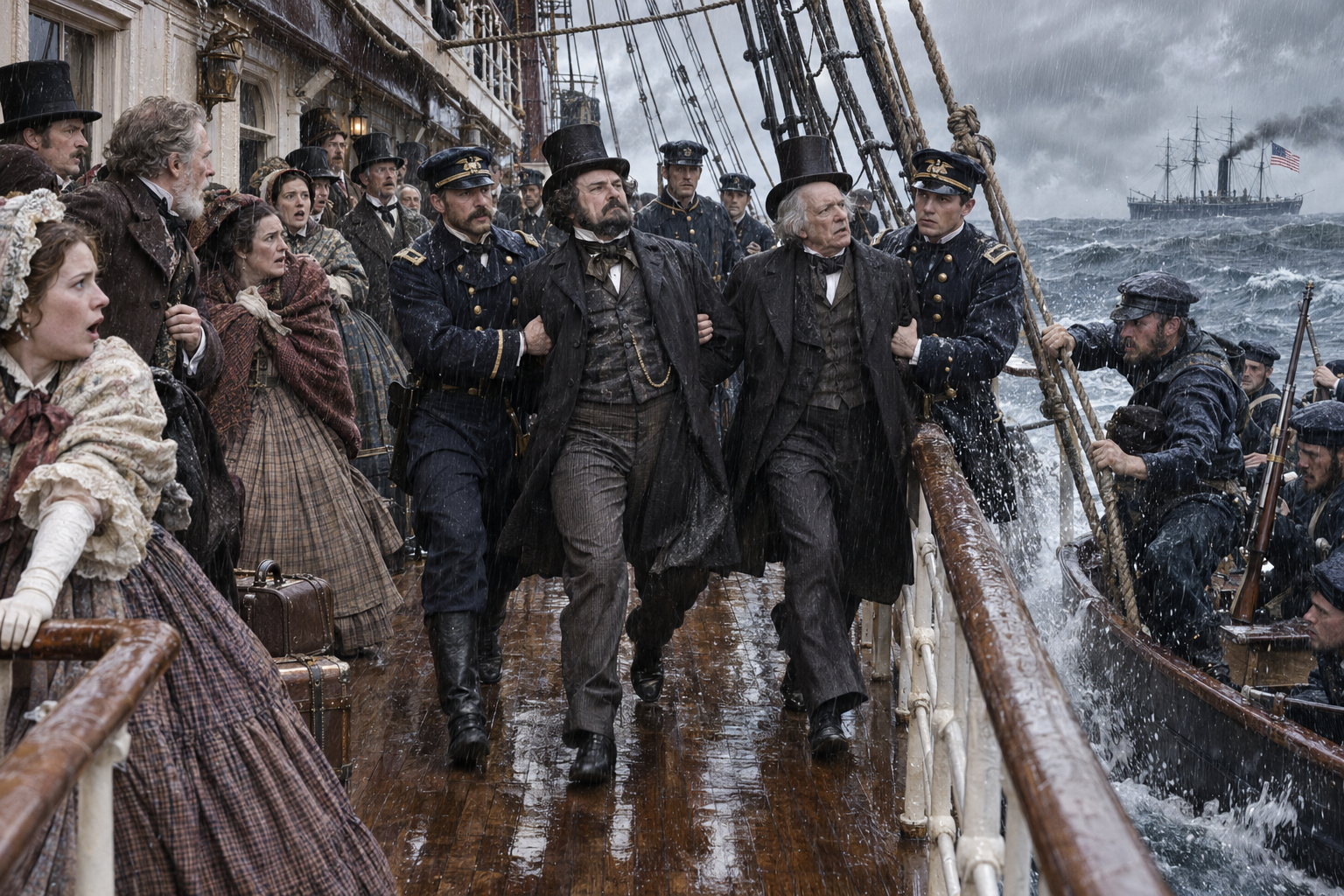
November 1861 began like another month of Civil War headlines — then a U.S. Navy captain pulled a move that could have widened the war to two oceans. Commander Charles Wilkes, cruising in the USS San Jacinto, stopped the British mail packet RMS Trent in the Atlantic. He physically removed two Confederate envoys, James Mason and John Slidell, who were bound for Europe to lobby for recognition and support.

Wilkes treated the seizure as a bold wartime action: strike at Confederate diplomacy, hinder foreign recognition. For many in the North it felt like a victory. The captains, the crew, and newspapers cheered. But the Trent was a neutral British vessel operating under international rules that normally shielded passengers from forcible removal. What looked like a tactical coup in a gunboat brief soon became a political fuse.

Britain’s thunder and America’s scramble

London reacted with shock and anger. The British government demanded the release of Mason and Slidell, protested the violation of neutral rights, and began to prepare for the worst. Troops and ships were readied for defense in Canada; naval squadrons adjusted their dispositions. British politicians framed the incident as a matter of national honor and international law, not merely a quarrel across the Atlantic.

In Washington the mood shifted from triumph to alarm. President Abraham Lincoln and his cabinet understood that a war with Britain would be ruinous for the Union. The Confederacy’s hopes for recognition had just been handed a propitious opportunity, and British intervention could alter the conflict’s balance. The administration faced a delicate legal and diplomatic tightrope: how to placate Britain without appearing to reward insubordination by an American naval officer.

How it cooled — and why it mattered

Secretary of State William H. Seward offered a solution grounded in law and face-saving. The government disavowed Wilkes’s action as exceeding his authority and arranged for Mason and Slidell’s release. Britain accepted the outcome and a formal apology was avoided; the two sides stepped back from the brink.

The Trent Affair mattered because it revealed how fragile American foreign policy was in the war’s first year. A single captain’s decision nearly pulled two great powers into conflict. It also underscored the importance of neutral rights at sea and set a precedent: the Union would pursue the Confederacy’s defeat without risking a major European war over ad hoc naval seizures.

Conclusion

For weeks the world watched a diplomatic scuffle escalate toward war. The Trent Affair is a tidy reminder that small, impulsive actions at sea can have outsized consequences on land. In the end, cooler heads and careful legal maneuvering defused a crisis — but the episode left both sides wary and reshaped how diplomacy and naval power intersected during the American Civil War.

Previous Post

After the Quake: How 1755 Lisbon Reshaped an Empire

Next Post

The Erie Canal: A Waterway That Built New York

Related Posts

The Matchgirls’ Revolt: Women Who Struck Back in 1888
History

The Matchgirls’ Revolt: Women Who Struck Back in 1888

November 18, 2026
Tulipmania: How a Flower Became Holland’s First Bubble
History

Tulipmania: How a Flower Became Holland’s First Bubble

November 18, 2026
The Defenestration That Ignited the Thirty Years’ War
History

The Defenestration That Ignited the Thirty Years’ War

November 13, 2026
The Great Cat Massacre: Craftsmen, Protest, and Parisian Mischief
History

The Great Cat Massacre: Craftsmen, Protest, and Parisian Mischief

November 13, 2026
Next Post
The Erie Canal: A Waterway That Built New York

The Erie Canal: A Waterway That Built New York

Search..

No Result
View All Result

Recent Articles

Isabella Stewart Gardner: Boston’s Provocative Collector and Her Museum

Isabella Stewart Gardner: Boston’s Provocative Collector and Her Museum

November 22, 2026
The Erie Canal: A Waterway That Built New York

The Erie Canal: A Waterway That Built New York

November 22, 2026
The Trent Affair: How a Diplomatic Snag Nearly Brought Britain In

The Trent Affair: How a Diplomatic Snag Nearly Brought Britain In

November 21, 2026
After the Quake: How 1755 Lisbon Reshaped an Empire

After the Quake: How 1755 Lisbon Reshaped an Empire

November 21, 2026
The Jazz Age: Sound, Speakeasies, and Urban Style

The Jazz Age: Sound, Speakeasies, and Urban Style

November 20, 2026

Subscribe Us

By clicking submit, I authorize History Ours and its affiliated companies to: (1) use, sell, and share my information for marketing purposes, including cross-context behavioral advertising, as described in our Terms of Service and Privacy Policy, (2) supplement the information that I provide with additional information lawfully obtained from other sources, like demographic data from public sources, interests inferred from web page views, or other data relevant to what might interest me, like past purchase or location data, (3) contact me or enable others to contact me by email with offers for goods and services from any category at the email address provided, and (4) retain my information while I am engaging with marketing messages that I receive and for a reasonable amount of time thereafter. I understand I can opt out at any time through an email that I receive, or by clicking here

Subscribe To Our Newsletter

By clicking submit, I authorize History Ours and its affiliated companies to: (1) use, sell, and share my information for marketing purposes, including cross-context behavioral advertising, as described in our Terms of Service and Privacy Policy, (2) supplement the information that I provide with additional information lawfully obtained from other sources, like demographic data from public sources, interests inferred from web page views, or other data relevant to what might interest me, like past purchase or location data, (3) contact me or enable others to contact me by email with offers for goods and services from any category at the email address provided, and (4) retain my information while I am engaging with marketing messages that I receive and for a reasonable amount of time thereafter. I understand I can opt out at any time through an email that I receive, or by clicking here.

© 2026 History Ours | All Rights Reserved

  • Contact Us
  • Privacy Policy
  • Terms of Service
  • Unsubscribe
  • Privacy Choices
  • Contact Us
  • Privacy Policy
  • Terms of Service
  • Unsubscribe
  • Privacy Choices

© 2026 History Ours | All Rights Reserved

No Result
View All Result
  • Home
  • History
  • Biographies
  • Eras
  • Regions
  • Timeline

© 2026 History Ours | All Rights Reserved

Skip to content
Open toolbar Accessibility Tools

Accessibility Tools

  • Increase TextIncrease Text
  • Decrease TextDecrease Text
  • GrayscaleGrayscale
  • High ContrastHigh Contrast
  • Negative ContrastNegative Contrast
  • Light BackgroundLight Background
  • Links UnderlineLinks Underline
  • Readable FontReadable Font
  • Reset Reset