
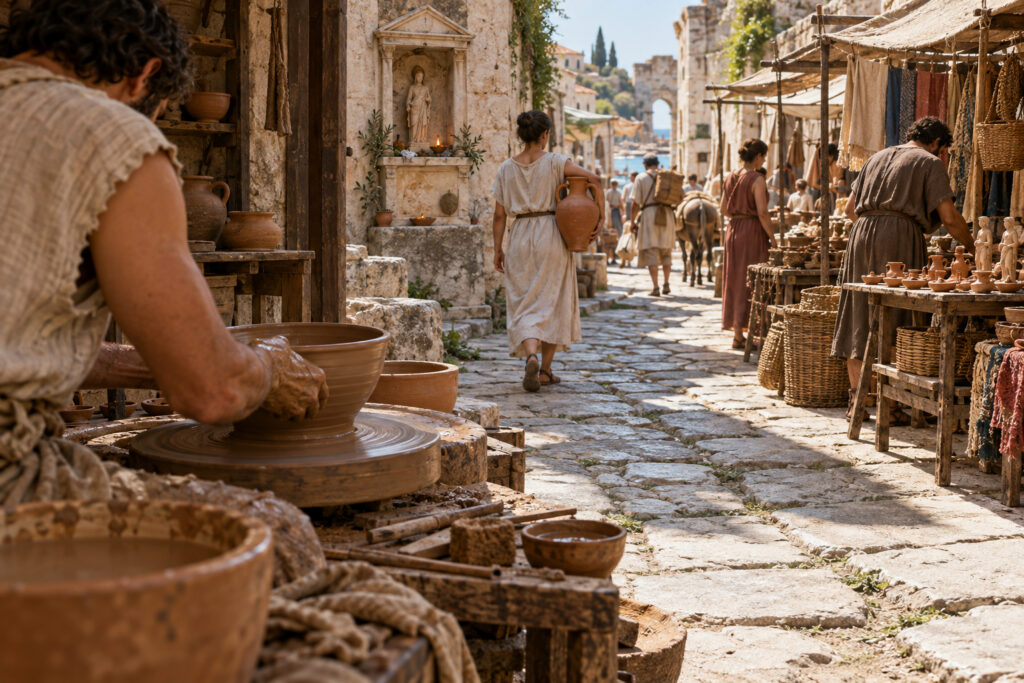
Histories of ancient cities often focus on rulers, monuments, and warfare, but everyday people made urban life functional and meaningful. Craftspeople, traders, householders, and ritual specialists negotiated space, labor, and social ties that sustained complex communities. Archaeology and documentary evidence can reveal patterns of consumption, work, and social interaction that illuminate ordinary experience. Exploring these traces helps us understand how cities were lived in, not just governed.
Urban Rituals and Public Spaces
Public spaces in ancient cities were stages for routine rituals as much as ceremonial spectacles, and they structured daily movements and encounters. Markets, fountains, workshops, and shrines anchored neighborhoods and became sites where social norms were reinforced and negotiated. Inscriptions, wear patterns on paving stones, and the distribution of small votive objects show how common people used and reshaped communal areas. These practices made abstract civic identities tangible through repeated, grounded activities that connected individuals to larger urban rhythms.
Understanding these rituals highlights the interplay between formal institutions and popular custom. Ordinary acts of devotion, bargaining, and repair created continuity and adaptability in urban life.
Trade, Labor and the Informal Economy
Markets and artisanal quarters formed the economic backbone of ancient cities, and much of this work happened outside elite oversight. Skilled artisans and day laborers operated in dense networks of credit, apprenticeship, and reputation that facilitated production and exchange. Archaeological remains of workshops, tool assemblages, and small-scale finished goods point to diverse specialties and local innovations. Documentary sources occasionally record contracts and disputes, providing glimpses of how labor relations and commercial norms were negotiated.
- Short-term labor arrangements allowed households to diversify income.
- Shared workshop spaces encouraged knowledge transfer across generations.
- Informal credit networks reduced reliance on formal institutions.
These elements underline the resilience of urban economies, which depended on flexible, everyday practices as much as on grand trade routes.
Domestic Life and Material Culture
Homes reveal the rhythms of daily life: cooking areas, storage spaces, and domestic shrines show how families managed resources and identities. Pottery, textiles, and household tools reflect consumption choices shaped by availability, status, and cultural preference. Spatial organization within houses indicates patterns of privacy and social interaction among kin and guests. Small, ordinary objects often provide the clearest evidence of continuity and change in everyday practices.
By focusing on material traces, historians reconstruct routines that did not make it into official annals. This approach balances grand narratives with lived experience.
Conclusion
Studying ordinary people transforms our picture of ancient urban life from static monuments to dynamic communities. Material culture and spatial analysis reveal how routines, work, and ritual bound cities together. Paying attention to these practices enriches historical understanding and connects past urban realities to present human experiences.