
Uncover History’s Secrets with Daily Updates!
Daily News Entertainment
  • Home
  • History
  • Biographies
  • Eras
  • Regions
  • Timeline
No Result
View All Result
History Ours
  • Home
  • History
  • Biographies
  • Eras
  • Regions
  • Timeline
No Result
View All Result
History Ours
No Result
View All Result
Home History

The Strasbourg Dancing Plague: When People Couldn’t Stop Dancing

in History
The Strasbourg Dancing Plague: When People Couldn’t Stop Dancing

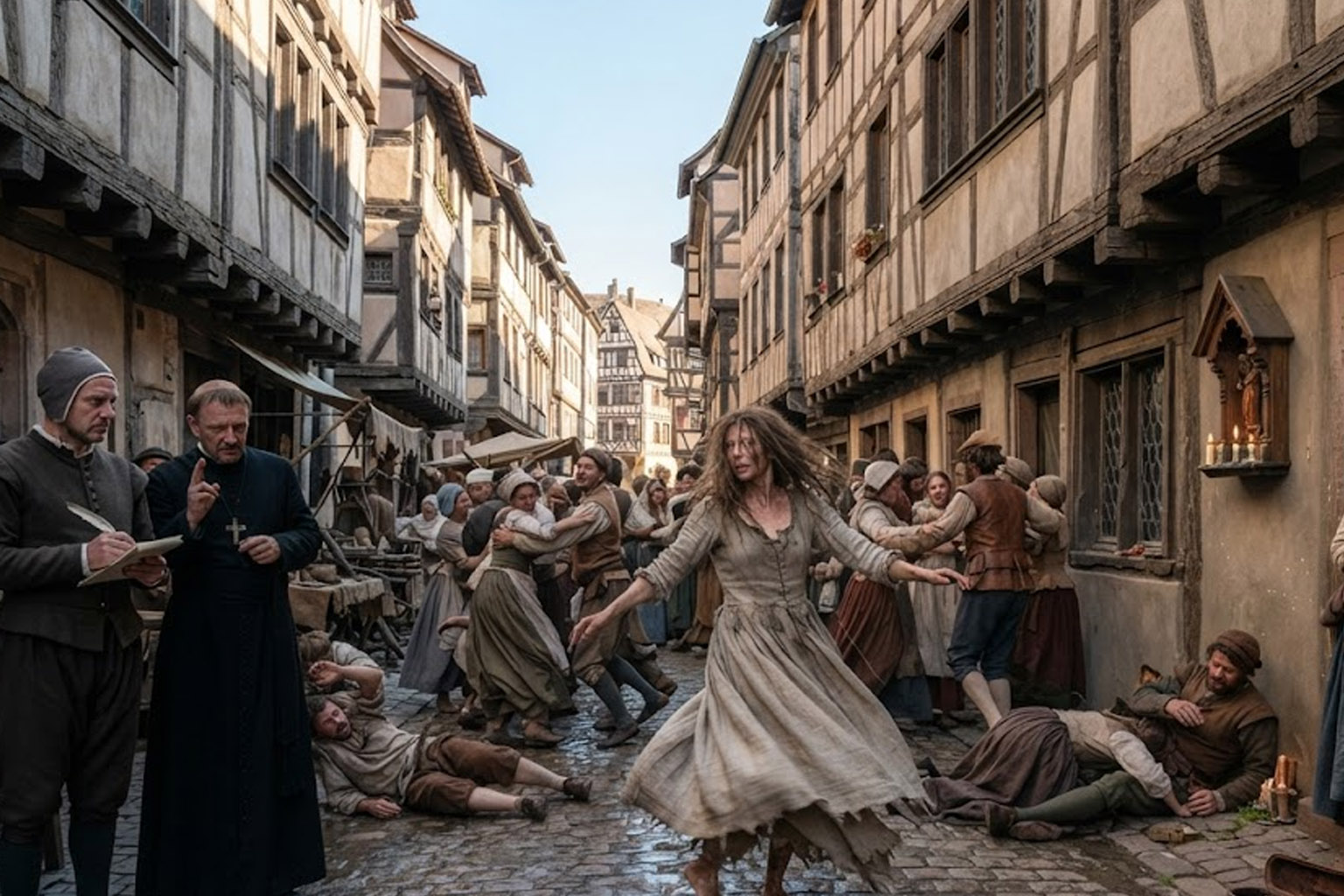
In July 1518 a woman in Strasbourg — then a free city in the Holy Roman Empire — stepped out into a narrow street and began to dance. She moved without music, without company at first, and kept going for days. City records name her only as Frau Troffea. Within a week others had joined. What began as a single peculiar display soon swelled into a spectacle of bodies in motion, collapsing from exhaustion in doorways and on the cobbles.

How it unfolded

Municipal records from the time describe the outbreak as lasting several weeks. Contemporary clerks wrote that dozens — and by some later accounts as many as hundreds — were affected. Men and women, sometimes whole families, danced until they fainted. Some accounts say people suffered heart attacks or strokes; others simply fell exhausted and were carried away. The city first treated the condition as a medical curiosity, then as a public nuisance, then as a crisis, and finally as something to be contained.

Authorities reacted awkwardly. At first they appeared to tolerate the dancing, even arranging a place for the afflicted to perform and hiring musicians. That plan may have been intended to help sufferers ‘‘dance it out’’ or to lead them politely to a shrine for spiritual relief. When the dancing continued and the toll of physical collapse mounted, officials closed the makeshift halls and turned to harsher measures.

What’s behind the mania?

Scholars have floated several explanations over the centuries. In the early 20th century, ergotism — poisoning from a fungus that can grow on damp rye and produces convulsions — was a popular theory. It offers a neat physiological mechanism, but it doesn’t fit every detail: ergot typically causes hallucinations and gangrene as well as convulsions, and the pattern of the Strasbourg episodes and similar outbreaks favors a social explanation.

Most historians and medical researchers today favor a form of mass psychogenic illness — a kind of collective stress response. 1518 was a hard year for many parts of Europe: crop failures, hunger, and disease created an atmosphere of desperation. In that context, intense religious beliefs about saints, sin, and the body could channel distress into dramatic, shared behavior. The dancing plague becomes, in this reading, both a symptom and a form of communication in a community pushed to the edge.

Conclusion

The dancing plague of Strasbourg is less a neat diagnosis than a window into how people in the past handled fear, belief, and the limits of medicine and authority. It looks strange to modern eyes: a spontaneous carnival of motion that turned dangerous. But it also reminds us how the body and the social world can respond together to pressure. More than five centuries later, the episode still prompts unease and curiosity — and an uncomfortable recognition that communities sometimes answer crisis with unexpected, human behaviors.
Previous Post

When a Brewing Vat Turned London Streets into a River of Beer

Related Posts

When a Brewing Vat Turned London Streets into a River of Beer
History

When a Brewing Vat Turned London Streets into a River of Beer

September 24, 2026
How Krakatoa’s 1883 Blast Echoed Around the World
History

How Krakatoa’s 1883 Blast Echoed Around the World

September 19, 2026
When Soldiers Were Sent to Fight Emus in Western Australia
History

When Soldiers Were Sent to Fight Emus in Western Australia

September 19, 2026
How the Crystal Palace Turned Glass and Iron into a Modern Stage
History

How the Crystal Palace Turned Glass and Iron into a Modern Stage

September 15, 2026

Search..

No Result
View All Result

Recent Articles

The Strasbourg Dancing Plague: When People Couldn’t Stop Dancing

The Strasbourg Dancing Plague: When People Couldn’t Stop Dancing

September 24, 2026
When a Brewing Vat Turned London Streets into a River of Beer

When a Brewing Vat Turned London Streets into a River of Beer

September 24, 2026
Timeline: The Pony Express — Rush, Risk, and Rapid Decline

Timeline: The Pony Express — Rush, Risk, and Rapid Decline

September 23, 2026
The Voyages and Legacy of Zheng He

The Voyages and Legacy of Zheng He

September 23, 2026
Pampas: How Gauchos, Railways, and Beef Built Argentina

Pampas: How Gauchos, Railways, and Beef Built Argentina

September 22, 2026

Subscribe Us

By clicking submit, I authorize History Ours and its affiliated companies to: (1) use, sell, and share my information for marketing purposes, including cross-context behavioral advertising, as described in our Terms of Service and Privacy Policy, (2) supplement the information that I provide with additional information lawfully obtained from other sources, like demographic data from public sources, interests inferred from web page views, or other data relevant to what might interest me, like past purchase or location data, (3) contact me or enable others to contact me by email with offers for goods and services from any category at the email address provided, and (4) retain my information while I am engaging with marketing messages that I receive and for a reasonable amount of time thereafter. I understand I can opt out at any time through an email that I receive, or by clicking here

Subscribe To Our Newsletter

By clicking submit, I authorize History Ours and its affiliated companies to: (1) use, sell, and share my information for marketing purposes, including cross-context behavioral advertising, as described in our Terms of Service and Privacy Policy, (2) supplement the information that I provide with additional information lawfully obtained from other sources, like demographic data from public sources, interests inferred from web page views, or other data relevant to what might interest me, like past purchase or location data, (3) contact me or enable others to contact me by email with offers for goods and services from any category at the email address provided, and (4) retain my information while I am engaging with marketing messages that I receive and for a reasonable amount of time thereafter. I understand I can opt out at any time through an email that I receive, or by clicking here.

© 2026 History Ours | All Rights Reserved

  • Contact Us
  • Privacy Policy
  • Terms of Service
  • Unsubscribe
  • Privacy Choices
  • Contact Us
  • Privacy Policy
  • Terms of Service
  • Unsubscribe
  • Privacy Choices

© 2026 History Ours | All Rights Reserved

No Result
View All Result
  • Home
  • History
  • Biographies
  • Eras
  • Regions
  • Timeline

© 2026 History Ours | All Rights Reserved

Skip to content
Open toolbar Accessibility Tools

Accessibility Tools

  • Increase TextIncrease Text
  • Decrease TextDecrease Text
  • GrayscaleGrayscale
  • High ContrastHigh Contrast
  • Negative ContrastNegative Contrast
  • Light BackgroundLight Background
  • Links UnderlineLinks Underline
  • Readable FontReadable Font
  • Reset Reset