Uncover History’s Secrets with Daily Updates!
Daily News Entertainment
  • Home
  • History
  • Biographies
  • Eras
  • Regions
  • Timeline
No Result
View All Result
History Ours
  • Home
  • History
  • Biographies
  • Eras
  • Regions
  • Timeline
No Result
View All Result
History Ours
No Result
View All Result
Home History

How the Crystal Palace Turned Glass and Iron into a Modern Stage

in History
How the Crystal Palace Turned Glass and Iron into a Modern Stage

A revolutionary greenhouse becomes a national spectacle

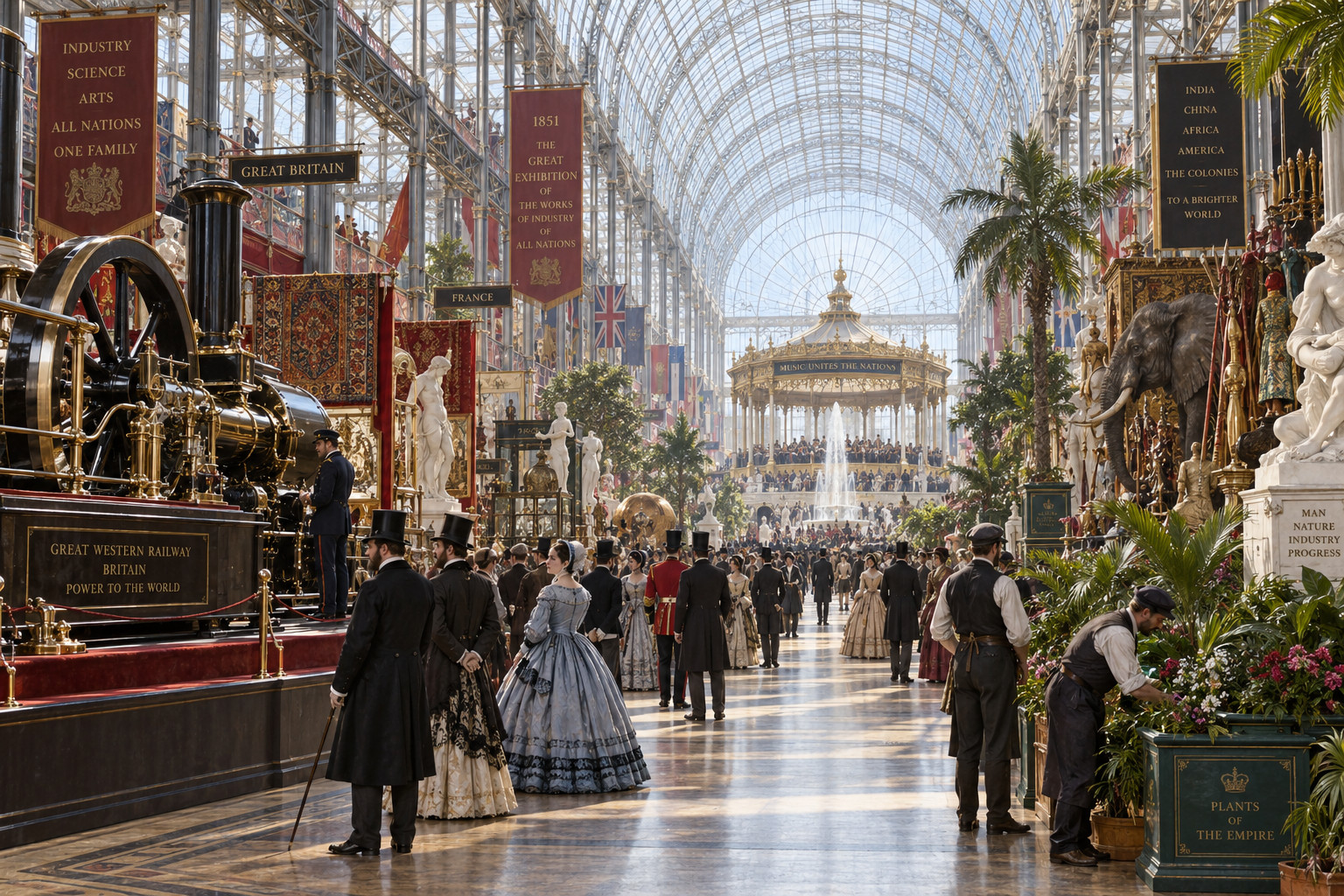
When London’s Great Exhibition opened in Hyde Park in 1851, the building that held it looked nothing like the stone-fronted institutions people expected. Joseph Paxton, long known as the head gardener at Chatsworth House, proposed something based on greenhouses—long spans of iron framed with vast sheets of glass. The result was a structure that felt more like a machine for seeing than a traditional museum: light poured in, floors stretched away under a cathedral of iron ribs, and the objects on display—steam engines, textiles, colonial curiosities—were lit as if on a theatrical stage.

Design, speed, and a new way to build

What made the Crystal Palace remarkable was how it was made. Paxton translated horticultural technology into architecture: standardized components, repetitive frames, and prefabricated parts that could be assembled quickly. The method cut building time dramatically—erected in under a year—and suggested that buildings could be produced in the manner of industrial goods. The lightness of glass and the strength of iron let architects imagine roofs and spans previously impossible with masonry. For visitors used to dim, enclosed museums, the airy openness felt like a glimpse of something new—architecture responding to industry rather than imitating old styles.

After the Exhibition: spectacle, relocation, and influence

The Crystal Palace did not vanish with the exhibition. Officials dismantled and relocated it to Sydenham, south London, where it reopened in 1854 as a park-like destination of concerts, sericultural displays, and public promenades. It became a laboratory of 19th-century spectacle: model villages, fountains, illuminated nights, and botanical exhibitions filled its galleries. Architects and engineers watched and borrowed. Railway stations, department stores, and later conservatories echoed its vocabulary—large glass surfaces, iron frameworks, and internal spaces organized for crowd movement and display. In that way the Palace was less an isolated marvel than the prototype for an architectural language of the modern city.

Conclusion

The Crystal Palace’s story is a tidy illustration of how material innovation reshapes imagination. A gardener’s solution for growing plants became a building that framed an empire’s products and a public’s curiosity. Though the Palace itself was destroyed by fire in 1936, its legacy survived in skylines and station roofs, in glass-fronted shops and public halls. It didn’t just house the modern age—it helped invent the forms in which that age would present itself.

Previous Post

Anne Bonny: The Pirate Who Broke Rules and Expectations

Next Post

Bass Reeves: The Marshal Who Hunted Outlaws in Indian Territory

Related Posts

Anne Bonny: The Pirate Who Broke Rules and Expectations
History

Anne Bonny: The Pirate Who Broke Rules and Expectations

September 15, 2026
Mary Anning and the Coast That Revealed Lost Worlds
History

Mary Anning and the Coast That Revealed Lost Worlds

September 15, 2026
When Mount Pelée Erased Saint-Pierre, 1902
History

When Mount Pelée Erased Saint-Pierre, 1902

September 15, 2026
When London Walked on the River: Thames Frost Fairs
History

When London Walked on the River: Thames Frost Fairs

September 15, 2026
Next Post
Bass Reeves: The Marshal Who Hunted Outlaws in Indian Territory

Bass Reeves: The Marshal Who Hunted Outlaws in Indian Territory

Search..

No Result
View All Result

Recent Articles

The Disguise That Broke Chains: Ellen and William Craft

The Disguise That Broke Chains: Ellen and William Craft

September 15, 2026
Bass Reeves: The Marshal Who Hunted Outlaws in Indian Territory

Bass Reeves: The Marshal Who Hunted Outlaws in Indian Territory

September 15, 2026
How the Crystal Palace Turned Glass and Iron into a Modern Stage

How the Crystal Palace Turned Glass and Iron into a Modern Stage

September 15, 2026
Anne Bonny: The Pirate Who Broke Rules and Expectations

Anne Bonny: The Pirate Who Broke Rules and Expectations

September 15, 2026
How Haiti Broke Its Chains: A 1791–1804 Timeline

How Haiti Broke Its Chains: A 1791–1804 Timeline

September 15, 2026

Subscribe Us

By clicking submit, I authorize History Ours and its affiliated companies to: (1) use, sell, and share my information for marketing purposes, including cross-context behavioral advertising, as described in our Terms of Service and Privacy Policy, (2) supplement the information that I provide with additional information lawfully obtained from other sources, like demographic data from public sources, interests inferred from web page views, or other data relevant to what might interest me, like past purchase or location data, (3) contact me or enable others to contact me by email with offers for goods and services from any category at the email address provided, and (4) retain my information while I am engaging with marketing messages that I receive and for a reasonable amount of time thereafter. I understand I can opt out at any time through an email that I receive, or by clicking here

Subscribe To Our Newsletter

By clicking submit, I authorize History Ours and its affiliated companies to: (1) use, sell, and share my information for marketing purposes, including cross-context behavioral advertising, as described in our Terms of Service and Privacy Policy, (2) supplement the information that I provide with additional information lawfully obtained from other sources, like demographic data from public sources, interests inferred from web page views, or other data relevant to what might interest me, like past purchase or location data, (3) contact me or enable others to contact me by email with offers for goods and services from any category at the email address provided, and (4) retain my information while I am engaging with marketing messages that I receive and for a reasonable amount of time thereafter. I understand I can opt out at any time through an email that I receive, or by clicking here.

© 2026 History Ours | All Rights Reserved

  • Contact Us
  • Privacy Policy
  • Terms of Service
  • Unsubscribe
  • Privacy Choices
  • Contact Us
  • Privacy Policy
  • Terms of Service
  • Unsubscribe
  • Privacy Choices

© 2026 History Ours | All Rights Reserved

No Result
View All Result
  • Home
  • History
  • Biographies
  • Eras
  • Regions
  • Timeline

© 2026 History Ours | All Rights Reserved

Skip to content
Open toolbar Accessibility Tools

Accessibility Tools

  • Increase TextIncrease Text
  • Decrease TextDecrease Text
  • GrayscaleGrayscale
  • High ContrastHigh Contrast
  • Negative ContrastNegative Contrast
  • Light BackgroundLight Background
  • Links UnderlineLinks Underline
  • Readable FontReadable Font
  • Reset Reset