Uncover History’s Secrets with Daily Updates!
Daily News Entertainment
  • Home
  • History
  • Biographies
  • Eras
  • Regions
  • Timeline
No Result
View All Result
History Ours
  • Home
  • History
  • Biographies
  • Eras
  • Regions
  • Timeline
No Result
View All Result
History Ours
No Result
View All Result
Home History

Mapping Trade Networks Through Pottery and Coin Circulation

in History
Mapping Trade Networks Through Pottery and Coin Circulation

Archaeologists use everyday objects to chart connections across regions.
Pottery styles and coin hoards reveal routes and economic ties.
When examined together they offer a map of exchange over centuries.
Combining typology with scientific analysis builds a layered picture of past trade.

Artifacts as Trade Signatures

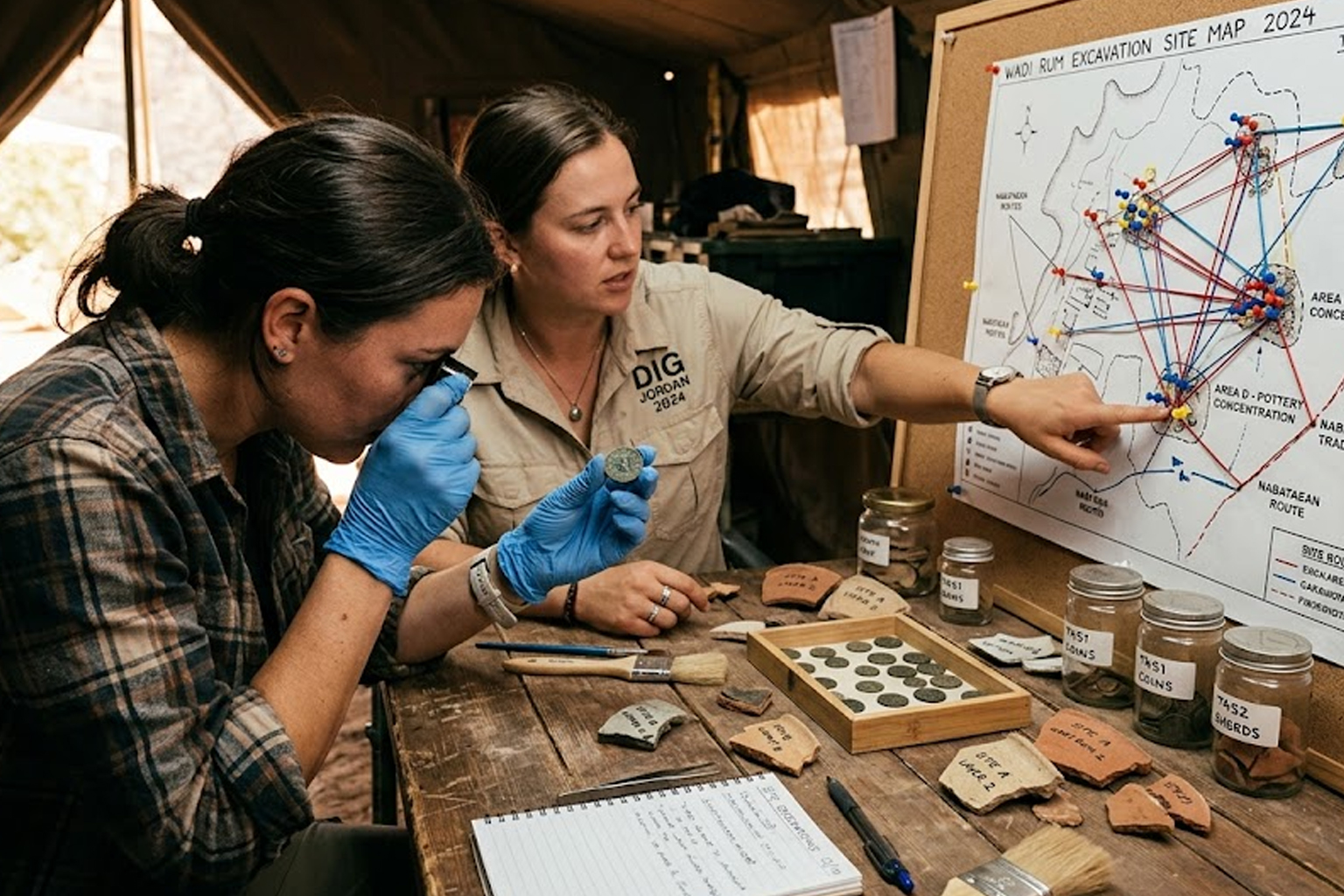
Pottery and coins act as durable signatures of exchange, surviving where organic materials do not. Distinctive clay sources, temper, and decorative techniques allow pottery to be tied to production zones. Coins carry metallic composition, mint marks and iconography that locate monetary flows. Together they indicate both practical trade and the movement of ideas and people. Patterns of wear and repair also signal usage and exchange across households and regions.

  • Amphorae and transport pottery
  • Mint marks and denominations
  • Small finds like weights and seals

Interpreting these signals requires attention to context, from findspots to stratigraphy. Context distinguishes traded objects from locally copied styles. Such differentiation is crucial for accurate maps of interaction.

Methods for Reconstructing Networks

Scholars combine typological analysis with scientific methods such as petrography, XRF and lead isotope studies to trace raw materials. Spatial analysis and GIS map artifact distributions and identify hubs and corridors. Numismatic studies provide chronological anchors through hoards and circulation patterns. Cross-referencing historical texts and shipwreck evidence refines models of trade intensity. Isotopic studies of metals can link coinage to ore sources and mining regions.

  • Petrography and thin-section analysis
  • Portable XRF and elemental characterization
  • GIS mapping and spatial statistics

No single method gives a full picture; convergence of evidence strengthens interpretations. Transparent reporting of sampling and statistical uncertainty is essential. Collaboration between laboratories and field teams improves datasets.

Case Studies and Interpretations

Well-documented case studies show how combined datasets reveal surprising connections. For instance, ceramic forms once considered local can be traced to distant workshops through mineral signatures, while coin finds reveal rapid economic integration after political change. Shipwreck assemblages often provide snapshots of cargo composition and trade routes. Regional studies illuminate different scales of exchange, from elite long-distance trade to everyday provisioning. Long-term datasets capture changes in routes and commodity preferences over generations.

  • Cargo assemblages revealing commodity mixes
  • Hoards indicating sudden economic shifts

Interpretations must account for non-economic movement such as gift exchange and migration. Considering social and cultural dimensions prevents reducing artifacts to mere commodities. This broader lens helps interpret artifacts within social networks and rituals.

Conclusion

Pottery and coins remain indispensable tools for mapping past trade networks.
Their study combines artifactual detail with scientific analysis to reconstruct flows of goods and ideas.
Sustained interdisciplinary work will continue to refine our understanding of historical exchange.
Previous Post

Strategic Timeline Design for Connected Historical Narratives

Next Post

Tracing Social Lives Through Household Artifacts

Related Posts

John Snow, the Broad Street Pump, and Cholera’s Fall
History

John Snow, the Broad Street Pump, and Cholera’s Fall

October 29, 2026
The Vasa: Sweden’s Giant Ship That Couldn’t Sail
History

The Vasa: Sweden’s Giant Ship That Couldn’t Sail

October 29, 2026
The Ghost Army: How Artists Fooled Hitler’s Front
History

The Ghost Army: How Artists Fooled Hitler’s Front

October 24, 2026
How Iceland’s 1783 Laki Fissure Eruption Chilled an Age
History

How Iceland’s 1783 Laki Fissure Eruption Chilled an Age

October 24, 2026
Next Post
Tracing Social Lives Through Household Artifacts

Tracing Social Lives Through Household Artifacts

Search..

No Result
View All Result

Recent Articles

Mary Seacole: The Jamaican Nurse Who Went to War

Mary Seacole: The Jamaican Nurse Who Went to War

October 30, 2026
Ada Lovelace: The Poet Who Helped Imagine Modern Computers

Ada Lovelace: The Poet Who Helped Imagine Modern Computers

October 30, 2026
John Snow, the Broad Street Pump, and Cholera’s Fall

John Snow, the Broad Street Pump, and Cholera’s Fall

October 29, 2026
The Vasa: Sweden’s Giant Ship That Couldn’t Sail

The Vasa: Sweden’s Giant Ship That Couldn’t Sail

October 29, 2026
How the Black Death Spread Across Europe, 1347–1351

How the Black Death Spread Across Europe, 1347–1351

October 28, 2026

Subscribe Us

By clicking submit, I authorize History Ours and its affiliated companies to: (1) use, sell, and share my information for marketing purposes, including cross-context behavioral advertising, as described in our Terms of Service and Privacy Policy, (2) supplement the information that I provide with additional information lawfully obtained from other sources, like demographic data from public sources, interests inferred from web page views, or other data relevant to what might interest me, like past purchase or location data, (3) contact me or enable others to contact me by email with offers for goods and services from any category at the email address provided, and (4) retain my information while I am engaging with marketing messages that I receive and for a reasonable amount of time thereafter. I understand I can opt out at any time through an email that I receive, or by clicking here

Subscribe To Our Newsletter

By clicking submit, I authorize History Ours and its affiliated companies to: (1) use, sell, and share my information for marketing purposes, including cross-context behavioral advertising, as described in our Terms of Service and Privacy Policy, (2) supplement the information that I provide with additional information lawfully obtained from other sources, like demographic data from public sources, interests inferred from web page views, or other data relevant to what might interest me, like past purchase or location data, (3) contact me or enable others to contact me by email with offers for goods and services from any category at the email address provided, and (4) retain my information while I am engaging with marketing messages that I receive and for a reasonable amount of time thereafter. I understand I can opt out at any time through an email that I receive, or by clicking here.

© 2026 History Ours | All Rights Reserved

  • Contact Us
  • Privacy Policy
  • Terms of Service
  • Unsubscribe
  • Privacy Choices
  • Contact Us
  • Privacy Policy
  • Terms of Service
  • Unsubscribe
  • Privacy Choices

© 2026 History Ours | All Rights Reserved

No Result
View All Result
  • Home
  • History
  • Biographies
  • Eras
  • Regions
  • Timeline

© 2026 History Ours | All Rights Reserved

Skip to content
Open toolbar Accessibility Tools

Accessibility Tools

  • Increase TextIncrease Text
  • Decrease TextDecrease Text
  • GrayscaleGrayscale
  • High ContrastHigh Contrast
  • Negative ContrastNegative Contrast
  • Light BackgroundLight Background
  • Links UnderlineLinks Underline
  • Readable FontReadable Font
  • Reset Reset