
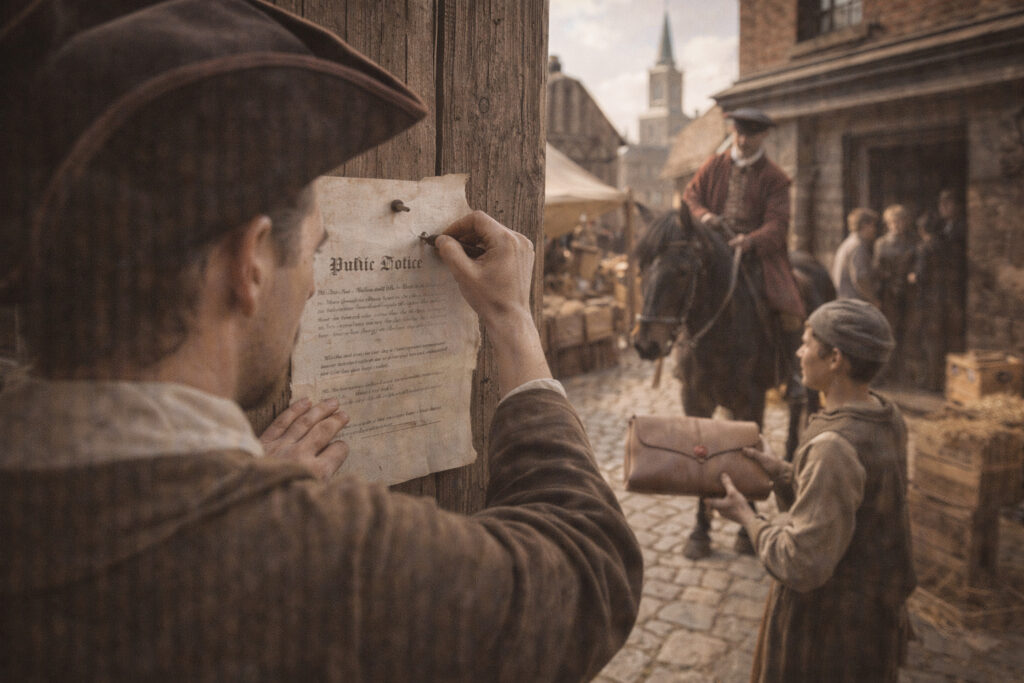
Before modern mass media, towns relied on layered systems to move news, goods, and opinion. Couriers, notice boards, taverns, and church gatherings created intertwined channels that shaped how people understood events near and far. These channels combined formal institutions like postal services with informal mechanisms such as gossip and rumor, producing a mixed information ecology. Exploring how these networks operated helps explain social cohesion, economic decisions, and political mobilization in historic communities.
Formal Channels: Post, Messengers, and Notices
Formal communication in historic towns centered on scheduled posts, hired messengers, and public notices affixed to gates or market stalls. Postal routes connected towns to regional centers, carrying letters, official proclamations, and commercial correspondence that merchants relied on for prices and contracts. Town clerks, guilds, and religious institutions also maintained records and communicated directives through written bulletins. The reliability of these channels depended on infrastructure, seasonal conditions, and the cost of sending information.
Even when dependable, formal systems could be slow and selective, favoring elites or commercial actors. That limitation created space for complementary informal practices that filled gaps and accelerated the spread of news.
Informal Channels: Taverns, Markets, and Word of Mouth
Taverns, market squares, and communal workspaces functioned as hubs where people exchanged observations and updates in real time. Merchants compared prices, laborers discussed harvest conditions, and travelers relayed distant events, all of which produced rapid, crowd-sourced intelligence. Rumor and oral accounts traveled faster than official dispatches, but they were also prone to exaggeration and local reinterpretation. Social ties and reputation helped listeners weigh the credibility of different sources during everyday exchanges.
Informal networks also supported rumor correction: repeated retellings and the input of returning informants could confirm, revise, or debunk initial reports. Over time, this conversational filtering shaped a town’s collective sense of what was true and what mattered.
Interplay and Impact on Civic Life
The interaction between formal and informal information flows shaped civic responses to crises, elections, and economic change. Officials used proclamations to assert authority, while informal channels tested public acceptance and spread dissent when official notices proved unpopular. Merchants blended postal intelligence with market chatter to set prices and manage risk, and community leaders monitored rumor to anticipate unrest or cooperation. The dynamic balance between control and grassroots exchange determined how quickly towns adapted to new circumstances.
Understanding these intersecting channels reveals why some towns mobilized effectively and others fractured under pressure. Patterns of trust, access to written communication, and the vibrancy of public spaces all influenced outcomes.
Conclusion
Historic towns depended on a woven network of postal services, messengers, and daily conversation to circulate information. Both formal systems and informal chatter mattered, each compensating for the other’s limits while shaping public judgment. Studying their interplay helps explain social resilience and the rhythms of local life.