
Uncover History’s Secrets with Daily Updates!
Daily News Entertainment
  • Home
  • History
  • Biographies
  • Eras
  • Regions
  • Timeline
No Result
View All Result
History Ours
  • Home
  • History
  • Biographies
  • Eras
  • Regions
  • Timeline
No Result
View All Result
History Ours
No Result
View All Result
Home History

Postal Routes and Rumor: Information Flow in Historic Towns

in History
Notices, Gossip, and Gesture Around the Market Cross

Before modern mass media, towns relied on layered systems to move news, goods, and opinion. Couriers, notice boards, taverns, and church gatherings created intertwined channels that shaped how people understood events near and far. These channels combined formal institutions like postal services with informal mechanisms such as gossip and rumor, producing a mixed information ecology. Exploring how these networks operated helps explain social cohesion, economic decisions, and political mobilization in historic communities.

Formal Channels: Post, Messengers, and Notices

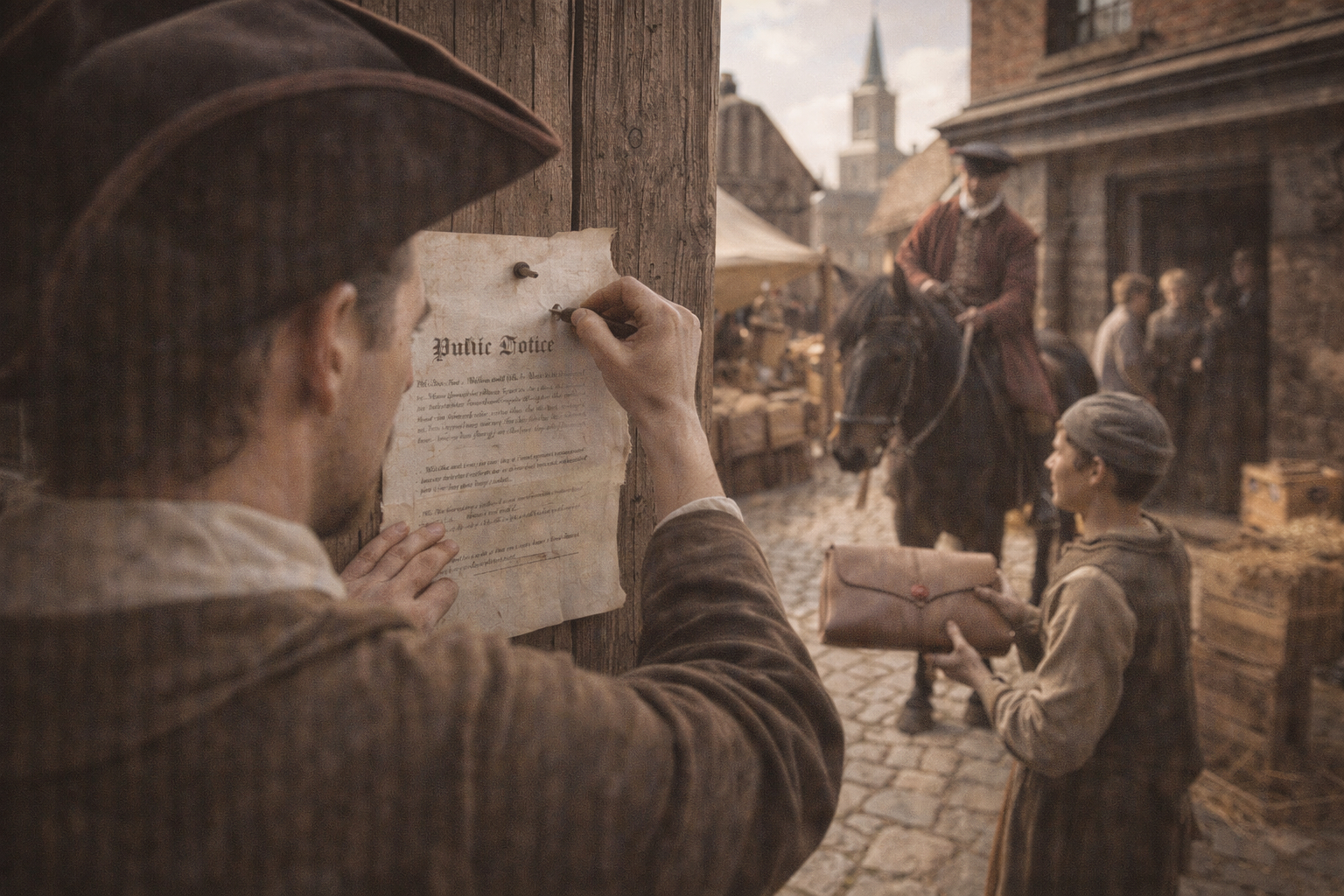
Formal communication in historic towns centered on scheduled posts, hired messengers, and public notices affixed to gates or market stalls. Postal routes connected towns to regional centers, carrying letters, official proclamations, and commercial correspondence that merchants relied on for prices and contracts. Town clerks, guilds, and religious institutions also maintained records and communicated directives through written bulletins. The reliability of these channels depended on infrastructure, seasonal conditions, and the cost of sending information.

Even when dependable, formal systems could be slow and selective, favoring elites or commercial actors. That limitation created space for complementary informal practices that filled gaps and accelerated the spread of news.

Informal Channels: Taverns, Markets, and Word of Mouth

Taverns, market squares, and communal workspaces functioned as hubs where people exchanged observations and updates in real time. Merchants compared prices, laborers discussed harvest conditions, and travelers relayed distant events, all of which produced rapid, crowd-sourced intelligence. Rumor and oral accounts traveled faster than official dispatches, but they were also prone to exaggeration and local reinterpretation. Social ties and reputation helped listeners weigh the credibility of different sources during everyday exchanges.

Informal networks also supported rumor correction: repeated retellings and the input of returning informants could confirm, revise, or debunk initial reports. Over time, this conversational filtering shaped a town’s collective sense of what was true and what mattered.

Interplay and Impact on Civic Life

The interaction between formal and informal information flows shaped civic responses to crises, elections, and economic change. Officials used proclamations to assert authority, while informal channels tested public acceptance and spread dissent when official notices proved unpopular. Merchants blended postal intelligence with market chatter to set prices and manage risk, and community leaders monitored rumor to anticipate unrest or cooperation. The dynamic balance between control and grassroots exchange determined how quickly towns adapted to new circumstances.

Understanding these intersecting channels reveals why some towns mobilized effectively and others fractured under pressure. Patterns of trust, access to written communication, and the vibrancy of public spaces all influenced outcomes.

Conclusion

Historic towns depended on a woven network of postal services, messengers, and daily conversation to circulate information. Both formal systems and informal chatter mattered, each compensating for the other’s limits while shaping public judgment. Studying their interplay helps explain social resilience and the rhythms of local life.

Previous Post

Guiding Audiences Through Complex Historical Timelines

Next Post

Notices, Gossip, and Gesture Around the Market Cross

Related Posts

Anne Bonny: The Pirate Who Broke Rules and Expectations
History

Anne Bonny: The Pirate Who Broke Rules and Expectations

September 15, 2026
How the Crystal Palace Turned Glass and Iron into a Modern Stage
History

How the Crystal Palace Turned Glass and Iron into a Modern Stage

September 15, 2026
Mary Anning and the Coast That Revealed Lost Worlds
History

Mary Anning and the Coast That Revealed Lost Worlds

September 15, 2026
When Mount Pelée Erased Saint-Pierre, 1902
History

When Mount Pelée Erased Saint-Pierre, 1902

September 15, 2026
Next Post
Notices, Gossip, and Gesture Around the Market Cross

Notices, Gossip, and Gesture Around the Market Cross

Search..

No Result
View All Result

Recent Articles

The Disguise That Broke Chains: Ellen and William Craft

The Disguise That Broke Chains: Ellen and William Craft

September 15, 2026
Bass Reeves: The Marshal Who Hunted Outlaws in Indian Territory

Bass Reeves: The Marshal Who Hunted Outlaws in Indian Territory

September 15, 2026
How the Crystal Palace Turned Glass and Iron into a Modern Stage

How the Crystal Palace Turned Glass and Iron into a Modern Stage

September 15, 2026
Anne Bonny: The Pirate Who Broke Rules and Expectations

Anne Bonny: The Pirate Who Broke Rules and Expectations

September 15, 2026
How Haiti Broke Its Chains: A 1791–1804 Timeline

How Haiti Broke Its Chains: A 1791–1804 Timeline

September 15, 2026

Subscribe Us

By clicking submit, I authorize History Ours and its affiliated companies to: (1) use, sell, and share my information for marketing purposes, including cross-context behavioral advertising, as described in our Terms of Service and Privacy Policy, (2) supplement the information that I provide with additional information lawfully obtained from other sources, like demographic data from public sources, interests inferred from web page views, or other data relevant to what might interest me, like past purchase or location data, (3) contact me or enable others to contact me by email with offers for goods and services from any category at the email address provided, and (4) retain my information while I am engaging with marketing messages that I receive and for a reasonable amount of time thereafter. I understand I can opt out at any time through an email that I receive, or by clicking here

Subscribe To Our Newsletter

By clicking submit, I authorize History Ours and its affiliated companies to: (1) use, sell, and share my information for marketing purposes, including cross-context behavioral advertising, as described in our Terms of Service and Privacy Policy, (2) supplement the information that I provide with additional information lawfully obtained from other sources, like demographic data from public sources, interests inferred from web page views, or other data relevant to what might interest me, like past purchase or location data, (3) contact me or enable others to contact me by email with offers for goods and services from any category at the email address provided, and (4) retain my information while I am engaging with marketing messages that I receive and for a reasonable amount of time thereafter. I understand I can opt out at any time through an email that I receive, or by clicking here.

© 2026 History Ours | All Rights Reserved

  • Contact Us
  • Privacy Policy
  • Terms of Service
  • Unsubscribe
  • Privacy Choices
  • Contact Us
  • Privacy Policy
  • Terms of Service
  • Unsubscribe
  • Privacy Choices

© 2026 History Ours | All Rights Reserved

No Result
View All Result
  • Home
  • History
  • Biographies
  • Eras
  • Regions
  • Timeline

© 2026 History Ours | All Rights Reserved

Skip to content
Open toolbar Accessibility Tools

Accessibility Tools

  • Increase TextIncrease Text
  • Decrease TextDecrease Text
  • GrayscaleGrayscale
  • High ContrastHigh Contrast
  • Negative ContrastNegative Contrast
  • Light BackgroundLight Background
  • Links UnderlineLinks Underline
  • Readable FontReadable Font
  • Reset Reset