
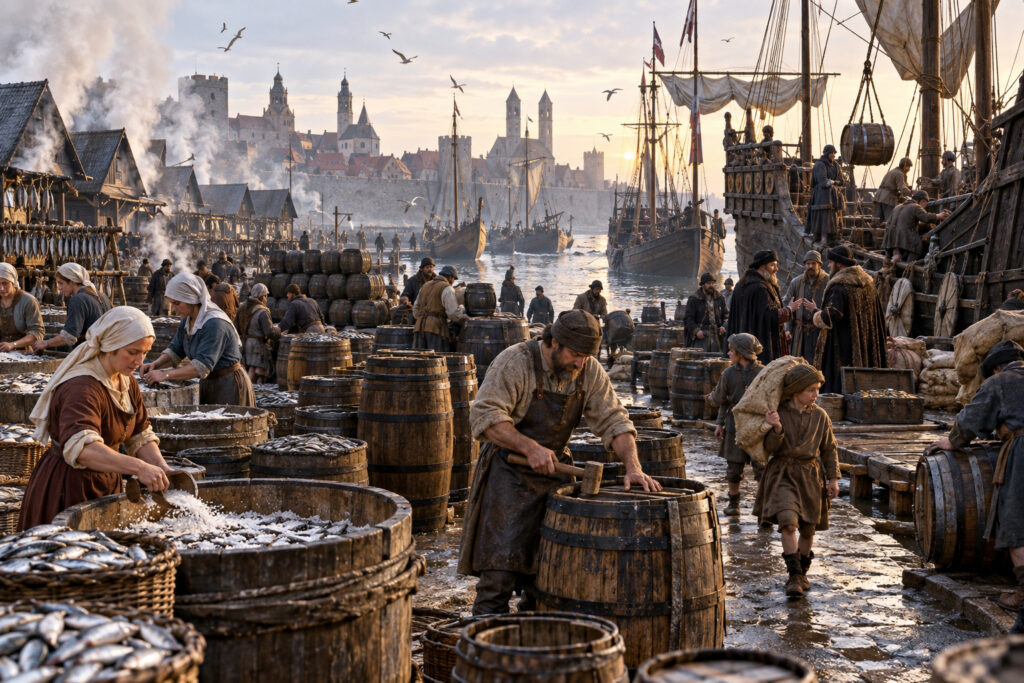
Off the Swedish coast, the island of Gotland sat where migrating herring funneled through the Baltic. When the fish arrived in large schools, the island changed overnight: small farms turned into supply stations, Visby’s quays filled with tarred barrels, and smokehouses multiplied along the shore. Salted and packed for long-distance trade, those herring became one of northern Europe’s most reliable staples and a startlingly visible engine of local life.
Markets, ships, and a web of commerce
Gotland’s fish did more than feed mouths. Seasonal catches attracted merchants from the Hanseatic ports, coastal Scania, and beyond. Sack-like piles of salted herring left Visby for Lübeck, Bergen, and the Low Countries, traded for cloth, grain, and iron. The flow of goods reshaped the island: boatyards grew, inns expanded to house crews and buyers, and a whole set of laborers—net-makers, coopers, salt suppliers—clustered around the harbors.
The herring trade also pressed practical innovations. Preservation mattered: salt, barrels sealed with pitch, and smoke preserved fish for months at sea. Ship design adjusted to carry heavy casks. And because herring runs came in pulses, the island learned to operate on boom-and-bust rhythms—years of plenty followed by quieter times when economies shifted back toward farming, sheep, or trade in other goods.
Lives shaped by the catch
For ordinary Gotlanders, the booms rewrote seasonal work. Men went to sea in fleets; women and children worked in drying sheds, salting fish, and rolling barrels. The smell of curing herring, the sight of stacked casks, and the chatter of foreign buyers became part of daily life. The island’s landscape bears traces of that era: rows of rocks that once marked curing racks, middens full of fish bones, and settlement patterns that clustered near favorable anchorages.
But herring wealth was never steady. Fish stocks shifted, and the most productive runs could move elsewhere, leaving coastal communities to adapt. Competition for rich grounds sometimes led to political pressure and negotiated fishing rights among ports and rulers, shaping the Baltic’s diplomatic and commercial map as much as any fortification.
Conclusion
Gotland’s herring booms were not just a sequence of catches. They were a force that built ports, rewired labor, and stitched the island into a Baltic trading world. Even after the major medieval runs faded, the patterns they created—coastal clusters of industry, culinary habits centered on preserved fish, and archaeological layers of barrels and bones—kept the memory of those seasons alive. Look, then, at a Visby quay or a yellowed smokehouse and you’ll find not a quaint relic but the outline of a region once shaped, quite literally, by waves of silver fish.