
Uncover History’s Secrets with Daily Updates!
Daily News Entertainment
  • Home
  • History
  • Biographies
  • Eras
  • Regions
  • Timeline
No Result
View All Result
History Ours
  • Home
  • History
  • Biographies
  • Eras
  • Regions
  • Timeline
No Result
View All Result
History Ours
No Result
View All Result
Home Regions

How the Ruhr Became Germany’s Engine and Then Its Archive

in Regions
How the Ruhr Became Germany’s Engine and Then Its Archive

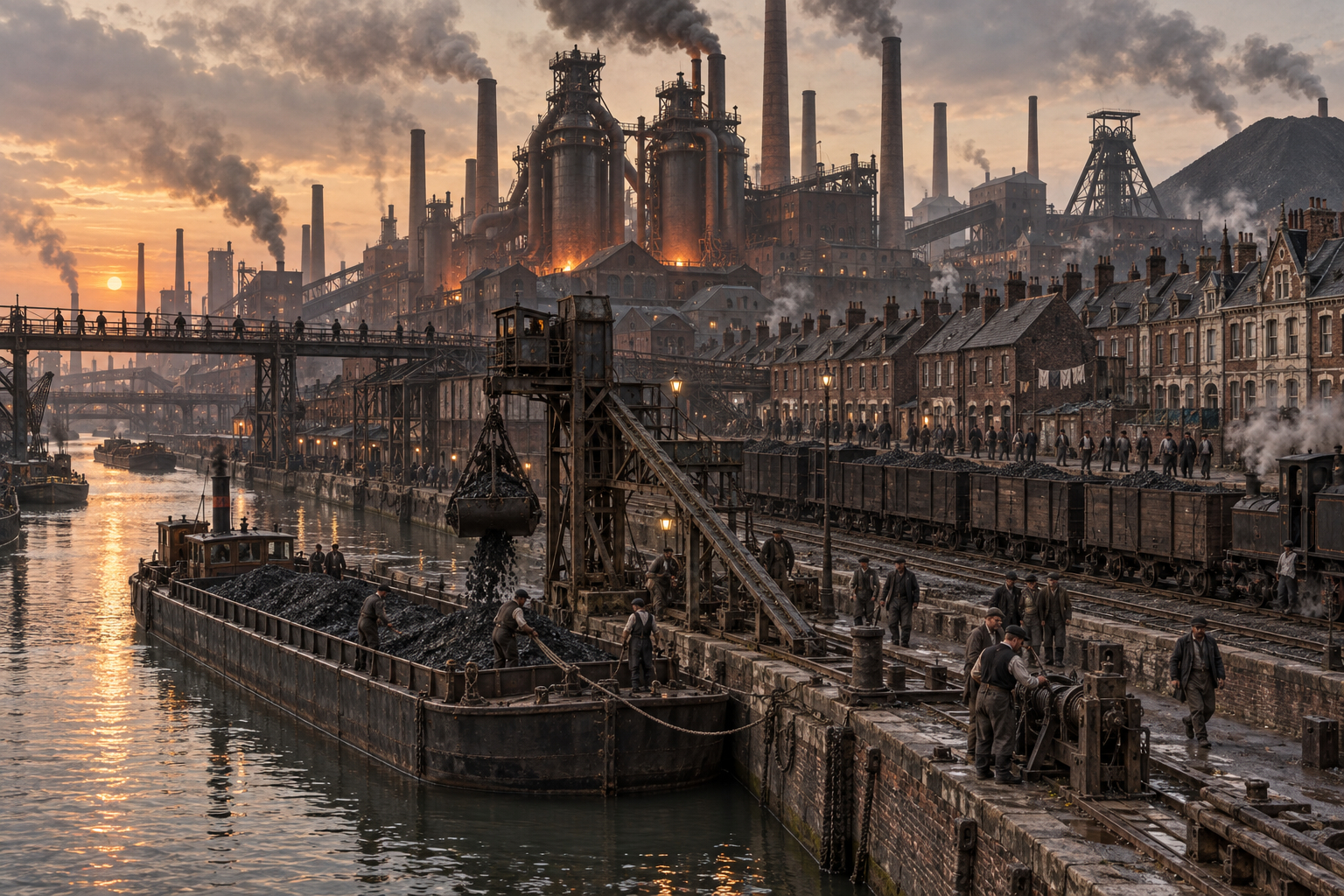
The Ruhr began as a patchwork of villages and river valleys. In the 19th century it hardened into something else: a continuous belt of mines, rails, foundries and docks. Thick seams of coal and the growth of blast furnaces around Essen and Dortmund turned a lowland into an industrial landscape. Canals and new rail links stitched former market towns together; raw coal fed an expanding steel industry that supplied rails, ships and the modern city itself.

Companies such as the Krupp works became names that stood for the region’s power—both economic and political. The network of collieries and factories produced not only material goods but a shared infrastructure: housing blocks, workers’ cafes, co-operative stores and the company-sponsored social institutions that shaped daily life.

City Life, Migration, and Politics

The Ruhr’s growth imported people as surely as it exported steel. Labor came from across Germany and beyond—Polish migrants, seasonal workers from the east, young people from rural areas—so neighborhoods filled quickly. Gründerzeit terraces bumped up against miners’ row cottages and purpose-built housing estates from the late 19th and early 20th centuries. That density produced lively, often volatile politics: trade unions, social-democratic clubs, and strike movements were part of the rhythm of work.

Because industry concentrated so many strategic targets in one place, the Ruhr was a focal point during both world wars. Factories and rail hubs drew heavy bombing in the 20th century, reshaping cities and leaving scars that would complicate reconstruction for decades.

Decline, Reinvention, and Memory

From the 1960s onward, cheaper imports, new technologies and depleted seams put pressure on the old order. Mines and steelworks closed. Landscapes once defined by smoke and slag began to quiet. The economic shock was severe, but it also opened space for something different: large industrial sites turned into museums, parks and creative centers. The Zollverein coal mine in Essen, long a center of extraction, was preserved and repurposed as a cultural campus and is now recognized for its industrial heritage. In Duisburg, an enormous inland port remained a reminder of the region’s logistical role even as factories vanished.

Elsewhere, abandoned blast furnaces became parks where climbing routes and concert stages sit alongside rusted catwalks. Slag heaps were landscaped into viewpoints—symbols of a region that learned to read its industrial past as an asset.

Conclusion

The Ruhr’s history is not a single story of rise and fall but a layered record of work, migration, destruction and creativity. Walk its converted sites and you find archives in brick and steel: the evidence of labor, the politics born from crowded tenements, the engineering that remade rivers and land. Today the Ruhr is a metropolitan patchwork—still marked by industry, now also by museums, universities and parks—where the past is both visible and useful as the region imagines a different future.
Previous Post

Salt, Walls, and Ships: How Dalmatia Became a Maritime Frontier

Related Posts

Salt, Walls, and Ships: How Dalmatia Became a Maritime Frontier
Regions

Salt, Walls, and Ships: How Dalmatia Became a Maritime Frontier

September 17, 2026
Trieste: A Port at the Edge of Empires
Regions

Trieste: A Port at the Edge of Empires

September 15, 2026
Svalbard: How a Frozen Archipelago Became an International Outpost
Regions

Svalbard: How a Frozen Archipelago Became an International Outpost

September 15, 2026
Orkney: Where Norse Law and Scottish Life Intertwined
Regions

Orkney: Where Norse Law and Scottish Life Intertwined

September 15, 2026

Search..

No Result
View All Result

Recent Articles

How the Ruhr Became Germany’s Engine and Then Its Archive

How the Ruhr Became Germany’s Engine and Then Its Archive

September 17, 2026
Salt, Walls, and Ships: How Dalmatia Became a Maritime Frontier

Salt, Walls, and Ships: How Dalmatia Became a Maritime Frontier

September 17, 2026
Edo: Japan’s Urban Revolution of Lanterns and Printshops

Edo: Japan’s Urban Revolution of Lanterns and Printshops

September 16, 2026
How the Little Ice Age Changed Everyday Life in Europe

How the Little Ice Age Changed Everyday Life in Europe

September 16, 2026
The Disguise That Broke Chains: Ellen and William Craft

The Disguise That Broke Chains: Ellen and William Craft

September 15, 2026

Subscribe Us

By clicking submit, I authorize History Ours and its affiliated companies to: (1) use, sell, and share my information for marketing purposes, including cross-context behavioral advertising, as described in our Terms of Service and Privacy Policy, (2) supplement the information that I provide with additional information lawfully obtained from other sources, like demographic data from public sources, interests inferred from web page views, or other data relevant to what might interest me, like past purchase or location data, (3) contact me or enable others to contact me by email with offers for goods and services from any category at the email address provided, and (4) retain my information while I am engaging with marketing messages that I receive and for a reasonable amount of time thereafter. I understand I can opt out at any time through an email that I receive, or by clicking here

Subscribe To Our Newsletter

By clicking submit, I authorize History Ours and its affiliated companies to: (1) use, sell, and share my information for marketing purposes, including cross-context behavioral advertising, as described in our Terms of Service and Privacy Policy, (2) supplement the information that I provide with additional information lawfully obtained from other sources, like demographic data from public sources, interests inferred from web page views, or other data relevant to what might interest me, like past purchase or location data, (3) contact me or enable others to contact me by email with offers for goods and services from any category at the email address provided, and (4) retain my information while I am engaging with marketing messages that I receive and for a reasonable amount of time thereafter. I understand I can opt out at any time through an email that I receive, or by clicking here.

© 2026 History Ours | All Rights Reserved

  • Contact Us
  • Privacy Policy
  • Terms of Service
  • Unsubscribe
  • Privacy Choices
  • Contact Us
  • Privacy Policy
  • Terms of Service
  • Unsubscribe
  • Privacy Choices

© 2026 History Ours | All Rights Reserved

No Result
View All Result
  • Home
  • History
  • Biographies
  • Eras
  • Regions
  • Timeline

© 2026 History Ours | All Rights Reserved

Skip to content
Open toolbar Accessibility Tools

Accessibility Tools

  • Increase TextIncrease Text
  • Decrease TextDecrease Text
  • GrayscaleGrayscale
  • High ContrastHigh Contrast
  • Negative ContrastNegative Contrast
  • Light BackgroundLight Background
  • Links UnderlineLinks Underline
  • Readable FontReadable Font
  • Reset Reset