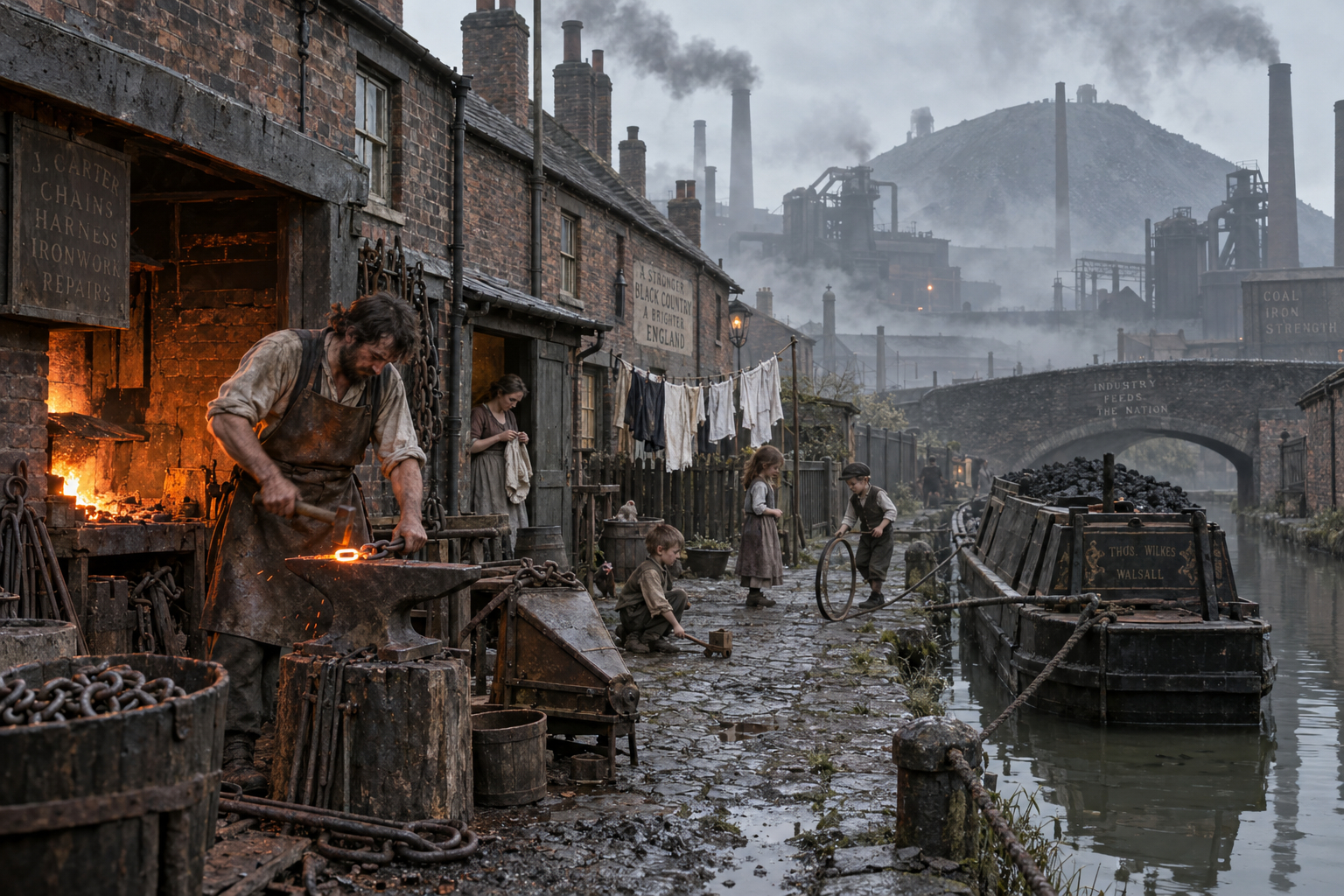
Walk a back lane in the English West Midlands and the clues are everywhere: low brick terraces pressed close to narrow canals, terraced houses streaked with the ghost of soot, and the odd cemetery of slag and reclaimed metal. This is the Black Country, a patchwork of towns—Dudley, Walsall, Wolverhampton and their neighbors—that in the 18th and 19th centuries stopped being a quiet rural rim and became one of the earliest landscapes of industrial Britain.
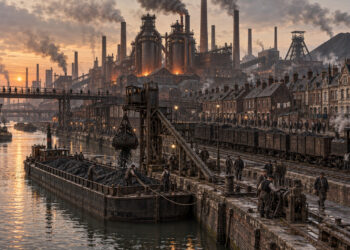
The region’s transformation didn’t come from a single factory but from the ground itself. Thick coal measures lay near the surface and, together with ironstone and a web of small streams, invited digging, smelting and smithing. Canals and early tramways threaded through fields and villages, not only carrying coal but allowing craftsmen to ship nails, chains and tools across Britain. Where water once turned mills for grain, it soon powered bellows, hammers and wheels for ironworks.
Backyard forges and the culture of making
What made the Black Country feel different from Manchester or Birmingham was scale and intimacy. Instead of vast single-plant complexes, the region was dense with small workshops: lock-makers tucked behind pubs, nailers working at home in short, hot shifts, chain-smiths shaping links in yards. A family could run a kiln or a small forge; smithing was as much domestic work as factory labor. That meant industry sat cheek-by-jowl with everyday life—the ring of hammers mixed with children playing and the smell of coal smoke rising over laundry lines.
This was a place of practical inventiveness. Local toolmakers and metalworkers refined cast-iron techniques and developed specialized products—hinges, keys, safety chains, implements for quarries and canals—that fed other industries. The Black Country supplied parts to ships, mines and railways across the empire, often invisibly: a tiny link or nail made here would end up hundreds of miles away doing hard, anonymous work.
From stigma to regional pride
The name “Black Country” began as an outsider’s shorthand for the soot-darkened roofs and industrial gloom; newspapers and travelers used the phrase with a mix of grim fascination and moral alarm. Over time, though, residents reclaimed it. The blackness was not merely pollution—it was proof of skilled labor, dense craft knowledge and a shared economy. Distinctive speech, recipes, songs and social institutions—chapels, clubs, miners’ lodges—grew with the industry and helped forge a local identity rooted in making things that mattered.
Today fragments of that history remain in working foundries, in place names, and in the careful reconstructions at local living museums. Walk these streets and you can still feel a landscape formed by practical needs: coal seams, narrow canals, and a human pattern of workshop and family that turned simple materials into the skeleton of modern Britain.
Conclusion
The Black Country reminds us that industrial change is not only about grand mills or famous inventors. It is also about how ordinary places—homes, yards, canalsides—rearrange themselves around resources, skills and markets. The region’s blackened roofs and dense rows of brick tell a story of small-scale industry multiplied across space until a whole region was remade.