
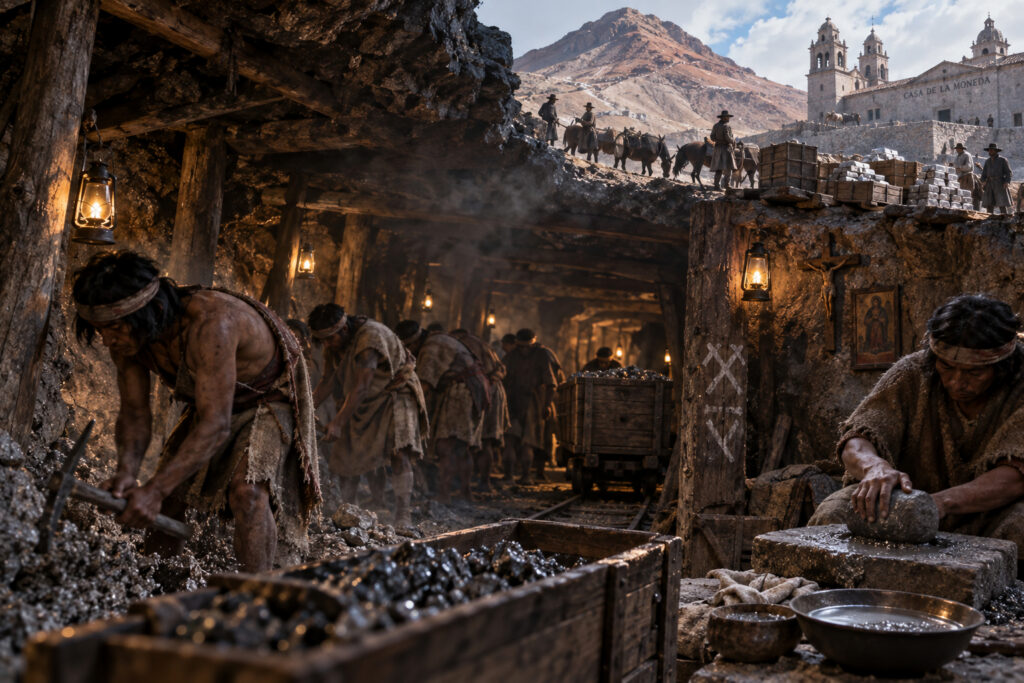
High on the Bolivian altiplano stands Cerro Rico, the “rich hill” that gave birth to Potosí. Spanish colonists began mining there in the 1540s; the town that mushroomed beside the mountain swelled faster than most European cities. Wealth poured out of the rock: silver so abundant that the mint—La Casa de la Moneda, established in the late 16th century—struck coins used from Madrid to Manila.
Streets once lined with ornate Baroque churches and grand houses still hint at that boom. The mint survives today as a museum, a stone reminder that Potosí was not only a mine but a monetary factory whose product lubricated early modern trade.
The human toll inside the mountain
That silver did not come free. The Spanish adapted the Inca mita—previously a rotational labor draft—into a brutal mining draft that conscripted indigenous men for months at a time. The galleries of Cerro Rico ran deep, often with no proper ventilation, and collapses were common. Miners worked with mercury and other poisons; the chemical methods used to extract silver left bodies and landscapes contaminated.
Contemporary accounts and later studies paint a grim picture: lives shortened by exposure, families torn by forced rotations, and entire highland societies reordered around the demands of the mines. Potosí’s glitter carried a shadow few visitors then could see from the plazas where silver wealth showed its public face.
Silver that crossed oceans
The metal from Cerro Rico did more than line Spanish coffers. It became a universal medium of exchange. Spanish silver coins—often called “pieces of eight”—floated in ships across the Atlantic and Pacific. Potosí bullion was exchanged for Asian goods in Manila, and Chinese silks and porcelains returned to Europe on the backs of that silver. In this way, a high-altitude Bolivian mountain linked peasants and miners to merchants in Canton, nobles in Seville, and sailors in Acapulco.
The global spread of Potosí silver reshaped markets and diets, funded wars and dynasties, and helped integrate distant economies in ways that still matter to how we trace early globalization.
Conclusion
Potosí reads like a condensed lesson in early modern history: spectacular wealth, technological change, and human cost sitting side by side. Walking its steep streets today, you pass churches, collapsed shafts, and a mint that once stamped value into bullion. Cerro Rico continues to be mined, and its legacy—economic, environmental, social—remains tangible. The mountain’s history reminds us that the coins in circulation centuries ago carried with them stories of labor, violence, and exchange that reshaped the world.