
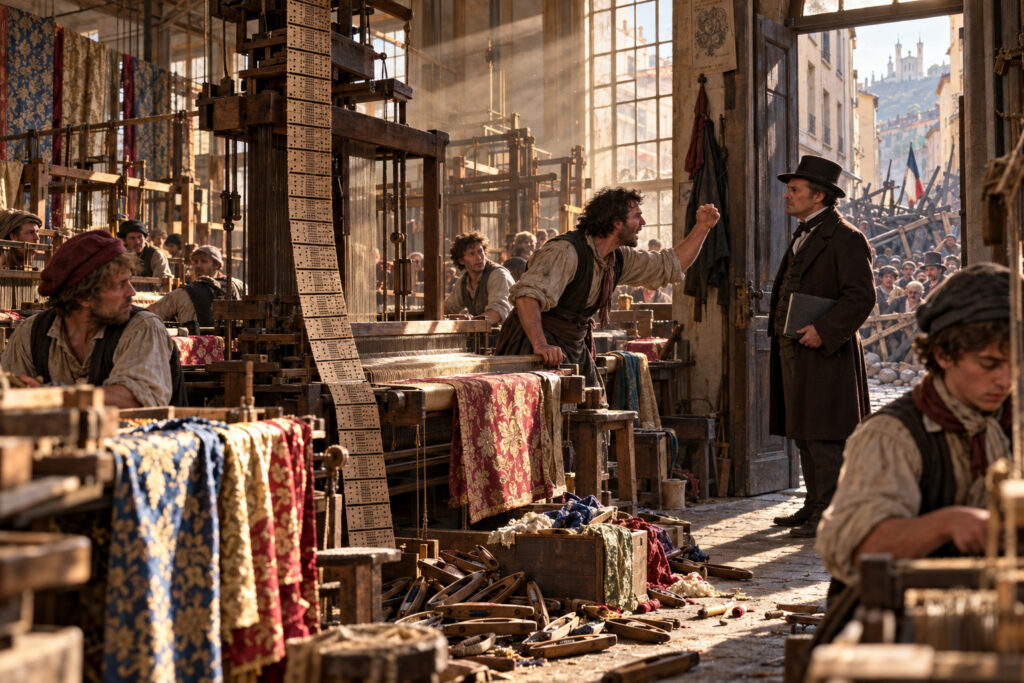
Walk Lyon’s Croix-Rousse today and the hill still feels made for machines: long, narrow rooms with high ceilings where sunlight once fell on rows of handlooms. From the early modern period onward, Lyon became Europe’s center for luxury silk weaving. Merchants gathered at the city’s fairs, maisons de soie arranged production and credit, and a distinctive local economy grew up around the craft. Silk wasn’t merely a commodity here; it organized roofs, streets and the rhythms of work.
Innovation, Cloth, and Conflict
The early 1800s brought a technological shock. Joseph Marie Jacquard’s punched-card loom made complex patterned weaving faster and cheaper, and workshops that adopted the mechanism changed the scale of production. For many skilled weavers—known locally as canuts—those changes cut into pay and autonomy. Piecework rates slid and middlemen pressed margins, so what had been an artisanal neighborhood turned into a tense industrial landscape.
Those tensions boiled over in two large uprisings in the 1830s. The canut revolts of 1831 and 1834 were not merely street disturbances but organized protests about wages and the right to fair terms in the new industrial order. They brought thousands into the streets of Lyon, challenged local authorities, and forced a national reckoning about urban labor. The uprisings were stamped down, but their memory shaped debates about workers’ rights across France.
Streets, Passages, and a Lasting Identity
Silk left more than political traces. The city’s architecture bears the imprint of production: tall ground floors to host massive looms, courtyards and the narrow covered passages called traboules that let merchants move bolts of fabric without stepping into weather. Those passages remain a distinctive feature of Lyon’s urban texture. The canuts themselves stamped local culture too—song, dialect, and a stubborn sense of place that resists the anonymous factory model.
Beyond Lyon, the Jacquard loom’s idea—programmable operation via punched cards—would echo into the hardware of modern computing. The silk workshops’ move from hand to machine is therefore a local story with surprisingly broad technical consequences: a hill of weavers shaped not only a regional economy but one thread in the story of industrial automation.
Conclusion
When you think of regional change, it’s easy to picture armies or rivers. Lyon’s history shows another kind of force: the material logic of a single product. Silk defined buildings and careers, provoked political upheaval, and nudged technological history forward. The city’s woven streets remind us that regions are made not only by borders but by the clack of looms, the anger of workers demanding fair pay, and the messy ways a craft finds its future.