
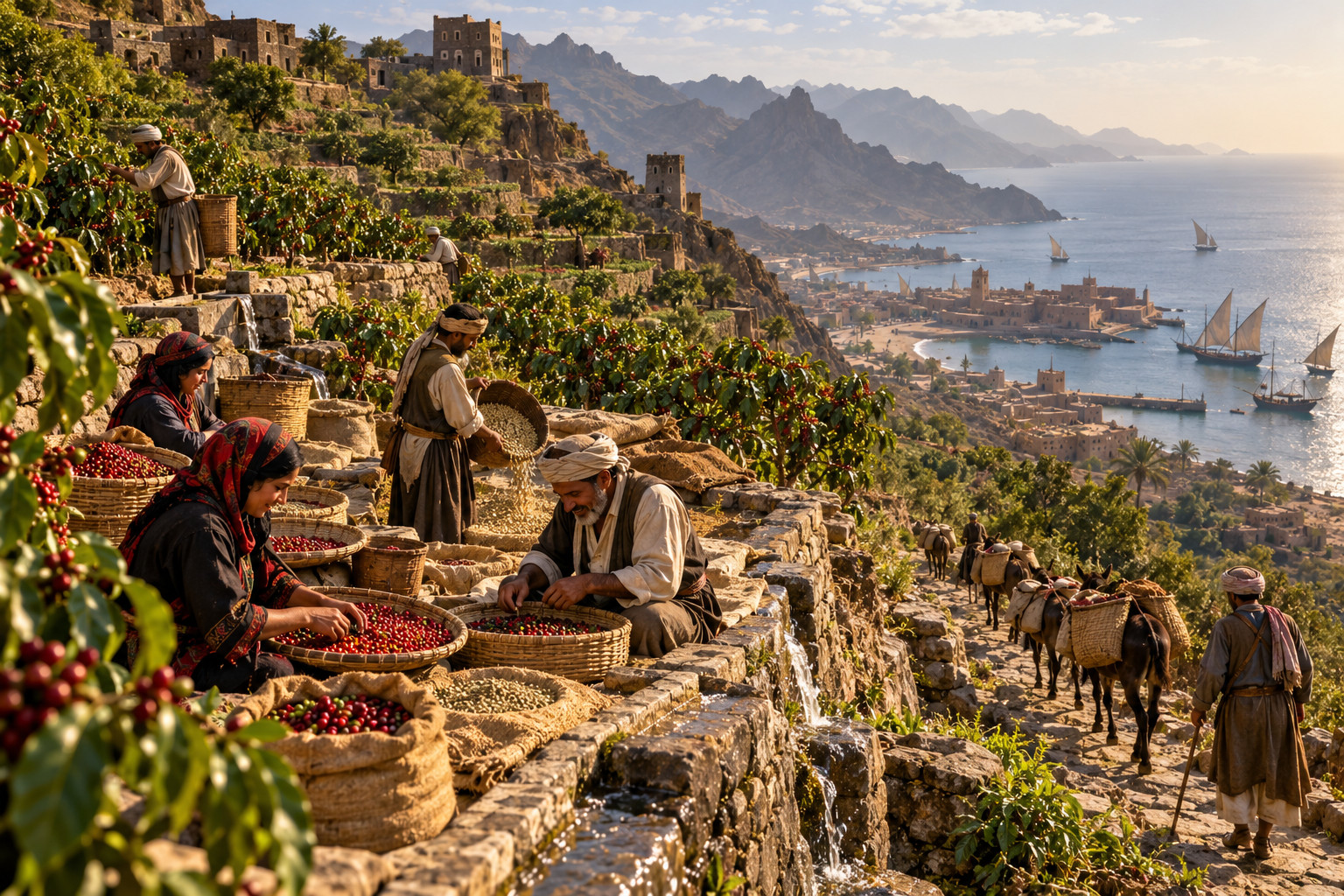
Long before the word “mocha” turned into a café menu item, the tiny Red Sea port of Mocha (al‑Makhā) was the hinge between Yemen’s highlands and the wider world. Coffee grown on steep terraces in the western highlands—often planted on narrow strips of reclaimed slope and watered by gravity‑fed channels—traveled down mule tracks and rivers to this single, famous export point. The trade concentrated wealth, people, and political attention in a narrow coastal strip while leaving the uplands shaped by hands and hoes.
Terraces, labor, and a regional rhythm
The coffee bush favors altitude and careful tending. In Yemen that meant smallholdings carved out of mountain slopes, where families rotated harvests, pruned bushes, and shelled beans by hand. Those terraces produced not only beans but rhythms of work that structured village life: harvest seasons, shared threshing, caravan preparation. Irrigation channels and stone walls still visible on the hillsides testify to an agrarian knowledge tailored to thin soil and scarce water.
Because coffee suited small-scale growers, the crop established a pattern of many owners rather than vast plantations. That created a patchwork region where local ties—kinship, neighborhood obligations, customary dispute resolution—retained force. At the same time, dependence on an export crop made those same places vulnerable to fluctuating demand, pirate raids, and shifting imperial controls that aimed to steer the lucrative trade.
Port culture, global curiosity, and the spread of a plant
Mocha’s docks were crowded with goods and languages. Merchants from the Ottoman world, Africa, and Europe converged; the port lent its name to a style of coffee prized in distant markets. European appetite for Yemeni beans helped create regular shipping links, and those links brought outsiders, taxes, and new tastes. When coffee plants and seedlings were removed to European and Asian colonies, cultivation exploded beyond Yemen—Java, the Caribbean, and parts of Africa became major producers—yet the coffee‑driven social forms that grew on Yemen’s slopes remained distinct.
Conclusion
The story of Yemen’s coffee is not just about a bean but about how a single commodity can sculpt landscapes and communities. Terraced hillsides, caravan routes, coastal marketplaces, and the rhythm of village life all bear its imprint. Even after cultivation shifted elsewhere, Mocha and the mountain farms around it left a lasting map: a region organized by the demands of export, the limits of water and soil, and the everyday work that turned wild plants into a global obsession.