
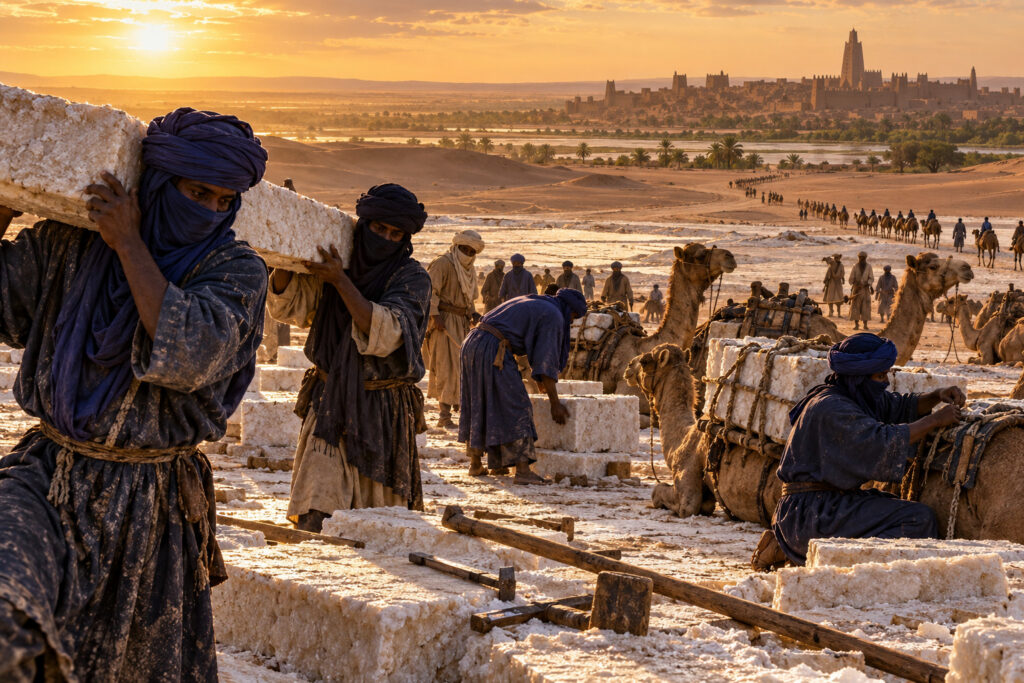
Salt looks ordinary to us, but across the central Sahara it was once treated like bullion. Wind-scraped pans of crystalline salt were carved into slabs at remote mines—well-known names include Taghaza and Taoudenni—and hauled away on camelback. In an environment where fresh food spoiled quickly and sweat leached minerals from the body, salt served as both preservative and lifeline. Traders packed it in long bars or blocks, and those white bricks turned into a unit of value that could be exchanged for gold, cloth, or grain hundreds of miles to the south.
Caravans, routes, and the people who kept them moving
The Sahara is not an empty void but a stitched network of tracks, wells, and oases. Caravan masters—often Berber or Tuareg—knew every dune and mirage. They steered lines of camels across seasonal sands, timing departures to avoid the worst heat and to meet rains along the Sahel. Those camel trains became the arteries of an economy: salt northward, West African gold, kola nuts, and ivory southward. The journeys were dangerous. Raiders, sandstorms, and the simple brutality of exhaustion were constant threats, yet the rewards for successful crossing were immense for both traders and the cities that waited at the routes’ ends.
Cities forged by salted wealth
Where trade concentrated, towns grew into cities. Timbuktu, Gao, and Djenné rose as commercial hubs, marketplaces where slab-salt met riverine grain and Sahelian cattle. But commerce wasn’t the only product: ideas traveled too. Mosques, manuscript schools, and libraries flourished in these centers, fueled in part by the wealth that salt and gold created. Rulers taxed caravans or controlled mines, turning mobile commerce into territorial power. At times, the spectacle of a wealthy ruler displaying vast quantities of gold and importing scholars and artisans made clear how deeply trade shaped prestige and governance across the region.
Conclusion
The salt trade did more than move a necessary mineral across a harsh landscape. It stitched distant ecologies and peoples together—desert miners, nomadic guides, riverine merchants and urban scholars—into an interconnected Sahelian world. Borders and polities shifted around the lines where trade passed, and long after the great caravan eras waned, the cultural and institutional traces remained: market towns, manuscript traditions, and regional identities that still recall a time when a block of salt could pay for a kingdom’s ambitions.