Uncover History’s Secrets with Daily Updates!
Daily News Entertainment
  • Home
  • History
  • Biographies
  • Eras
  • Regions
  • Timeline
No Result
View All Result
History Ours
  • Home
  • History
  • Biographies
  • Eras
  • Regions
  • Timeline
No Result
View All Result
History Ours
No Result
View All Result
Home Regions

How Wind and Loess Built the Palouse Wheatlands

in Regions
How Wind and Loess Built the Palouse Wheatlands

Drive east from the Columbia Gorge and the country seems to roll like a painted sea: smooth, rounded rises in green and gold that look almost intentional. Those soft contours are not the product of glaciers carving valleys, but of loess—fine, windblown silt heaped up after the last Ice Age. When glacial floods sluiced across the Columbia Basin they ground rock into powder; seasonal winds picked that powder up and laid it down in drifts dozens of feet deep. The result is one of the most fertile, strangely sculpted landscapes in North America: the Palouse.

From grassland to grainland

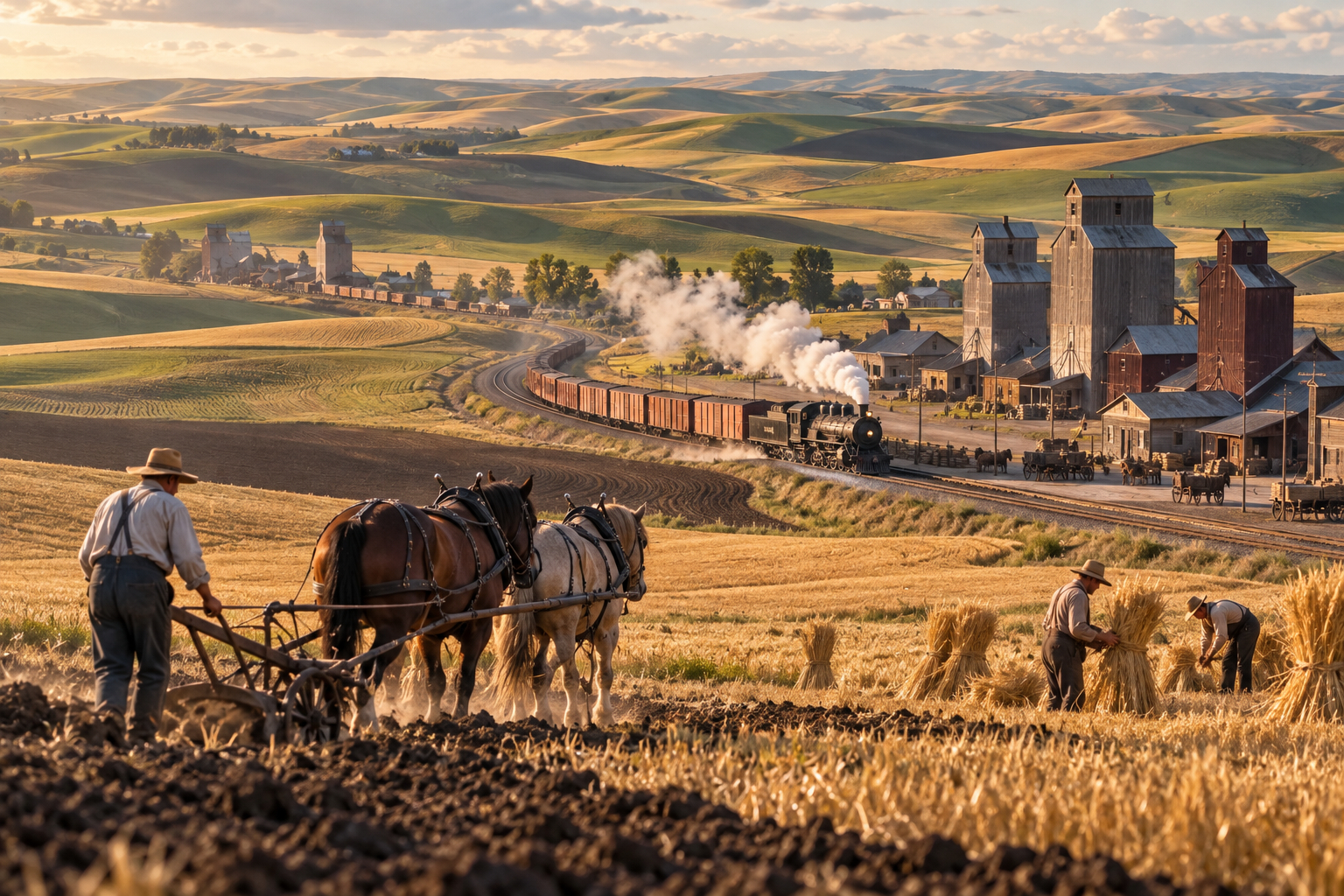
For millennia the region supported camas, bunchgrass, and the people who moved seasonally with them. In the late nineteenth century, that same loose silt attracted a different kind of visitor: settlers drawn by federal land laws and the promise of wheat. Loess soils are easy to till and rich in minerals, and once steel plows and dryland farming techniques arrived, spring wheat spread quickly across the ridges and swales.

The transformation depended as much on infrastructure as on soil. Narrow-gauge lines, then standard railroads, stitched the Palouse into national markets. Grain elevators sprouted at junctions and small towns became export hubs. Those tracks turned the landscape’s waves into commodity: fields were planted, threshed, loaded into cars and shipped to ports for distant mills.

Line patterns, erosion, and the modern Palouse

Under the microscope—and from the air—the Palouse becomes a patchwork of curving boundaries. Farmers follow the natural contours of the loess ridges to reduce runoff; aerial photographs reveal waves of fields, terraces cut into slopes, and the dark rectangles of fallow ground. That aesthetic is a byproduct of necessity: plowing straight up and down these hills accelerates erosion. Across the twentieth century, responses ranged from contour plowing and summer fallow to more recent no-till and crop-rotation methods aimed at holding the silt in place.

Crop choices also shaped identity. Beyond wheat, the Palouse turned out legumes—lentils and peas thrive here—and those crops rewrote local economies and menus. Small college towns like Pullman and Moscow anchor the region today: they are both market towns and cultural centers where the agricultural calendar still sets the rhythm.

Conclusion

The Palouse is a reminder that regions are made by geology and human decisions together. Wind and water deposited the soil; people taught it to yield; railroads and markets moved its harvests. The landscape’s rounded light and the patterns of fields are as much history as they are scenery—visible traces of an uneasy bargain between productivity and preservation that keeps shaping the Palouse into the present.
Previous Post

When the Erie Canal Made New York the Nation’s Gateway

Next Post

The Making and Fall of the Berlin Wall, 1945–1990

Related Posts

When the Erie Canal Made New York the Nation’s Gateway
Regions

When the Erie Canal Made New York the Nation’s Gateway

October 2, 2026
Gotland’s Herring Booms: How Fish Forged a Baltic Region
Regions

Gotland’s Herring Booms: How Fish Forged a Baltic Region

September 27, 2026
Black Country: Where Coal Turned Villages into an Industrial Landscape
Regions

Black Country: Where Coal Turned Villages into an Industrial Landscape

September 27, 2026
Pampas: How Gauchos, Railways, and Beef Built Argentina
Regions

Pampas: How Gauchos, Railways, and Beef Built Argentina

September 22, 2026
Next Post
The Making and Fall of the Berlin Wall, 1945–1990

The Making and Fall of the Berlin Wall, 1945–1990

Search..

No Result
View All Result

Recent Articles

Thirteen Days That Almost Ended the World

Thirteen Days That Almost Ended the World

October 3, 2026
The Making and Fall of the Berlin Wall, 1945–1990

The Making and Fall of the Berlin Wall, 1945–1990

October 3, 2026
How Wind and Loess Built the Palouse Wheatlands

How Wind and Loess Built the Palouse Wheatlands

October 2, 2026
When the Erie Canal Made New York the Nation’s Gateway

When the Erie Canal Made New York the Nation’s Gateway

October 2, 2026
Understanding Historical Eras and Their Lasting Impact

Understanding Historical Eras and Their Lasting Impact

October 1, 2026

Subscribe Us

By clicking submit, I authorize History Ours and its affiliated companies to: (1) use, sell, and share my information for marketing purposes, including cross-context behavioral advertising, as described in our Terms of Service and Privacy Policy, (2) supplement the information that I provide with additional information lawfully obtained from other sources, like demographic data from public sources, interests inferred from web page views, or other data relevant to what might interest me, like past purchase or location data, (3) contact me or enable others to contact me by email with offers for goods and services from any category at the email address provided, and (4) retain my information while I am engaging with marketing messages that I receive and for a reasonable amount of time thereafter. I understand I can opt out at any time through an email that I receive, or by clicking here

Subscribe To Our Newsletter

By clicking submit, I authorize History Ours and its affiliated companies to: (1) use, sell, and share my information for marketing purposes, including cross-context behavioral advertising, as described in our Terms of Service and Privacy Policy, (2) supplement the information that I provide with additional information lawfully obtained from other sources, like demographic data from public sources, interests inferred from web page views, or other data relevant to what might interest me, like past purchase or location data, (3) contact me or enable others to contact me by email with offers for goods and services from any category at the email address provided, and (4) retain my information while I am engaging with marketing messages that I receive and for a reasonable amount of time thereafter. I understand I can opt out at any time through an email that I receive, or by clicking here.

© 2026 History Ours | All Rights Reserved

  • Contact Us
  • Privacy Policy
  • Terms of Service
  • Unsubscribe
  • Privacy Choices
  • Contact Us
  • Privacy Policy
  • Terms of Service
  • Unsubscribe
  • Privacy Choices

© 2026 History Ours | All Rights Reserved

No Result
View All Result
  • Home
  • History
  • Biographies
  • Eras
  • Regions
  • Timeline

© 2026 History Ours | All Rights Reserved

Skip to content
Open toolbar Accessibility Tools

Accessibility Tools

  • Increase TextIncrease Text
  • Decrease TextDecrease Text
  • GrayscaleGrayscale
  • High ContrastHigh Contrast
  • Negative ContrastNegative Contrast
  • Light BackgroundLight Background
  • Links UnderlineLinks Underline
  • Readable FontReadable Font
  • Reset Reset