
Early Revolutions and the Birth of Modern Governance
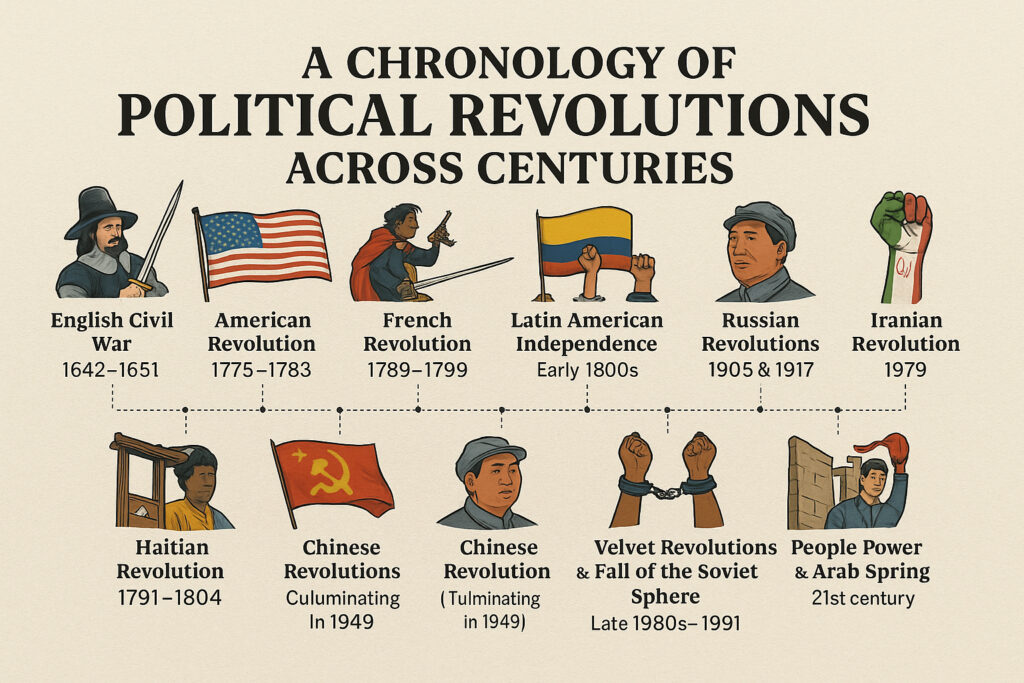
The idea of challenging absolute power began in the 17th century with the English Civil War, which questioned royal authority and paved the way for constitutional limits. The Glorious Revolution later established Parliament’s supremacy, shaping early democracy. In the 18th century, the American Revolution promoted self-governance, while the French Revolution ignited global movements for liberty, equality, and fraternity.
Global Movements for Freedom
The Haitian Revolution (1791–1804) became the first successful slave revolt, creating an independent Black republic and influencing anti-slavery efforts worldwide. Across Latin America, leaders like Simón Bolívar and José de San Martín led independence struggles, replacing European colonial empires with emerging republics.
Revolutionary Waves in the Modern Age
The Revolutions of 1848 across Europe reflected rising demands for social reform and nationalism, while the Russian Revolutions of 1905 and 1917 dismantled monarchy and introduced socialist governance. In China (1949), a communist revolution reshaped society, while anti-colonial movements in Asia and Africa mid-century brought independence and new national identities.
Contemporary Movements and Social Change
In the late 20th century, revolutions such as Iran’s 1979 uprising and the Velvet Revolutions in Eastern Europe ended old regimes and introduced new political systems. The Arab Spring of the 2010s showed that public demand for reform and freedom remains strong in the digital era.
Legacy of Revolutions
From monarchies to modern republics, revolutions have repeatedly redefined power and justice. Each uprising, whether violent or peaceful, reflects humanity’s continuous pursuit of equality, representation, and freedom—values that still drive political transformation today.