Uncover History’s Secrets with Daily Updates!
Daily News Entertainment
  • Home
  • History
  • Biographies
  • Eras
  • Regions
  • Timeline
No Result
View All Result
History Ours
  • Home
  • History
  • Biographies
  • Eras
  • Regions
  • Timeline
No Result
View All Result
History Ours
No Result
View All Result
Home Timeline

How Haiti Broke Its Chains: A 1791–1804 Timeline

in Timeline
How Haiti Broke Its Chains: A 1791–1804 Timeline

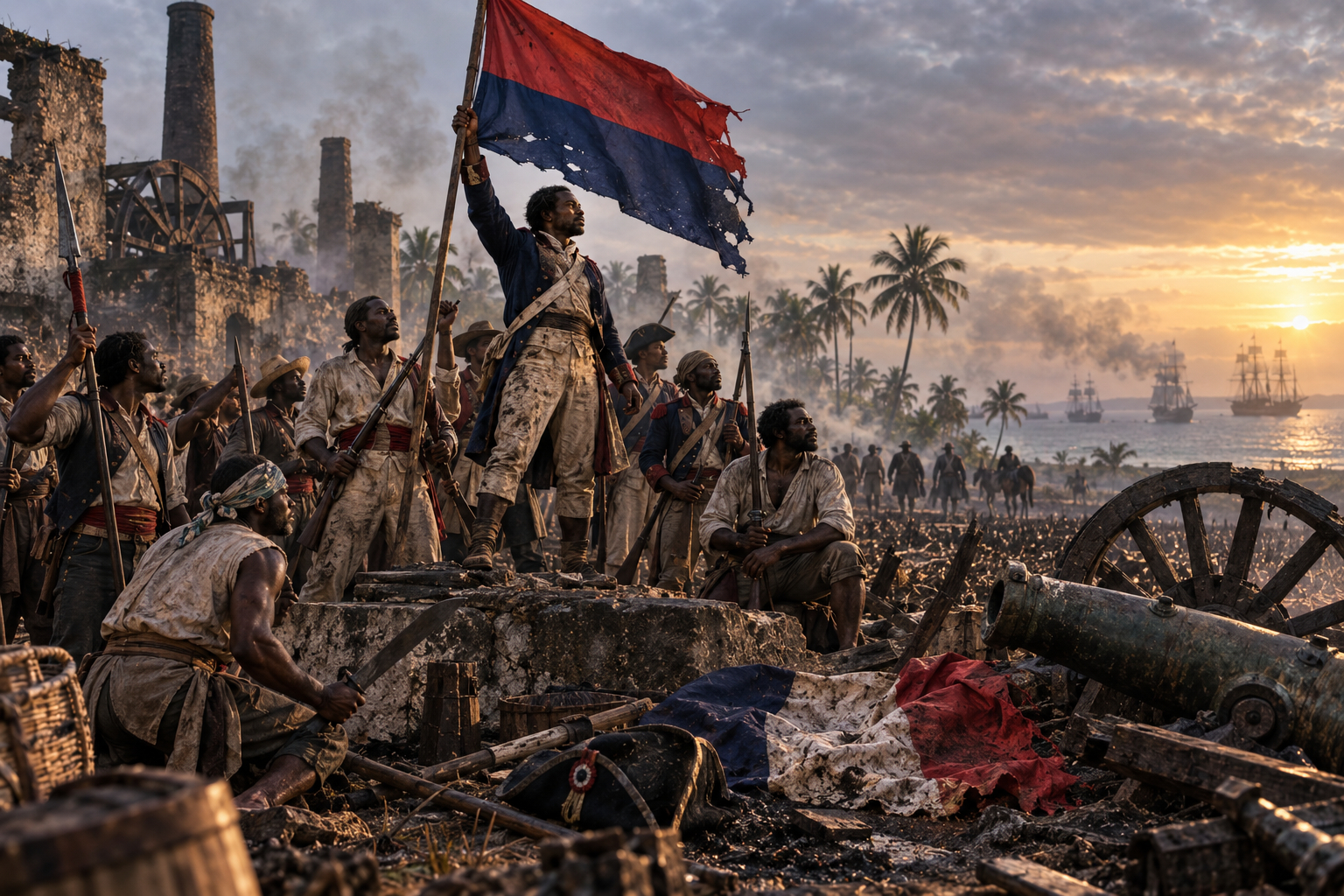
Saint-Domingue was the richest European colony in the Caribbean by the late 18th century, built on vast sugar and coffee plantations worked by an enslaved majority. In August 1791 a rebellion in the northern mountains—often linked in memory to a Bois Caïman ceremony—ignited a broader insurrection. What began as coordinated uprisings among enslaved people quickly spread into a general war: plantations burned, planters fled, and rival forces—enslaved insurgents, free people of color, white colonists, and foreign powers—competed for advantage.

Emancipation, shifting alliances, and Toussaint’s rise (1793–1801)

Revolution in France changed everything. Facing wars across Europe, the French revolutionary government declared the abolition of slavery in 1794, and many Black commanders in Saint-Domingue sided with the Republic. One of them, Toussaint Louverture, a formerly enslaved man who became a skilled general and administrator, emerged as the dominant figure by the late 1790s. Toussaint consolidated control over most of the colony, restored aspects of plantation agriculture to revive the economy, and navigated a web of treaties with Britain and Spain while keeping nominal loyalty to France.

Napoleon’s intervention and the final push (1802–1804)

When Napoleon Bonaparte moved to reassert imperial control, he dispatched a large expedition in 1802 under General Charles Leclerc. The arrival of French troops initially gained ground, and Toussaint was captured by treachery and deported to France, where he died in captivity in 1803. But the military situation turned against the French. Tropical disease—especially yellow fever—decimated their ranks, and new leaders, notably Jean-Jacques Dessalines, sustained guerrilla resistance and conventional battles. By late 1803 French forces were collapsing. On January 1, 1804, Dessalines proclaimed the independent state of Haiti—the first modern nation founded by formerly enslaved people and the second independent republic in the Americas.

Conclusion

The Haitian Revolution was more than a sequence of battles; it rewrote assumptions about who could claim sovereignty in the Atlantic world. Its consequences were immediate and long-lasting: the plantation economy was transformed, international recognition was delayed and often hostile, and France demanded a heavy indemnity decades later that hampered Haiti’s development. Still, between 1791 and 1804, formerly enslaved people overturned an entrenched colonial order and created a new nation—an achievement that reshaped the map and reverberated through revolutions and debates about liberty across the Americas.

Previous Post

From Horses to Wires: How the Pony Express Met the Telegraph

Next Post

Anne Bonny: The Pirate Who Broke Rules and Expectations

Related Posts

1453: The Fall of Constantinople — A Brief Timeline
Timeline

1453: The Fall of Constantinople — A Brief Timeline

November 2, 2026
How Penicillin Went from Petri Dish to Battlefield Medicine
Timeline

How Penicillin Went from Petri Dish to Battlefield Medicine

November 2, 2026
How the Black Death Spread Across Europe, 1347–1351
Timeline

How the Black Death Spread Across Europe, 1347–1351

October 28, 2026
The Great Stink of 1858: How London Smell Rebuilt Itself
Timeline

The Great Stink of 1858: How London Smell Rebuilt Itself

October 28, 2026
Next Post
Anne Bonny: The Pirate Who Broke Rules and Expectations

Anne Bonny: The Pirate Who Broke Rules and Expectations

Search..

No Result
View All Result

Recent Articles

1453: The Fall of Constantinople — A Brief Timeline

1453: The Fall of Constantinople — A Brief Timeline

November 2, 2026
How Penicillin Went from Petri Dish to Battlefield Medicine

How Penicillin Went from Petri Dish to Battlefield Medicine

November 2, 2026
How Carrara’s Marble Carved a Peculiar Mountain Region

How Carrara’s Marble Carved a Peculiar Mountain Region

November 1, 2026
The Great Dismal Swamp: Refuge, Labor, and a Hidden Region

The Great Dismal Swamp: Refuge, Labor, and a Hidden Region

November 1, 2026
The Salon Era: How Conversation Shaped the Enlightenment

The Salon Era: How Conversation Shaped the Enlightenment

October 31, 2026

Subscribe Us

By clicking submit, I authorize History Ours and its affiliated companies to: (1) use, sell, and share my information for marketing purposes, including cross-context behavioral advertising, as described in our Terms of Service and Privacy Policy, (2) supplement the information that I provide with additional information lawfully obtained from other sources, like demographic data from public sources, interests inferred from web page views, or other data relevant to what might interest me, like past purchase or location data, (3) contact me or enable others to contact me by email with offers for goods and services from any category at the email address provided, and (4) retain my information while I am engaging with marketing messages that I receive and for a reasonable amount of time thereafter. I understand I can opt out at any time through an email that I receive, or by clicking here

Subscribe To Our Newsletter

By clicking submit, I authorize History Ours and its affiliated companies to: (1) use, sell, and share my information for marketing purposes, including cross-context behavioral advertising, as described in our Terms of Service and Privacy Policy, (2) supplement the information that I provide with additional information lawfully obtained from other sources, like demographic data from public sources, interests inferred from web page views, or other data relevant to what might interest me, like past purchase or location data, (3) contact me or enable others to contact me by email with offers for goods and services from any category at the email address provided, and (4) retain my information while I am engaging with marketing messages that I receive and for a reasonable amount of time thereafter. I understand I can opt out at any time through an email that I receive, or by clicking here.

© 2026 History Ours | All Rights Reserved

  • Contact Us
  • Privacy Policy
  • Terms of Service
  • Unsubscribe
  • Privacy Choices
  • Contact Us
  • Privacy Policy
  • Terms of Service
  • Unsubscribe
  • Privacy Choices

© 2026 History Ours | All Rights Reserved

No Result
View All Result
  • Home
  • History
  • Biographies
  • Eras
  • Regions
  • Timeline

© 2026 History Ours | All Rights Reserved

Skip to content
Open toolbar Accessibility Tools

Accessibility Tools

  • Increase TextIncrease Text
  • Decrease TextDecrease Text
  • GrayscaleGrayscale
  • High ContrastHigh Contrast
  • Negative ContrastNegative Contrast
  • Light BackgroundLight Background
  • Links UnderlineLinks Underline
  • Readable FontReadable Font
  • Reset Reset