

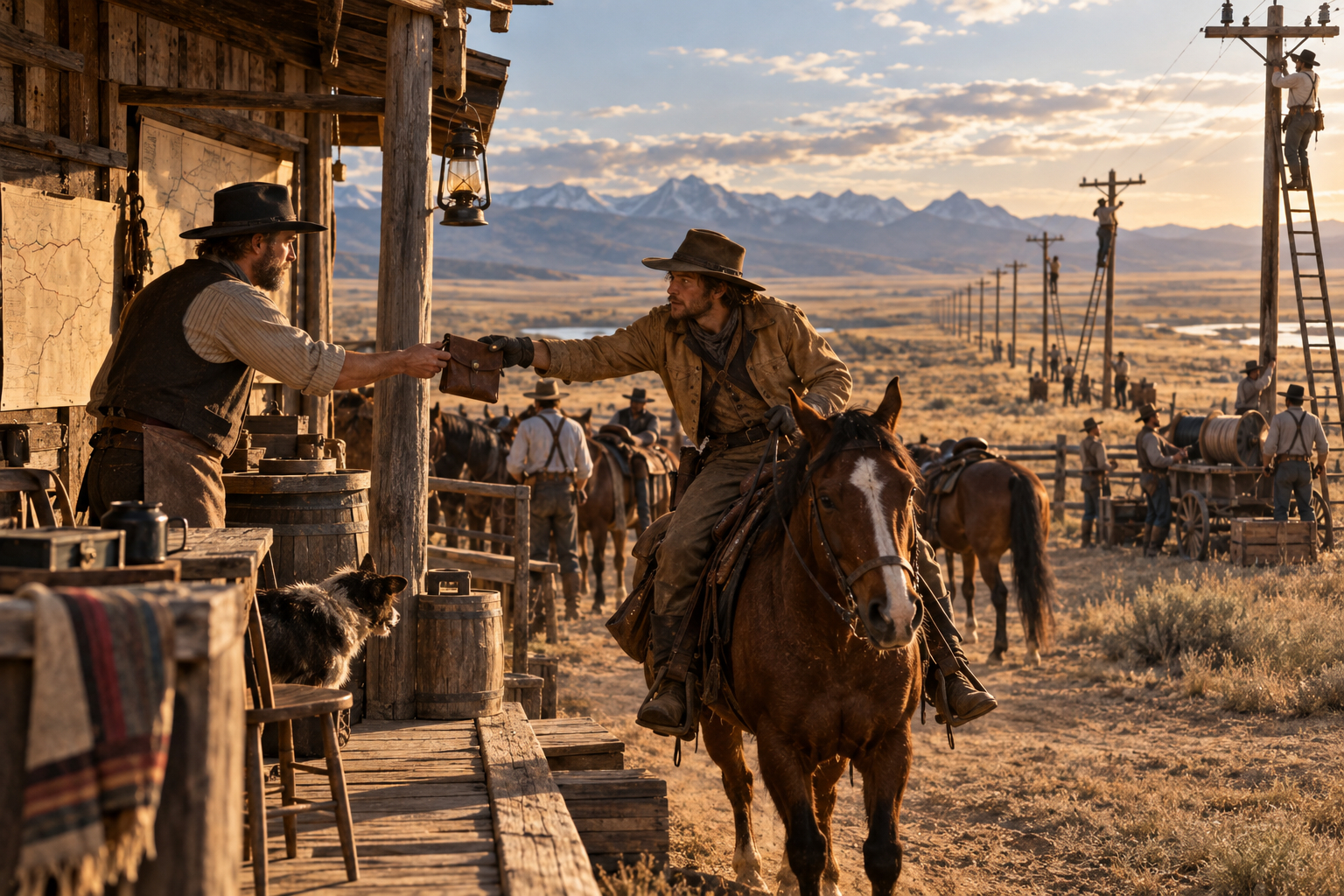
By mid-19th century America, distances mattered. Newspapers, merchants and politicians demanded faster news from the Pacific coast as migration and commerce surged. The telegraph had already rewritten how the East communicated: on May 24, 1844, Samuel F. B. Morse sent the first long-distance message, a startling proof that information could outrun a horse.
Yet wiring the vast western plains was slow and expensive. For a brief, romantic moment entrepreneurs saw a different solution—men on small, fast horses carrying sealed pouches of letters across relay stations. It was an elegant, dangerous interim between the old world of stagecoaches and the new world of electrical pulses.
The Pony Express in motion (April 1860–October 1861)
In April 1860 the Central Overland California and Pikes Peak Express Company launched the Pony Express, a relay of lightweight riders changing mounts every 10–15 miles. Stations—rough cabins, corrals and liveries spaced roughly 75–100 miles apart—kept the route moving. A top rider could cover the roughly 1,900 miles between Missouri and California in about ten days, a dramatic improvement over previous overland mail that could take weeks.
Riders were small, swift and stubbornly independent. They faced storms, hostile terrain, and occasional attacks. The service became an instantly evocative symbol of frontier daring: a network of wind, horseflesh and human endurance stitched across deserts and mountains.
The telegraph’s knockout blow (1861)
Meanwhile, telegraph builders were racing west. Driven by private companies, government need for rapid Civil War communications and the sheer economic promise, crews pushed poles and string through territory the Pony Express crossed. On October 24, 1861 the transcontinental telegraph was completed, linking the coasts with an instant channel for messages.
Two days later, with its raison d’être severed by wires, the Pony Express folded. It had never been a long-term, profitable venture—its costs and weather-dependent reliability were always liabilities—but its brief life captured the imagination and made a practical point: in an age of accelerating technology, speed often arrives in fits and starts, with vivid interim solutions.
Conclusion
The Pony Express didn’t die because it failed at its task; it died because something better arrived. Its ten-month run remains one of those transitional episodes that illuminate how societies adapt. The riders’ grit and the telegraph’s silent hum together transformed how America moved information, shrinking the continent in ways that reshaped commerce, politics and daily life.