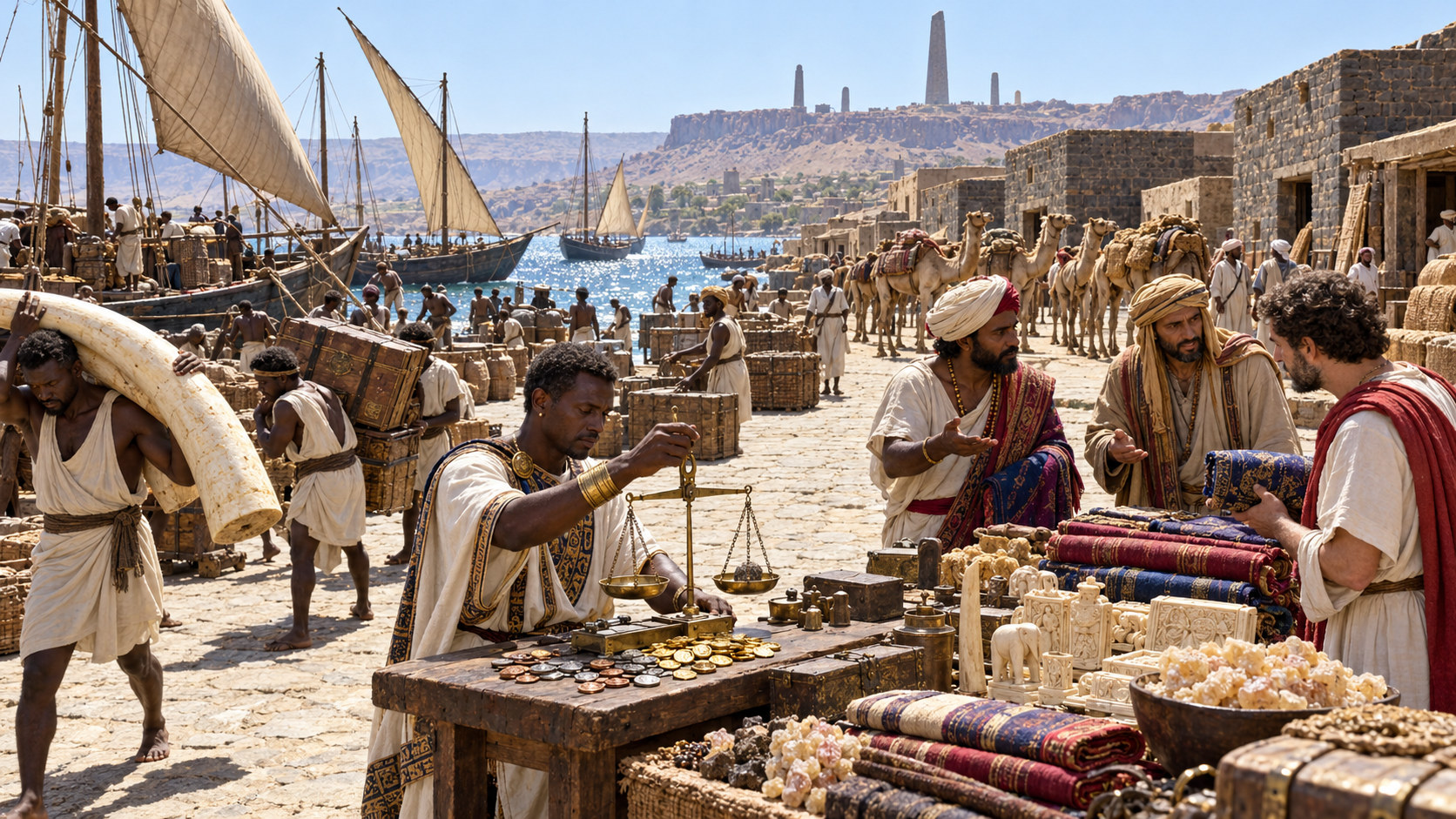
A trading powerhouse on the Red Sea
By the first century CE, Aksum (centered at modern Axum in northern Ethiopia) had staked out an unusual role: a highland African state with a port on the Red Sea that plugged straight into the commerce of Rome, India and Arabia. Its principal harbor, Adulis, appears in the Periplus of the Erythraean Sea as a bustling entrepôt for ivory, gold, frankincense, myrrh and slaves. Merchants arriving from the Mediterranean found not just goods but a government that could levy tolls, issue standards of weight and maintain diplomatic ties.
Stelae, coins, and an alphabet of power
Aksum’s monuments still dominate the landscape. Massive granite stelae—carved to mark royal tombs or proclaim building projects—rise like folded pages of stone. The best known, often called the Obelisk of Axum, is a single monolith that was dismantled and taken to Italy in the 20th century and returned decades later, a reminder that these stones have mattered to outsiders as well as locals.
Monumentality went hand in hand with administrative tools. Aksum issued its own gold, silver and copper coins from roughly the third century onward, the only African polity south of the Sahara known to do so in antiquity. Many coins bear Greek inscriptions, chosen so Aksumite currency would be readable to Mediterranean traders. The kingdom also used the Ge’ez script in inscriptions, an indigenous writing system that helped bind the state together.
Conversion, claim to Solomon, and the kingdom’s fade
In the fourth century a dramatic transformation occurred: King Ezana adopted Christianity. The conversion links Aksum to the wider late-antique world and to Constantinople’s orbit, while also setting the stage for Ethiopia’s long-standing Orthodox tradition. Centuries later medieval chronicles such as the Kebra Nagast would assert a dynastic connection to King Solomon and the Queen of Sheba, a powerful origin story that shaped Ethiopian identity even as historians debate its literal truth.
By the seventh and eighth centuries Aksum’s fortunes shifted. A combination of factors—the rise of new Muslim trading networks that altered Red Sea routes, environmental strain in the highlands, and political changes in the Arabian peninsula—reduced the kingdom’s wealth and reach. Urban centers shrank; monumental building slowed. Yet the cultural and religious legacies endured.
Conclusion
Aksum is a useful reminder that ancient globalization looked different from our own. From granite stelae and minted gold to seaside markets trading with Rome and India, this highland kingdom forged connections across oceans and deserts. Its ruins are not just stones; they are fingerprints of a state that once linked the Horn of Africa to the wider ancient world.