
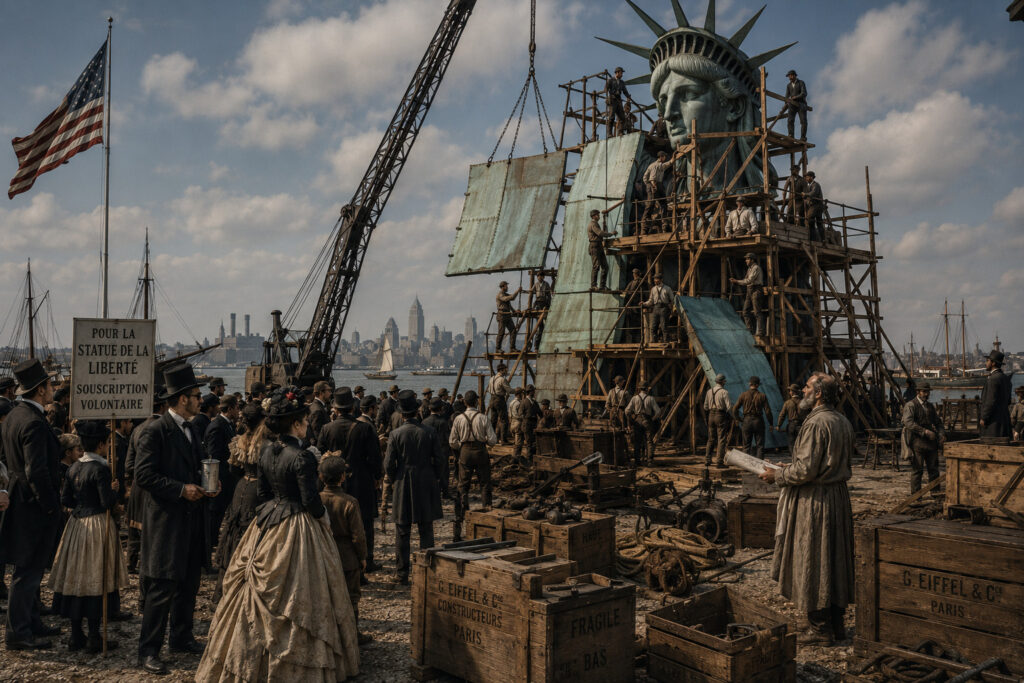
What began as a conversation among French intellectuals turned, over two decades, into one of the world’s most recognizable monuments. In the aftermath of the American Civil War a group of French republicans, led by Édouard de Laboulaye, proposed a commemorative gift: a sculpted personification of liberty to celebrate shared values and the 100th anniversary of American independence. The idea rested on goodwill, artistic ambition and, crucially, fundraising in two countries that were not always friendly to the idea of mass public sculpture.
Key dates in the statue’s creation
1865: The initial proposal takes shape in Paris as a symbolic Franco‑American gift celebrating liberty and republicanism.
1870s: Sculptor Frédéric Auguste Bartholdi develops designs. Early models and fundraising efforts begin; the concept grows from a small allegorical figure into a monumental statue intended for New York Harbor.
Early 1880s: Gustave Eiffel and his engineers accept the challenge of creating an internal iron framework. That skeletal armature would allow thin sheets of hammered copper to hold their form while resisting wind and weather.
1884: The completed sculpted pieces are finished in France. The statue is disassembled for shipment, packed into crates and readied for its Atlantic crossing.
1885–1886: Crated sections arrive in New York in 1885. The pedestal—funded after a spirited American fundraising campaign that included wide appeals in newspapers—rises on Bedloe’s Island (now Liberty Island). The reassembled statue is dedicated on October 28, 1886.
1886–1902: For a time the monument also served a practical role: its torch acted, for a period, as a lighthouse aiding ships entering New York Harbor.
1984–1986: Ahead of the statue’s centennial, a major restoration returned corroded elements to working order and refurbished visitor spaces; the site reopened in 1986.
Why those years mattered
The timeline shows repeated bottlenecks: artistic design, structural engineering, and two separate fundraising campaigns in France and America. Each pause shaped the final work. Gustave Eiffel’s framework turned Bartholdi’s copper skin from a fragile concept into a structure that could withstand storms. The American drive to pay for the pedestal turned the statue into a civic project, a reason for ordinary citizens to feel ownership of the gift.
Conclusion
More than a single date on a map, the Statue of Liberty arrived by stages—idea, design, build, transport, assembly, and restoration. Those steps reveal why the figure on the island has lasted: it is the product not only of artistic vision but of engineering, politics and popular will. Today it stands both as a nineteenth‑century present from one nation to another and as an evolving symbol that successive generations have layered with new meanings.