
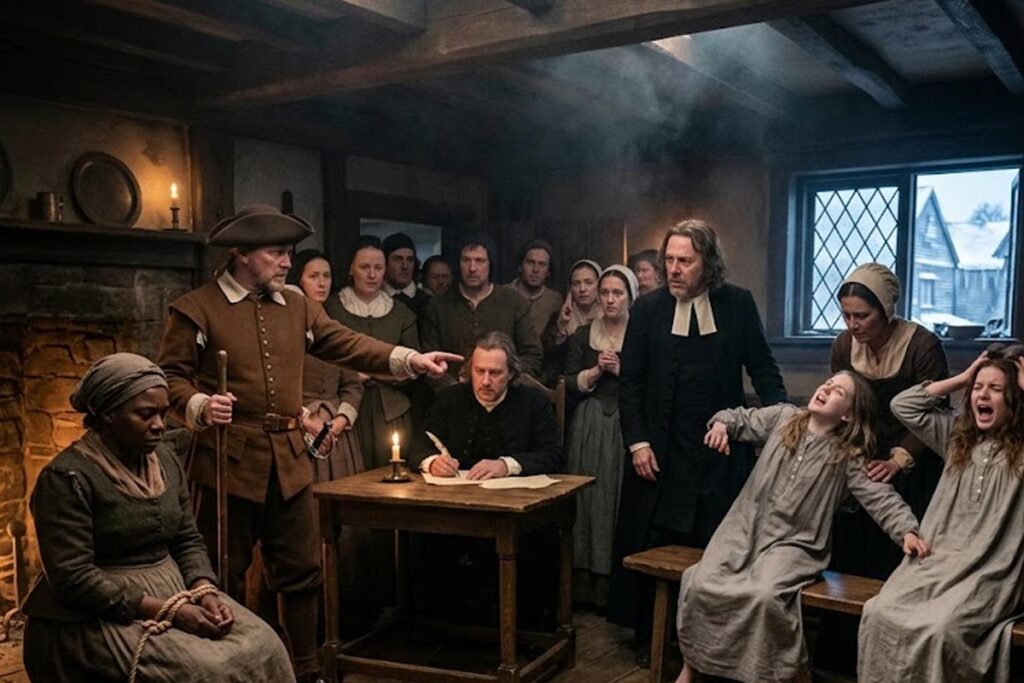
A small New England village turned inward in 1692. In February, two young girls in Salem Village—Betty Parris and Abigail Williams—began to behave strangely by the standards of the day: bouts of screaming, contortions, and what neighbors labeled “fits.” Local physicians found no physical cause. Under pressure and fear, attention shifted from illness to malice. The Reverend Samuel Parris’s enslaved woman, Tituba, was among the first accused; under interrogation she confessed to witchcraft and named others. Accusation spread not as a single event but as a chain of neighborhood disputes, family quarrels, and parish tensions that suddenly had a supernatural explanation.
Salem in 1692 was already a patchwork of stress. Close by, frontier skirmishes during King William’s War stirred anxiety. The village and the town were divided over property, governance, and religious practice. That mixture—economic strain, religious fervor, and recent violence on the frontier—created fertile ground for suspicion to escalate quickly into formal charges.
Trials, spectral evidence, and executions (Summer–Fall 1692)
By spring and early summer the colony’s courts were pulled into the drama. The Court of Oyer and Terminer, created by Governor William Phips, began hearing witchcraft cases in May. One controversial practice stood at the center: spectral evidence, testimony that the accused’s spirit or specter appeared to a victim. Judges accepted such testimony in many trials, and juries convicted on it.
Accusation became prosecution. Between June and September 1692 dozens of men and women were indicted. Eighteen people were hanged at Gallows Hill, and one man, Giles Corey, refused to plead and was pressed to death with heavy stones—a rare and brutal legal punishment. Scores more were jailed; some died in custody. Many who faced trial were ordinary townspeople—farmers, mothers, elders—caught between fear and legal machinery.
Collapse of the prosecutions and later redress
By late 1692 the credibility of the prosecutions began to unravel. Critics, including prominent clergymen, questioned the reliance on spectral evidence. Governor Phips dissolved the special court and ordered new procedures. Over the next year the remaining prisoners were released or had charges dropped. The colony’s official view shifted: delegations, petitions, and public remorse followed, and by the early 18th century the Massachusetts authorities acknowledged the miscarriages of justice and provided some restitution to victims’ families in 1711.
Historians still debate why the hysteria erupted so fiercely—reasons range from social tensions and local politics to medical explanations such as ergot poisoning, a theory that remains contested. Whatever the mix of causes, the Salem trials left a clear, unsettling record: a community’s fears, when legitimized by courts, can produce fatal outcomes and long shadows.
Conclusion
The Salem events of 1692 were not a single bizarre episode but a rapid sequence: strange symptoms, accusations, courtroom acceptance of intangible proof, executions, and eventual collapse. The legacy is both local and instructive—how ordinary social frictions, channeled through belief and law, can become a sudden, destructive force.