
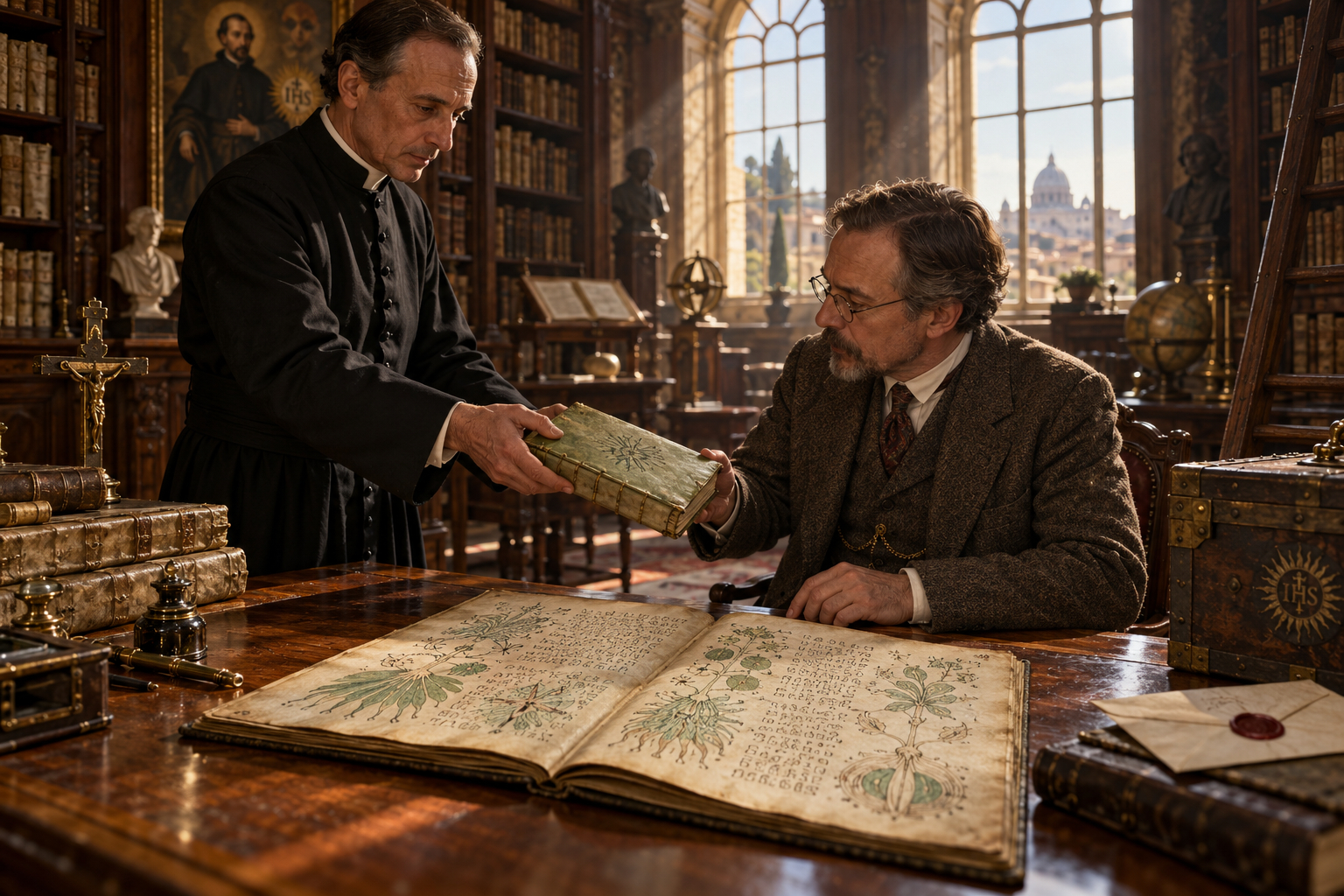
Bound in a greenish vellum and filled with looping, unknown characters, the Voynich Manuscript looks like an odd herbarium for a lost civilization. Modern tests on the parchment date the book to the early 15th century (roughly 1404–1438), placing its creation in late medieval Europe. Its drawings—plants that don’t match known species, circular star charts, and page-after-page of tight, unfamiliar script—give the impression of a laboratory notebook written in code.
Passing Through Early Hands
The manuscript’s trail grows dim but not silent through the early modern period. A 17th-century letter links it to Prague and to scholars who thought the writing might yield to learned interpreters. By the 1600s it had become an object of curiosity among collectors and clerics, and for centuries it remained a private puzzle, an oddity passed along in libraries and personal collections without anyone able to turn its script into sense.
Voynich, Cryptographers, and Carbon Dating
Its modern story begins in 1912 when antiquarian bookseller Wilfrid Voynich acquired the volume at a Jesuit house near Rome; his name stuck. In the 20th century the manuscript attracted codebreakers. William Friedman, one of America’s leading cryptanalysts, led a 1920s–30s effort that concluded the text resisted ordinary substitution ciphers. Interest never faded: scholars, amateur sleuths, and computer scientists kept trying.
The manuscript burned its own myth into scientific record in 2009 when radiocarbon testing of the vellum placed the book in the early 1400s. That result moved the object from speculative ages into a defined historical window, intensifying the puzzle: if the pages are medieval, what explains the strange script and those botanical drawings?
Recent Claims and Continuing Mystery
The 21st century brought new tools—statistical analyses, machine learning, and renewed philological arguments—but no consensus. Several researchers have announced decipherments or linguistic identifications; some proposed constructed languages, others argued for a cipher based on a lost tongue. A few high-profile claims attracted media attention, yet their methods or conclusions failed to win broad acceptance among specialists.
Today the Voynich Manuscript sits in a university library, digitized and available to readers around the world. It has become both a medieval object and a modern puzzle: a book whose pages preserve a maker’s intentions while inviting successive generations to imagine meanings. Two things remain clear—its vellum belongs to the early 1400s, and its script continues to resist a settled reading.
Conclusion
Part codex, part riddle, the Voynich Manuscript is a timeline of curiosity. From medieval hands to modern laboratories, each owner and analyst has added a layer to the story without resolving it. Its illustrated pages keep provoking questions about language, knowledge, and the limits of interpretation—proof that a single mysterious book can keep history alive by refusing to be fully explained.