
In 1519 Hernán Cortés landed on the Gulf coast with a handful of ships and a mixed force of Spaniards, native allies, and horses. He marched inland, encountering powerful city-states and forging a crucial alliance with the Tlaxcalans, longtime enemies of the Mexica capital. Word of the newcomers reached Moctezuma II in Tenochtitlan, a lakeside city of causeways, canals, and temples that astonished Spanish eyes. Cortés entered the city in November and stayed; for months the conquistadors lived amid the palaces and markets under a fragile arrangement that mixed diplomacy, opportunism, and miscommunication.
Crisis, Uprising, and La Noche Triste (1520)
Tensions mounted. Back in Cuba, rivals sent orders for Cortés to return to face the governor’s authority; Cortés left a deputy and hurried back, leaving unrest in Tenochtitlan. In May 1520 the situation exploded when Spanish behavior, combined with a massacre of Mexica nobles during a festival, provoked widespread revolt. The Spaniards attempted to flee the city on the night of June 30, 1520—an episode later called La Noche Triste—and suffered heavy losses as many soldiers and their loot were killed while crossing the causeways. Cortés and survivors retreated to Tlaxcala to regroup.
Smallpox, Siegecraft, and the New Campaign (1520–1521)
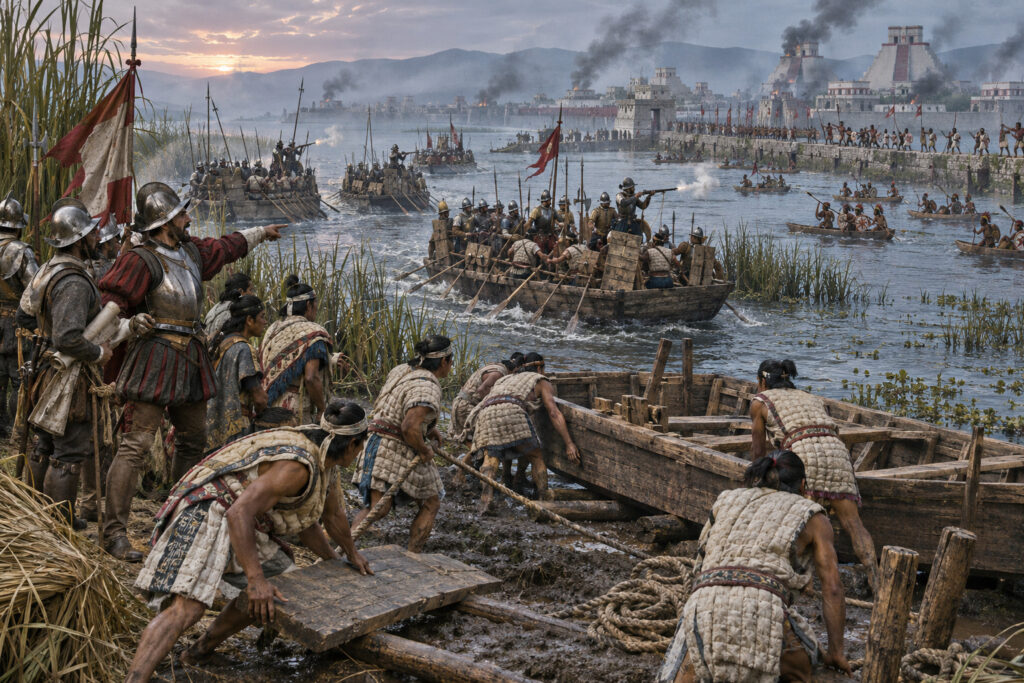
Two developments turned the campaign’s balance. First, an epidemic of smallpox swept through central Mexico in 1520–1521, decimating the native population and killing the new Mexica ruler, Cuitláhuac. The disease weakened social and military structures in ways that historians still weigh today. Second, Cortés returned in 1521 with reinforcements and a larger allied force. He supervised the construction of brigantines—small vessels launched on the lake—to control waterways, and his troops systematically cut Tenochtitlan off by destroying aqueducts and blocking causeways. The strategy combined naval action, siege tactics, and the numerical superiority of thousands of indigenous allies.
Conclusion
After months of bombardment, starvation, and street fighting, Tenochtitlan fell in August 1521. The city’s stones were later quarried to build Mexico City on the same island foundations. The conquest did not happen in a single decisive moment but through a string of military reversals, epidemic devastation, shifting indigenous alliances, and deliberate siege engineering. The fall of Tenochtitlan rewrote the map of the Americas: it ended the Mexica empire and began a Spanish colonial order that would transform landscapes, languages, and lives across the hemisphere.