Uncover History’s Secrets with Daily Updates!
Daily News Entertainment
  • Home
  • History
  • Biographies
  • Eras
  • Regions
  • Timeline
No Result
View All Result
History Ours
  • Home
  • History
  • Biographies
  • Eras
  • Regions
  • Timeline
No Result
View All Result
History Ours
No Result
View All Result
Home Timeline

Solving Longitude: The Clock, the Prize, and the Sea

in Timeline
Solving Longitude: The Clock, the Prize, and the Sea

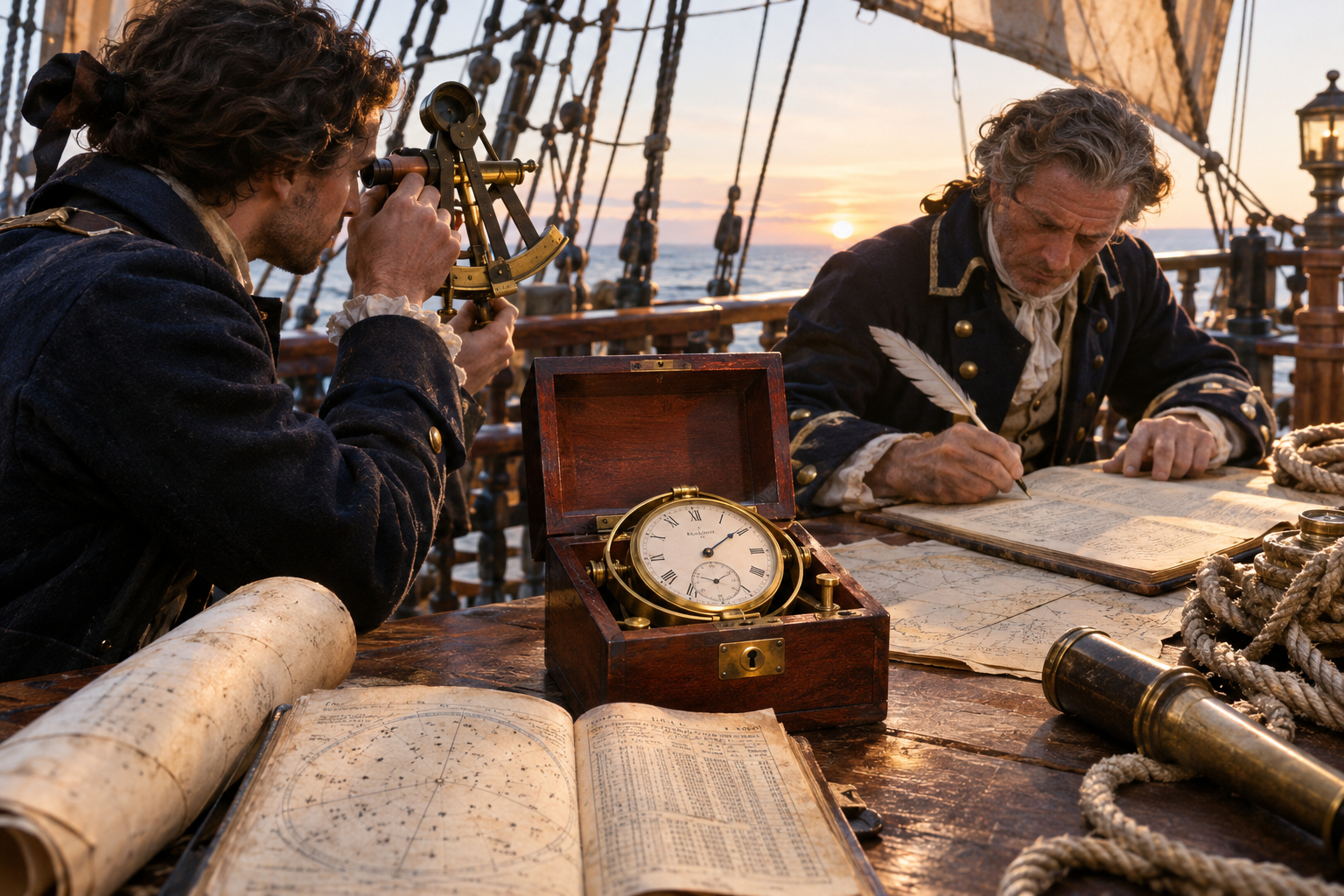
For sailors of the age of sail, latitude was easy enough: measure the sun at noon and you knew how far north or south you were. Longitude was another matter. Without an accurate way to fix east-west position, captains relied on dead reckoning — a mosaic of speed estimates, steering, and luck — and the results could be catastrophic. A string of costly wrecks in the early 1700s convinced the British government to act.

In 1714 Parliament created the Board of Longitude and offered a generous prize for any method that would determine longitude at sea within agreed limits. That single decision set off a half-century contest between astronomers and clockmakers, each pursuing very different ideas about how to pin a ship’s position on the open ocean.

Two contenders: the Moon and the Marine Clock

One route looked skyward. Astronomers proposed the lunar-distance method: measure the angle between the moon and a known star, then compare that reading to published lunar tables to find the time at a chosen reference meridian. Improving those tables mattered enormously. Midcentury advances — including refined tables and the publication of the Nautical Almanac in 1767 — made the lunar technique practical for skilled navigators long before chronometers were common.

The other route turned mechanical. John Harrison, a self-educated Yorkshire carpenter, believed a clock that kept reference time at sea would solve the problem. He built a succession of increasingly sophisticated timekeepers — H1 through H4 — each designed to resist temperature swings, humidity, and the ship’s motion. H4, completed in the 1750s, looked more like a large pocket watch than a tall clock. When it was tested at sea it kept surprisingly steady time, proving the core idea: if you know the hour at your home meridian and compare it with local noon, you can calculate longitude.

Both solutions had champions. The Board of Longitude split its awards between astronomical work and instruments. Instrument makers copied Harrison’s design; Larcum Kendall produced an expensive working copy of H4 that accompanied Captain James Cook and impressed seafarers with the new precision it offered.

From rarities to routine — and then to radio

The rest of the story is a familiar one of refinement and diffusion. Chronometers, once handmade and costly, became simpler, cheaper, and more reliable in the late 18th and 19th centuries. Navies and merchant fleets began to outfit ships with chronometers as standard navigational kit, while the lunar method continued as a backup where clocks failed.

By the 20th century, radio time signals and then satellite navigation displaced both lunar tables and marine chronometers. Still, the victory of the clock mattered in ways beyond technique: it turned longitude from a maddening uncertainty into a solved engineering problem, reshaping trade routes, naval strategy, and the map of a connected world.

Conclusion

The race for longitude is a compact history of practical problem-solving: a political prize, rival sciences, and a handful of brilliant tinkerers. Whether through the slow patience of astronomical tables or the steady tick of a marine chronometer, the seas that once swallowed ships became spaces of far greater certainty — and that change arrived not with a single flash but through decades of careful invention.

Previous Post

Baku: Oil, Ports, and the Birth of a Caspian Metropolis

Related Posts

When London Went Dark: The Great Smog Timeline
Timeline

When London Went Dark: The Great Smog Timeline

November 12, 2026
How London Burned: A Four-Day Timeline of 1666
Timeline

How London Burned: A Four-Day Timeline of 1666

November 12, 2026
The Dreyfus Affair: A Timeline of Scandal and Redemption
Timeline

The Dreyfus Affair: A Timeline of Scandal and Redemption

November 7, 2026
The Last Voyage of USS Indianapolis: A Short, Deadly Timeline
Timeline

The Last Voyage of USS Indianapolis: A Short, Deadly Timeline

November 7, 2026

Search..

No Result
View All Result

Recent Articles

Solving Longitude: The Clock, the Prize, and the Sea

Solving Longitude: The Clock, the Prize, and the Sea

November 17, 2026
Baku: Oil, Ports, and the Birth of a Caspian Metropolis

Baku: Oil, Ports, and the Birth of a Caspian Metropolis

November 16, 2026
How Kraków’s Cloth Hall Knit a Central European Region

How Kraków’s Cloth Hall Knit a Central European Region

November 16, 2026
Night Before Neon: How Cities Lived by Moonlight

Night Before Neon: How Cities Lived by Moonlight

November 15, 2026
The Cable-Laying Era: How Submarine Cables Shrank the World

The Cable-Laying Era: How Submarine Cables Shrank the World

November 15, 2026

Subscribe Us

By clicking submit, I authorize History Ours and its affiliated companies to: (1) use, sell, and share my information for marketing purposes, including cross-context behavioral advertising, as described in our Terms of Service and Privacy Policy, (2) supplement the information that I provide with additional information lawfully obtained from other sources, like demographic data from public sources, interests inferred from web page views, or other data relevant to what might interest me, like past purchase or location data, (3) contact me or enable others to contact me by email with offers for goods and services from any category at the email address provided, and (4) retain my information while I am engaging with marketing messages that I receive and for a reasonable amount of time thereafter. I understand I can opt out at any time through an email that I receive, or by clicking here

Subscribe To Our Newsletter

By clicking submit, I authorize History Ours and its affiliated companies to: (1) use, sell, and share my information for marketing purposes, including cross-context behavioral advertising, as described in our Terms of Service and Privacy Policy, (2) supplement the information that I provide with additional information lawfully obtained from other sources, like demographic data from public sources, interests inferred from web page views, or other data relevant to what might interest me, like past purchase or location data, (3) contact me or enable others to contact me by email with offers for goods and services from any category at the email address provided, and (4) retain my information while I am engaging with marketing messages that I receive and for a reasonable amount of time thereafter. I understand I can opt out at any time through an email that I receive, or by clicking here.

© 2026 History Ours | All Rights Reserved

  • Contact Us
  • Privacy Policy
  • Terms of Service
  • Unsubscribe
  • Privacy Choices
  • Contact Us
  • Privacy Policy
  • Terms of Service
  • Unsubscribe
  • Privacy Choices

© 2026 History Ours | All Rights Reserved

No Result
View All Result
  • Home
  • History
  • Biographies
  • Eras
  • Regions
  • Timeline

© 2026 History Ours | All Rights Reserved

Skip to content
Open toolbar Accessibility Tools

Accessibility Tools

  • Increase TextIncrease Text
  • Decrease TextDecrease Text
  • GrayscaleGrayscale
  • High ContrastHigh Contrast
  • Negative ContrastNegative Contrast
  • Light BackgroundLight Background
  • Links UnderlineLinks Underline
  • Readable FontReadable Font
  • Reset Reset