Uncover History’s Secrets with Daily Updates!
Daily News Entertainment
  • Home
  • History
  • Biographies
  • Eras
  • Regions
  • Timeline
No Result
View All Result
History Ours
  • Home
  • History
  • Biographies
  • Eras
  • Regions
  • Timeline
No Result
View All Result
History Ours
No Result
View All Result
Home Biographies

Ada Lovelace and the Origins of Computing Thought

in Biographies
Ada Lovelace and the Origins of Computing Thought

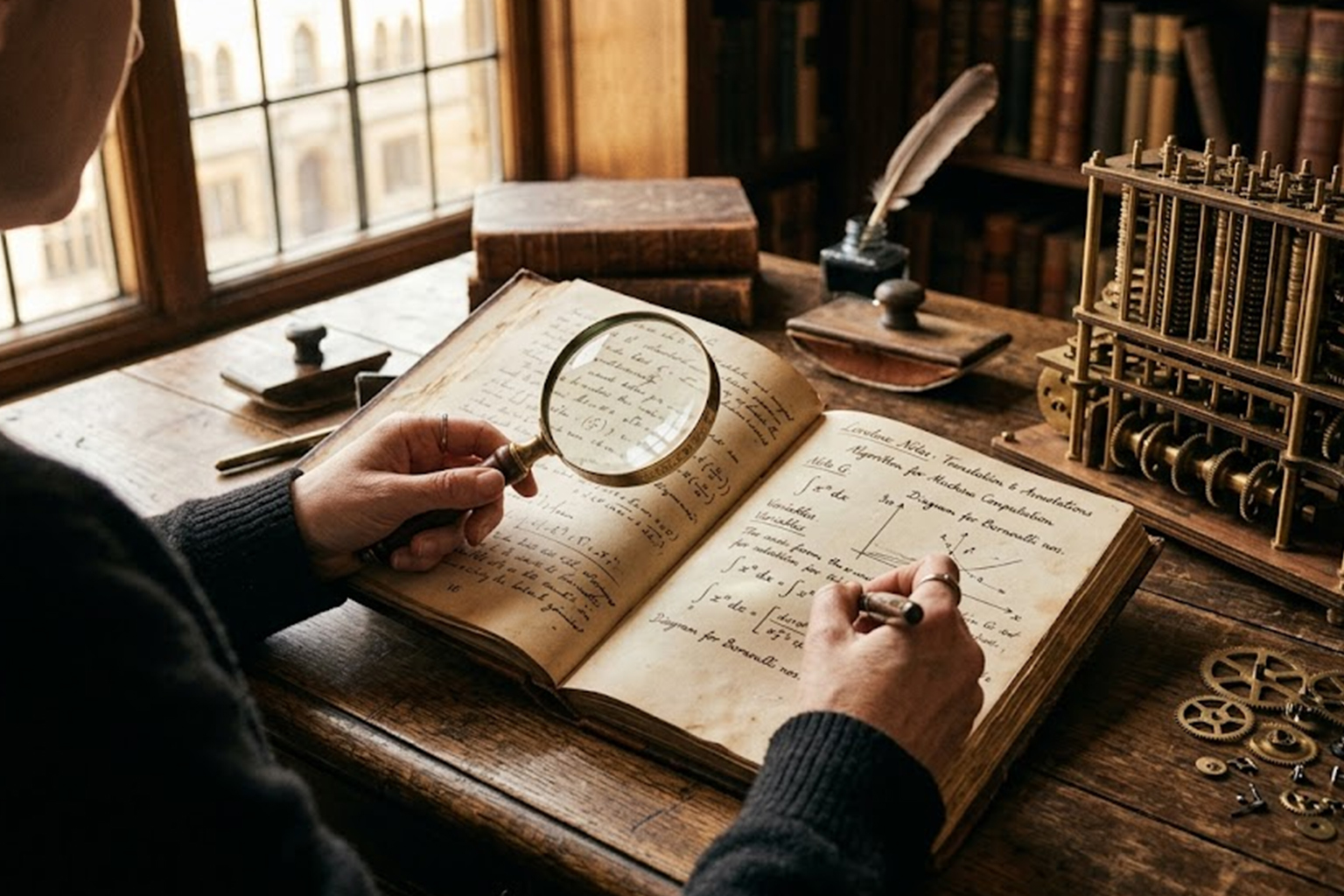
Ada Lovelace stands as a pivotal figure in the early history of computing whose life bridged mathematics, imagination, and mechanical invention. Born into a household that valued intellectual curiosity, she developed an early facility for numbers and an appetite for abstract thinking. Her collaboration with a contemporary inventor allowed her to translate complex mechanical ideas into conceptual frameworks that anticipated programmable machines. For many scholars, her notes and insights represent the first sustained attempt to imagine software as distinct from hardware.

Early Life and Formation

Her upbringing combined rigorous tutoring with exposure to scientific discourse, creating a foundation in mathematics that was rare for women of her social milieu. Tutors encouraged analytical exercises, and she was drawn to patterns and symbolic reasoning from a young age. Social connections introduced her to leading thinkers and technical demonstrations that shaped her intellectual trajectory. This environment helped her synthesize practical observation with theoretical speculation.

These formative experiences also fostered a habit of precise notation and careful argumentation. Her notebooks later reveal a disciplined approach to explaining complex subjects in accessible prose. That blend of rigor and clarity became one of her signature strengths.

Contributions to Mechanical Computation

Her most enduring work involved translating and expanding on an exposition of a programmable mechanical device developed by an engineer of the period. In extensive annotations she proposed that such a device could go beyond numerical calculation to manipulate symbols, presaging modern ideas about algorithms and software. She famously outlined how a sequence of operations could be specified to produce complex outcomes, effectively articulating an early model of programmatic instruction. Her writing combined technical detail with speculative foresight, moving the conversation from mechanism to method.

By framing operations as sequences capable of generalization, she shifted attention to the logic that underpins computation. That conceptual leap is why many historians recognize her as an intellectual ancestor of later computing disciplines.

Legacy and Modern Interpretation

Over time her ideas have been revisited by historians, computer scientists, and educators who seek to trace the intellectual roots of programming. Interpretations vary, but a consistent theme is her unique ability to imagine potential uses for machinery beyond immediate applications. Her notes continue to inspire discussions about creativity in technical fields and about the contributions of often-overlooked figures in scientific histories. Modern curricula sometimes invoke her story to illustrate the early interplay between theory and engineering.

Her legacy endures because she exemplified how conceptual clarity can broaden the significance of technical innovation. In doing so she offers a model for interdisciplinary thinking that remains relevant to contemporary challenges.

Conclusion

Ada Lovelace combined rigorous mathematical training with imaginative vision to articulate principles that foreshadowed programmable computation. Her writings transformed a mechanical invention into a conceptual framework for algorithms and symbolic manipulation. Today her life and work encourage a more inclusive and philosophically rich understanding of computing history.

Previous Post

Tracing Social Lives Through Household Artifacts

Next Post

Hypatia: A Life Between Philosophy and Mathematics

Related Posts

Mary Seacole: The Jamaican Nurse Who Went to War
Biographies

Mary Seacole: The Jamaican Nurse Who Went to War

October 30, 2026
Ada Lovelace: The Poet Who Helped Imagine Modern Computers
Biographies

Ada Lovelace: The Poet Who Helped Imagine Modern Computers

October 30, 2026
Katherine Johnson: The Numbers Behind America’s First Orbits
Biographies

Katherine Johnson: The Numbers Behind America’s First Orbits

October 25, 2026
Bessie Coleman: How a Texan Manicurist Conquered the Skies
Biographies

Bessie Coleman: How a Texan Manicurist Conquered the Skies

October 25, 2026
Next Post
Hypatia: A Life Between Philosophy and Mathematics

Hypatia: A Life Between Philosophy and Mathematics

Search..

No Result
View All Result

Recent Articles

Mary Seacole: The Jamaican Nurse Who Went to War

Mary Seacole: The Jamaican Nurse Who Went to War

October 30, 2026
Ada Lovelace: The Poet Who Helped Imagine Modern Computers

Ada Lovelace: The Poet Who Helped Imagine Modern Computers

October 30, 2026
John Snow, the Broad Street Pump, and Cholera’s Fall

John Snow, the Broad Street Pump, and Cholera’s Fall

October 29, 2026
The Vasa: Sweden’s Giant Ship That Couldn’t Sail

The Vasa: Sweden’s Giant Ship That Couldn’t Sail

October 29, 2026
How the Black Death Spread Across Europe, 1347–1351

How the Black Death Spread Across Europe, 1347–1351

October 28, 2026

Subscribe Us

By clicking submit, I authorize History Ours and its affiliated companies to: (1) use, sell, and share my information for marketing purposes, including cross-context behavioral advertising, as described in our Terms of Service and Privacy Policy, (2) supplement the information that I provide with additional information lawfully obtained from other sources, like demographic data from public sources, interests inferred from web page views, or other data relevant to what might interest me, like past purchase or location data, (3) contact me or enable others to contact me by email with offers for goods and services from any category at the email address provided, and (4) retain my information while I am engaging with marketing messages that I receive and for a reasonable amount of time thereafter. I understand I can opt out at any time through an email that I receive, or by clicking here

Subscribe To Our Newsletter

By clicking submit, I authorize History Ours and its affiliated companies to: (1) use, sell, and share my information for marketing purposes, including cross-context behavioral advertising, as described in our Terms of Service and Privacy Policy, (2) supplement the information that I provide with additional information lawfully obtained from other sources, like demographic data from public sources, interests inferred from web page views, or other data relevant to what might interest me, like past purchase or location data, (3) contact me or enable others to contact me by email with offers for goods and services from any category at the email address provided, and (4) retain my information while I am engaging with marketing messages that I receive and for a reasonable amount of time thereafter. I understand I can opt out at any time through an email that I receive, or by clicking here.

© 2026 History Ours | All Rights Reserved

  • Contact Us
  • Privacy Policy
  • Terms of Service
  • Unsubscribe
  • Privacy Choices
  • Contact Us
  • Privacy Policy
  • Terms of Service
  • Unsubscribe
  • Privacy Choices

© 2026 History Ours | All Rights Reserved

No Result
View All Result
  • Home
  • History
  • Biographies
  • Eras
  • Regions
  • Timeline

© 2026 History Ours | All Rights Reserved

Skip to content
Open toolbar Accessibility Tools

Accessibility Tools

  • Increase TextIncrease Text
  • Decrease TextDecrease Text
  • GrayscaleGrayscale
  • High ContrastHigh Contrast
  • Negative ContrastNegative Contrast
  • Light BackgroundLight Background
  • Links UnderlineLinks Underline
  • Readable FontReadable Font
  • Reset Reset