Uncover History’s Secrets with Daily Updates!
Daily News Entertainment
  • Home
  • History
  • Biographies
  • Eras
  • Regions
  • Timeline
No Result
View All Result
History Ours
  • Home
  • History
  • Biographies
  • Eras
  • Regions
  • Timeline
No Result
View All Result
History Ours
No Result
View All Result
Home Biographies

Hypatia: A Life Between Philosophy and Mathematics

in Biographies
Hypatia: A Life Between Philosophy and Mathematics

Introduction

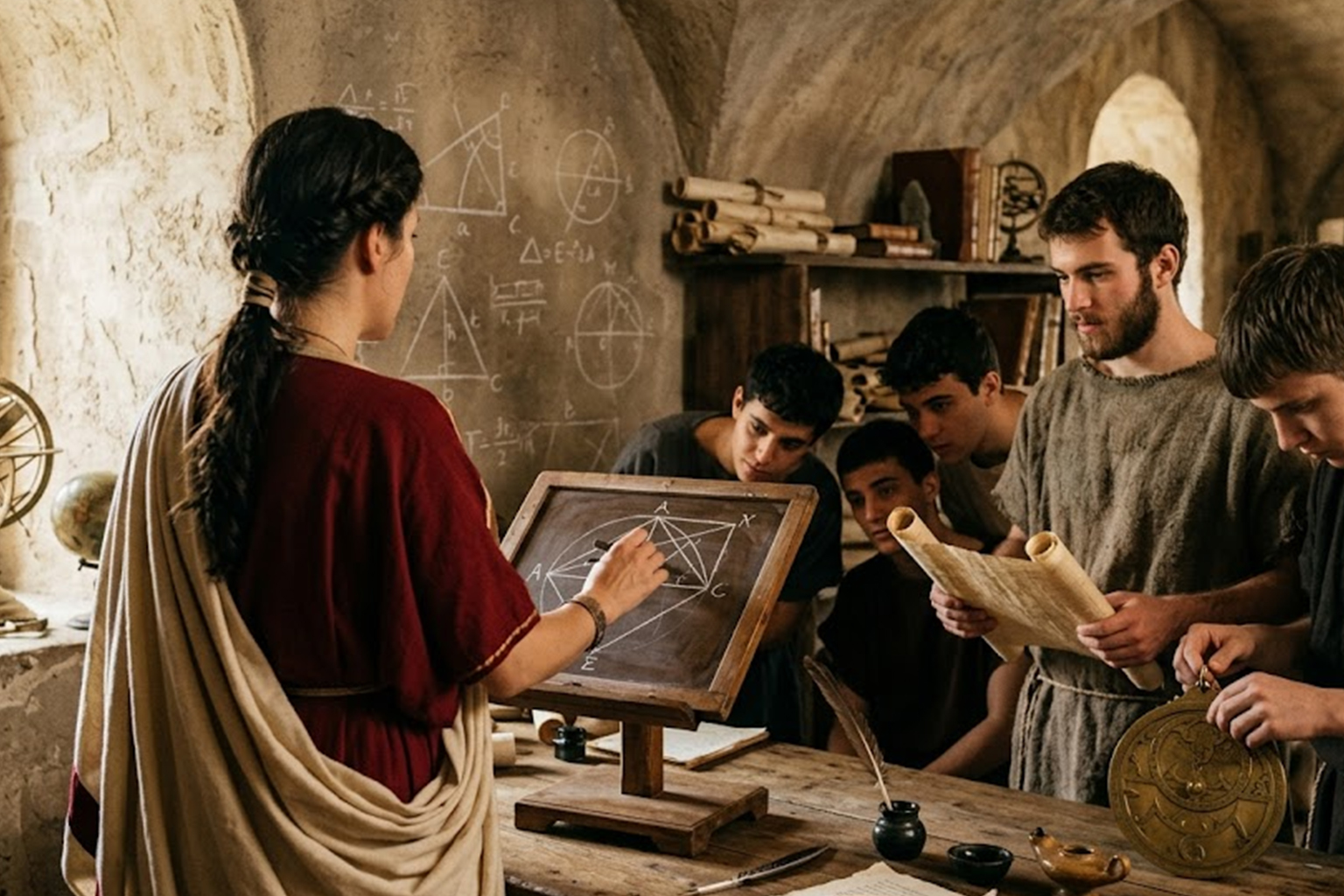
Hypatia remains one of the most compelling figures of the late classical era, remembered for her intellect and public life. She taught philosophy and mathematics to students from varied backgrounds and engaged with civic leaders. Her presence at the intersection of science, teaching, and public discourse gave her a unique influence in her city. Her story reflects the possibilities and perils of intellectual leadership in a turbulent time.

Early Life and Education

Born into an environment that prized learning, Hypatia benefited from a highly educated upbringing that emphasized rhetoric, geometry, and astronomy. Her father, himself a scholar, provided rigorous training that prepared her for a public career in teaching and scholarship. She studied classical texts and mathematical works, becoming proficient enough to lecture and write in fields traditionally dominated by men. Her classroom attracted students who sought exposure to Neoplatonic thought and practical mathematics.

Her education shaped an approach combining abstract reasoning with applied calculation. This synthesis allowed her to engage both abstract philosophy and concrete scientific problems in her teachings. Students recalled her as a clear and disciplined instructor who valued evidence and logical demonstration.

Intellectual Contributions

Hypatia worked on commentaries and clarifications of existing mathematical and astronomical texts, helping to transmit complex ideas to new audiences. Her efforts included refining geometrical proofs and explaining astronomical models, which aided scholars who followed. She emphasized clarity of argument and the pedagogical presentation of technical material. While few of her original writings survive, contemporary accounts credit her with deep understanding and the ability to communicate difficult concepts.

Her work supported the continuity of classical knowledge through teaching and mentorship. By making dense materials accessible, she helped preserve scholarly methods that would influence later thinkers. Her role as a mediator between theory and instruction proved invaluable for intellectual continuity.

Challenges and Legacy

Despite scholarly respect, Hypatia operated in a climate of political tensions and religious change, which complicated her public role. Her association with civic leaders and insistence on intellectual independence placed her at odds with some factions. The violent end to her life became a symbol of wider cultural and political transformations. Accounts of her death underscore how intellectual figures can become entangled in struggles beyond their control.

Her legacy persisted in the memory of students and later writers who portrayed her as both a martyr for learning and an emblem of philosophical integrity. Over centuries, scholars have revisited her life to explore themes of education, gender, and the transmission of knowledge. Hypatia’s story continues to provoke reflection on the value and vulnerability of public intellectuals.

Conclusion

Hypatia’s life highlights the power of teaching and the risks of public intellectual engagement.
Her efforts to clarify and teach complex ideas preserved important strands of classical thought.
Her memory endures as a touchstone for conversations about knowledge, leadership, and courage.

Previous Post

Ada Lovelace and the Origins of Computing Thought

Next Post

How Historical Eras Shape Long-Term Social Change

Related Posts

Mary Seacole: The Jamaican Nurse Who Went to War
Biographies

Mary Seacole: The Jamaican Nurse Who Went to War

October 30, 2026
Ada Lovelace: The Poet Who Helped Imagine Modern Computers
Biographies

Ada Lovelace: The Poet Who Helped Imagine Modern Computers

October 30, 2026
Katherine Johnson: The Numbers Behind America’s First Orbits
Biographies

Katherine Johnson: The Numbers Behind America’s First Orbits

October 25, 2026
Bessie Coleman: How a Texan Manicurist Conquered the Skies
Biographies

Bessie Coleman: How a Texan Manicurist Conquered the Skies

October 25, 2026
Next Post
How Historical Eras Shape Long-Term Social Change

How Historical Eras Shape Long-Term Social Change

Search..

No Result
View All Result

Recent Articles

Mary Seacole: The Jamaican Nurse Who Went to War

Mary Seacole: The Jamaican Nurse Who Went to War

October 30, 2026
Ada Lovelace: The Poet Who Helped Imagine Modern Computers

Ada Lovelace: The Poet Who Helped Imagine Modern Computers

October 30, 2026
John Snow, the Broad Street Pump, and Cholera’s Fall

John Snow, the Broad Street Pump, and Cholera’s Fall

October 29, 2026
The Vasa: Sweden’s Giant Ship That Couldn’t Sail

The Vasa: Sweden’s Giant Ship That Couldn’t Sail

October 29, 2026
How the Black Death Spread Across Europe, 1347–1351

How the Black Death Spread Across Europe, 1347–1351

October 28, 2026

Subscribe Us

By clicking submit, I authorize History Ours and its affiliated companies to: (1) use, sell, and share my information for marketing purposes, including cross-context behavioral advertising, as described in our Terms of Service and Privacy Policy, (2) supplement the information that I provide with additional information lawfully obtained from other sources, like demographic data from public sources, interests inferred from web page views, or other data relevant to what might interest me, like past purchase or location data, (3) contact me or enable others to contact me by email with offers for goods and services from any category at the email address provided, and (4) retain my information while I am engaging with marketing messages that I receive and for a reasonable amount of time thereafter. I understand I can opt out at any time through an email that I receive, or by clicking here

Subscribe To Our Newsletter

By clicking submit, I authorize History Ours and its affiliated companies to: (1) use, sell, and share my information for marketing purposes, including cross-context behavioral advertising, as described in our Terms of Service and Privacy Policy, (2) supplement the information that I provide with additional information lawfully obtained from other sources, like demographic data from public sources, interests inferred from web page views, or other data relevant to what might interest me, like past purchase or location data, (3) contact me or enable others to contact me by email with offers for goods and services from any category at the email address provided, and (4) retain my information while I am engaging with marketing messages that I receive and for a reasonable amount of time thereafter. I understand I can opt out at any time through an email that I receive, or by clicking here.

© 2026 History Ours | All Rights Reserved

  • Contact Us
  • Privacy Policy
  • Terms of Service
  • Unsubscribe
  • Privacy Choices
  • Contact Us
  • Privacy Policy
  • Terms of Service
  • Unsubscribe
  • Privacy Choices

© 2026 History Ours | All Rights Reserved

No Result
View All Result
  • Home
  • History
  • Biographies
  • Eras
  • Regions
  • Timeline

© 2026 History Ours | All Rights Reserved

Skip to content
Open toolbar Accessibility Tools

Accessibility Tools

  • Increase TextIncrease Text
  • Decrease TextDecrease Text
  • GrayscaleGrayscale
  • High ContrastHigh Contrast
  • Negative ContrastNegative Contrast
  • Light BackgroundLight Background
  • Links UnderlineLinks Underline
  • Readable FontReadable Font
  • Reset Reset