
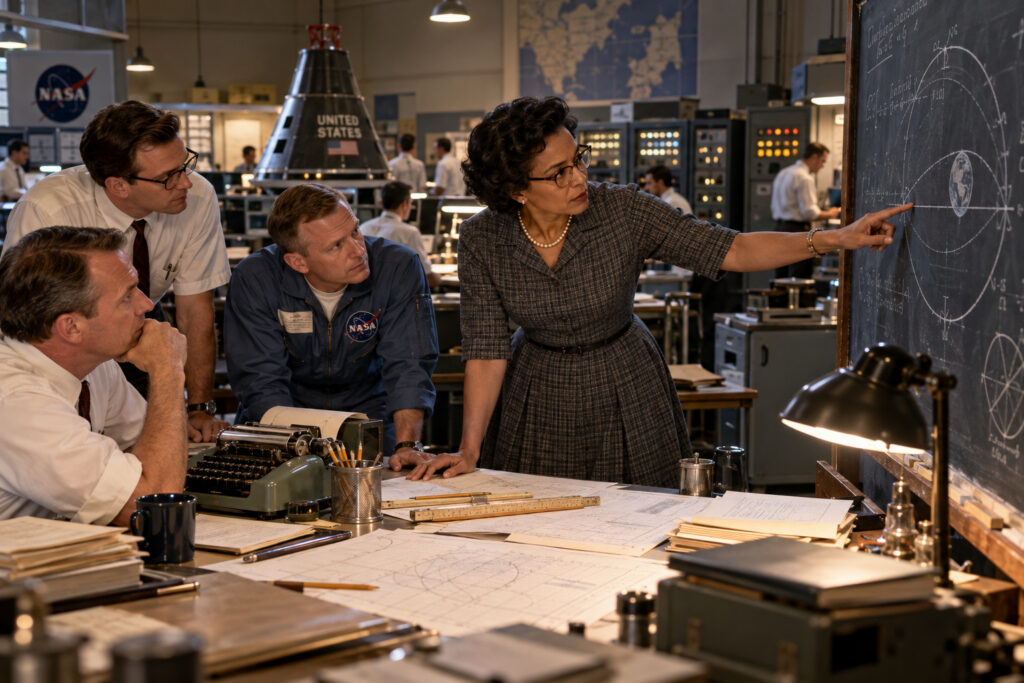
Quiet genius from West Virginia
Katherine Johnson was born in 1918 in White Sulphur Springs, West Virginia, and showed an early gift for numbers that carried her through a fast-tracked education. She finished college at a young age with degrees in mathematics and then spent years teaching before answering a different kind of call: in 1953 she joined the National Advisory Committee for Aeronautics (NACA), the predecessor to NASA, as a human “computer.” Her skill with analytic geometry and orbital mechanics would soon lift her beyond the desk work that most women at the center were assigned.
From hand calculations to mission-critical checks
At Langley Research Center Johnson moved into the group that handled flight trajectories and mission planning. Computers — both human and electronic — worked side by side, but the stakes were literal: lives and rockets depended on precise numbers. Johnson calculated launch and re-entry trajectories, windows for Earth-orbit rendezvous, and the kind of step-by-step procedures that let pilots and engineers know where the capsule would be at each second of a mission.
Her most famous moment came during the Mercury program. When astronaut John Glenn prepared to make America’s first orbital flight in 1962, he specifically asked that Johnson recheck the computer’s trajectory calculations by hand. She did, and he went up. That request was not celebrity theater; it was a vote of confidence in the quiet accuracy of paper, pencil, and experience standing alongside new electronic methods.
Beyond Mercury: Apollo, Skylab, and an enduring footprint
Johnson continued to work on increasingly complex problems. Her work supported later projects that involved lunar missions and space station planning, and she contributed to procedures that would help when missions encountered emergencies. Over the decades her calculations fed into the transition from manually plotted courses to the software-driven navigation that dominates aerospace today, but engineers repeatedly relied on her mathematical judgment during the era of development.
Conclusion
Katherine Johnson’s life ended in 2020, but her legacy is concrete: trajectories that launched people into orbit, calculations that helped bring them home, and a career that quietly pushed the boundaries of who was considered essential to the space program. In 2015 she received the Presidential Medal of Freedom, and her story reached a wider public through the book and film Hidden Figures. For anyone who imagines spaceflight as pure hardware, Johnson’s work is a reminder that some of the most decisive engines are the human minds doing the arithmetic.