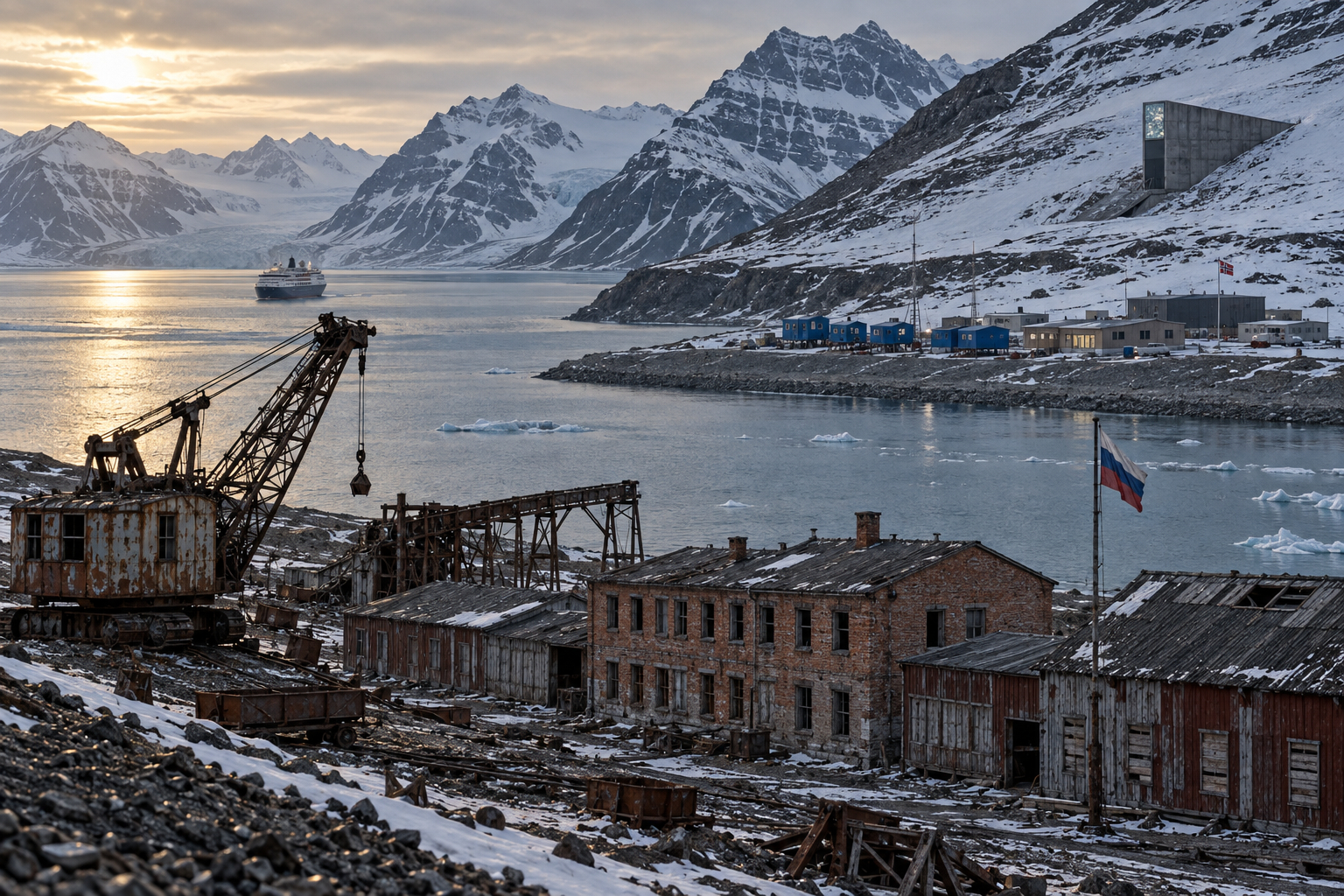
Point a map at the Arctic and you find Svalbard: a scattering of islands three hundred miles north of mainland Norway, with Spitsbergen the largest and Longyearbyen its main town. What looks like a bleak stretch of tundra and jagged fjords is, in fact, a curious experiment in sovereignty. After World War I the Svalbard Treaty of 1920 put the archipelago under Norwegian rule but granted citizens of treaty signatories equal rights to live and work there. The result has been an unusually international outpost where Norwegians, Russians, scientists and tourists all make overlapping claims on the same little slice of the High North.
Coal, Cold War echoes, and frozen towns
Life in Svalbard was shaped for decades by coal. Longyearbyen itself began as a coal company town in the early 1900s, named after the American entrepreneur John Munro Longyear who set up mining there. Nearby settlements tell the rest of the story: Barentsburg remains a Russian-run mining community, while Pyramiden, once a Soviet showpiece, now stands preserved and eerily intact after being abandoned in 1998. Ny-Ålesund transformed from a coal outpost into one of the world’s northernmost research villages.
These places carry Cold War echoes without the front lines: Russian and Norwegian flags fly within sight of one another, and practical cooperation—shared rescues, joint environmental monitoring—has often mattered more than ideology. The practical demands of Arctic life also left their mark: hunters, engineers and miners learned to read crevasse lines and iceberg currents as keenly as commodity prices.
Science, seeds, and the politics of melt
In recent decades the archipelago’s story has shifted from coal to science and tourism. Ny-Ålesund hosts international research stations studying everything from polar atmospheres to migratory birds. A much more public symbol arrived in 2008: the Global Seed Vault, carved into permafrost to hold duplicate samples of crop seeds from around the world. It is a literal Arctic insurance policy—an acknowledgement that what happens here matters far beyond the fjords.
That mattering is increasingly immediate. Warming in the Arctic runs faster than the global average, and scientists stationed on Svalbard are watching glaciers retreat, permafrost wobble, and ecosystems change. Cruise ships now thread the same waters that once served only whalers and supply boats, bringing visitors who come for midnight-sun hikes, polar-bear sightings and the odd contrast of neon-blue research huts beside rusting mining cranes.
Conclusion
Svalbard reads like a condensed history of the modern North: extraction and empire, Cold War positioning, scientific urgency and global cooperation. Its settlements—active, abandoned and repurposed—are more than curiosities. They are reminders that a handful of islands can host competing claims, practical collaborations, and ideas about the planet’s future, all under the long, cold arc of the Arctic sky.