
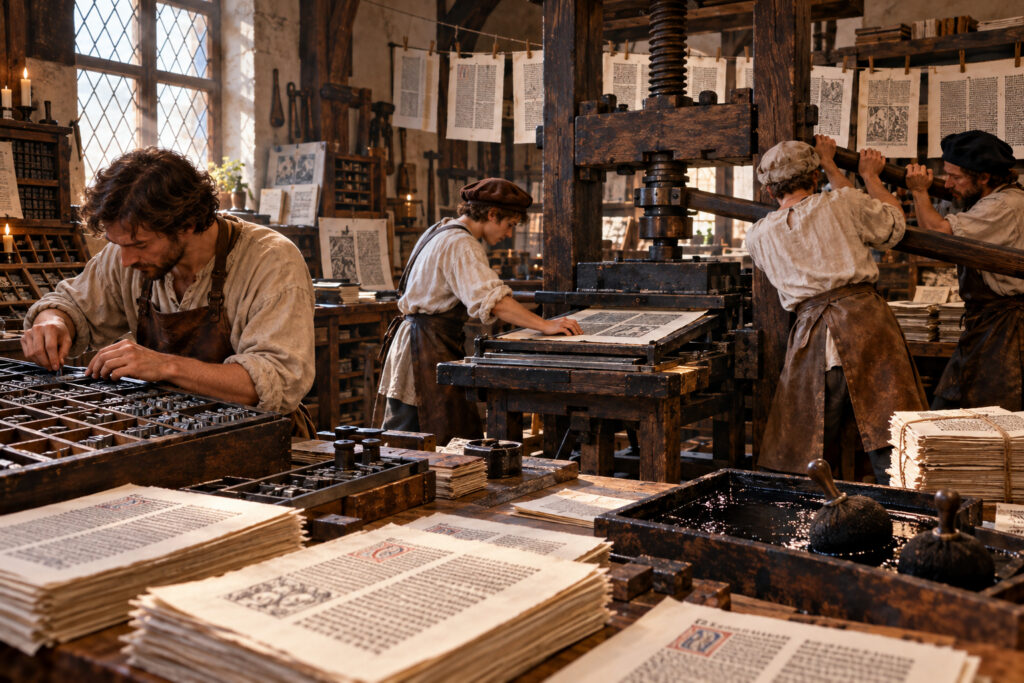
A press that fit in a workshop
Around the mid-15th century, in Mainz, a handful of craftsmen turned a handful of improvements into something bigger than any of them expected. They pulled together oil-based ink, a wooden screw press adapted from wine-making, and durable metal type that could be reset and reused. The result was not just a faster way to copy books; it was a technology that made reproducible, identical texts affordable for the first time in European history. One of the earliest—and most famous—products was the Gutenberg Bible. It announced, in precisely printed pages, that books would no longer be unique treasures produced slowly by hand.
Cheap words, loud arguments
What the new presses produced first was not only devotional tomes but pamphlets, broadsides, and cheaply printed images. These were the viral media of their day. News, political satire, and religious polemic could travel far faster than any manuscript. The 16th century shows the effect plainly: Martin Luther’s pamphlets and translated Bible passages circulated across German lands and beyond, carried by dozens of presses rather than by a few copyists. Printers supplied the raw material of public debate—short, punchy texts that could be sold in markets and read aloud in taverns.
Maps, manuals, and national tongues
Movable type did more than speed polemics. It made technical knowledge portable. Cartographers issued more accurate maps, surgeons and astronomers printed annotated diagrams, and explorers’ accounts reached readers hungry for news of distant coasts. Repeated printing meant words began to settle; printers favored particular spellings and phraseology. Over generations that quiet standardization helped forge recognizable national languages out of regional dialects. Where a manuscript culture left many local varieties, printed books created habits—shared vocabularies and often shared ideas about what counted as authoritative information.
Conclusion
The printing press did not remake Europe overnight. It did not instantly make everyone literate or erase local differences. But it provided the scaffolding for faster intellectual exchange, for wider argument, and for forms of authority that depended on reproducible texts. Legal codes, religious controversies, maps, and scientific diagrams all took on new lives once they could be printed, copied, and redistributed. The era of movable type is, in that sense, the first phase of a media transition whose echoes—standardized language, mass political debate, and rapid technical diffusion—still shape how we read the world today.