
It begins with a paradox: rulers who started life as exotic recruits and household slaves. The term “mamluk” simply means someone who was owned, usually a young man taken from the Eurasian steppe or the Caucasus, trained as a mounted warrior, converted to Islam and bound to a patron. In the chaos after the Ayyubid dynasty faltered, those trained soldiers seized power in Egypt and Syria. Their rule, roughly from the mid-13th century until the early 16th, was not a brief hiccup but a durable political order built on military service, patronage networks and surprisingly elaborate state institutions.
Cairo: Markets, Monuments, and Everyday Life
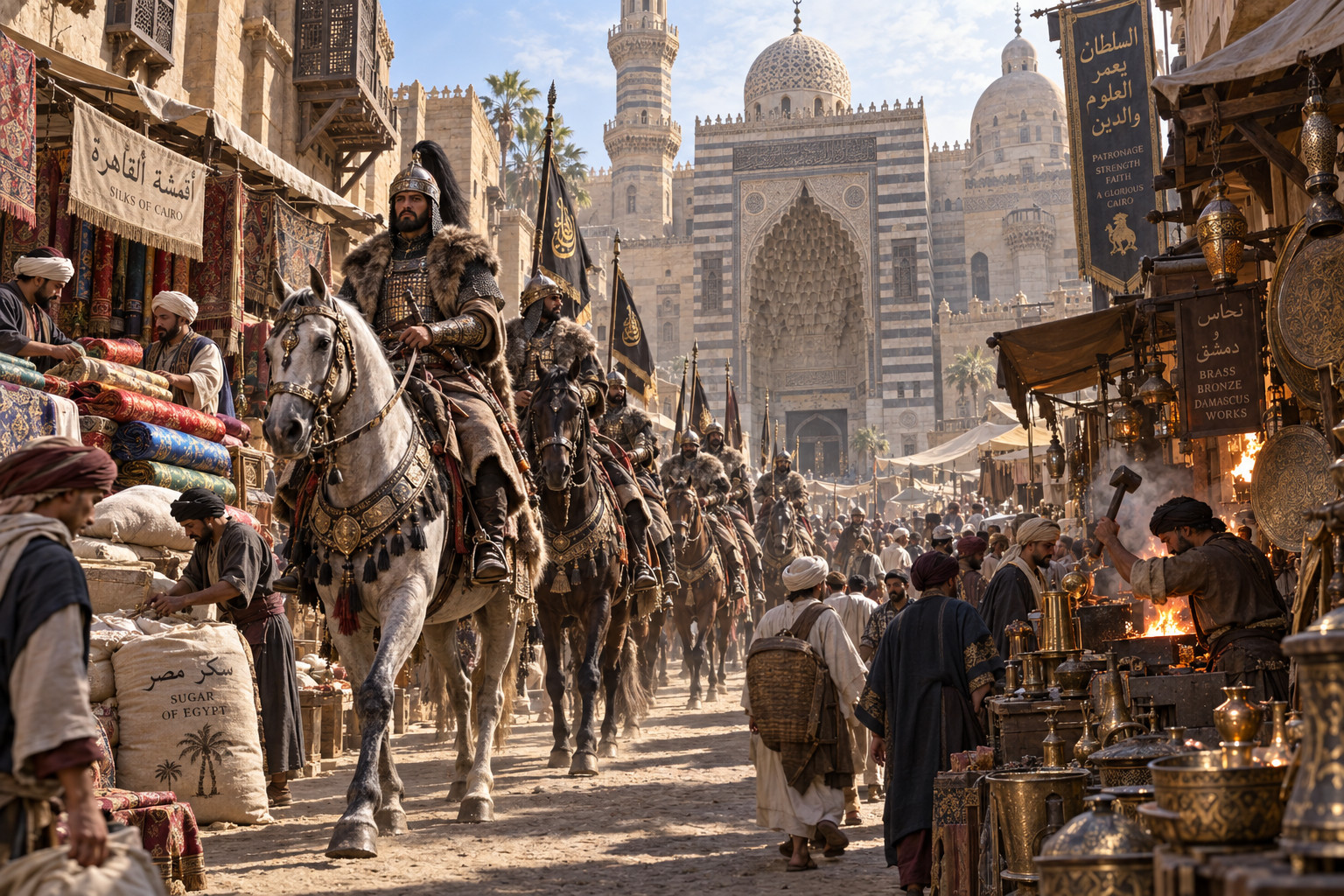
Cairo under the Mamluks felt like a city in motion. Caravan traffic funneled spices, textiles and sugar through its ports and bazaars; European merchants still arrived at Levantine harbors to barter for Eastern goods. Wealth translated quickly into stone. Mamluk sultans and emirs commissioned towering madrasa-mosque complexes, vaulted tombs and fortified hospitals that reshaped the skyline. Those buildings were practical displays of power: a charitable kitchen fed the poor, a school taught law and theology, and a mosque anchored a patron’s memory.
Daily life mixed the ordinary with the spectacular. Markets sold incense and silk beside more commonplace foods; craftsmen maintained workshops for metalwork and glass that later collectors prize. The elite lived in closely guarded palaces, their politics dominated by the circulation of mamluk households—promotions, marriage alliances, and the ever-present risk of palace coups.
War, Diplomacy, and the Wider World
The Mamluks made their name on the battlefield. They halted the Mongol advance at the Battle of Ain Jalut and later drove the remaining Crusader states from the Levant, a process that culminated with the capture of coastal strongholds in the late 13th century. Their armies were heavy cavalry led by commanders who had risen from slavery into rulership—an unusual social ladder for the medieval world.
Beyond fighting, the Mamluk state mastered diplomacy and trade. They governed the land routes linking the Mediterranean with the Red Sea and tried to control the flow of pilgrims to Mecca. The mid-14th-century plague and shifting trade patterns strained their revenues and changed recruitment patterns, but institutions proved resilient. Eventually, the rising Ottoman Empire absorbed their territories in 1517, ending a distinctive chapter of Near Eastern history.
Conclusion
The Mamluk era is a study in contradictions: an order born of servitude became a bastion of urban culture, military prowess and architectural patronage. Their legacy lingers in Cairo’s medieval monuments and in a political model—rule by professionalized soldiers—that shaped the eastern Mediterranean long after their banners fell. For a world where lineage often determined fate, the Mamluks showed a different path from slave to sovereign.