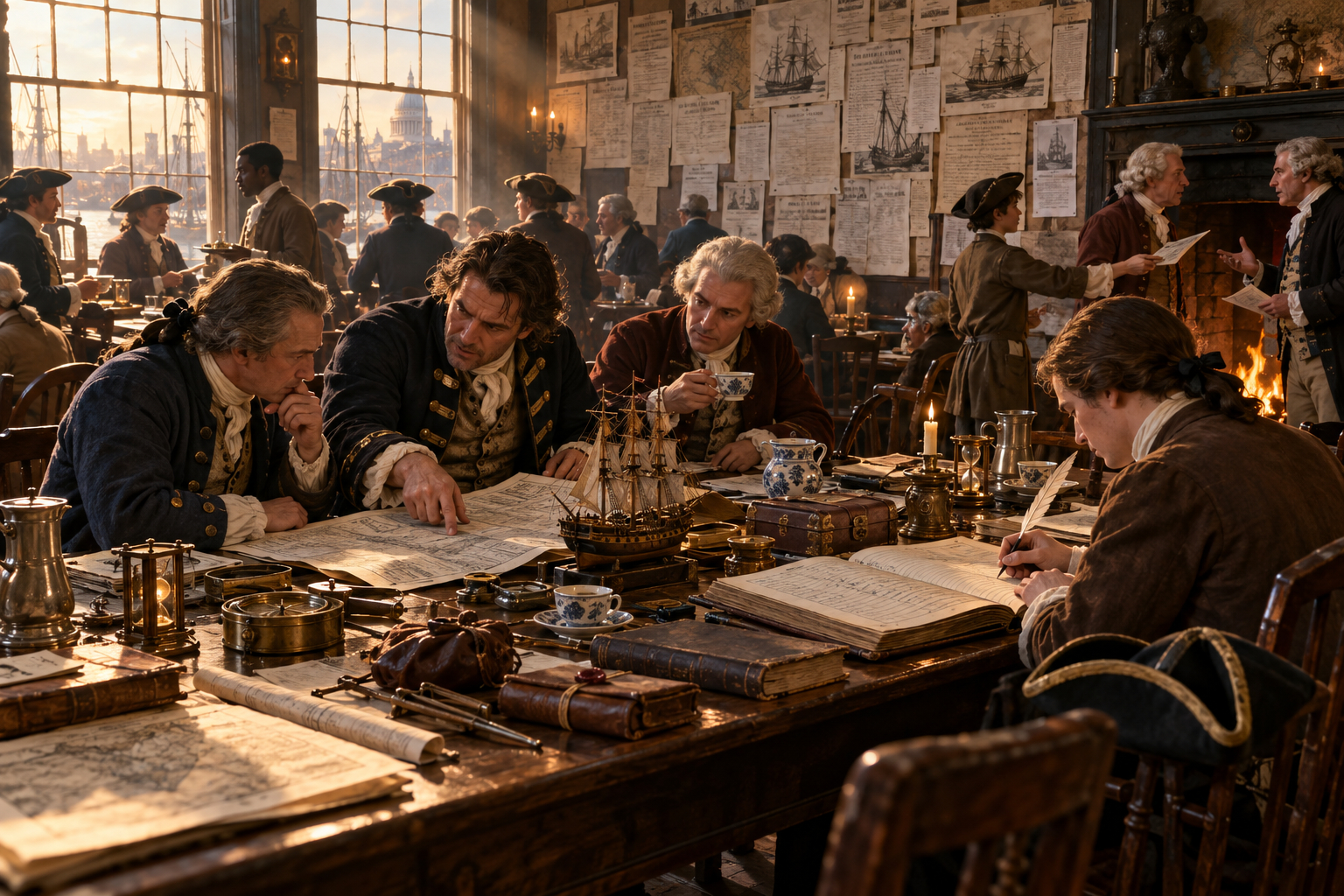
Call it roughly 1688 to 1815 and you get the texture: a world of crowded ports, clattering presses, and new urban meeting places where strangers discussed news, credit and politics over a cup of something hot. That span—often called the Long Eighteenth Century—was not a tidy block of identical years but a recognizable pattern of accelerating commerce, expanding information networks, and social experiments that remade everyday life across Europe and the Atlantic.
Step into a London coffeehouse and you encountered more than beverage. Places like Lloyd’s collected shipping news and led to organized marine insurance; others functioned as exchanges for bills, jobs and ideas. Newspapers multiplied. Printers turned pamphlets and trial reports into bestsellers. This was an era when timely information became money—a small but decisive shift from earlier centuries.
Trade, Silver, and the Consumer Revolution
Goods mattered. Sugar and rum, tea and tobacco, calicoes and porcelain flooded markets and changed domestic routines. The rising demand for these products drove new trading routes and financial instruments. Spanish American silver—flowing from places like Potosí—underpinned prices and credit, while British and Dutch merchants refined techniques of credit, insurance and joint-stock ventures that made larger-scale trade feasible.
Behind the headlines of empires were quieter engineering feats: canals, improved roads and better ship design shortened transit times and lowered costs. The 1760s saw the first modern canal projects in England, rearranging how coal, grain and manufactured goods moved and making urban growth more sustainable. These infrastructural changes helped set the stage for later industrial expansion.
Politics, Clubs, and Revolutions
Political life changed too. Salons in Paris, debating clubs in London, and provincial reading societies encouraged people to read, share and argue. That culture nourished political movements: the American Declaration of 1776 and the French Revolution of 1789 are the era’s dramatic pinnacles, but they grew from a longer diffusion of political vocabulary—liberty, rights, representation—that had circulated in pamphlets and coffeehouse debates for decades.
Not every experiment succeeded. Slavery and imperial violence were integral to the era’s prosperity; the profits of trade and plantation economies sat uneasily beside emerging ideas of human rights. These tensions would push politics in new directions through the nineteenth century.
Conclusion
The Long Eighteenth Century feels like a rehearsal for the modern world: faster information, mass markets, and political language spreading beyond courts into public spaces. Its distinctive combination of people meeting in public rooms, merchants connecting ports across oceans, and printed ideas leaping social boundaries produced both new opportunities and stark contradictions. Look closely and you see how ordinary things—tea, a newspaper, a canal toll—helped reshape societies on a global scale.