
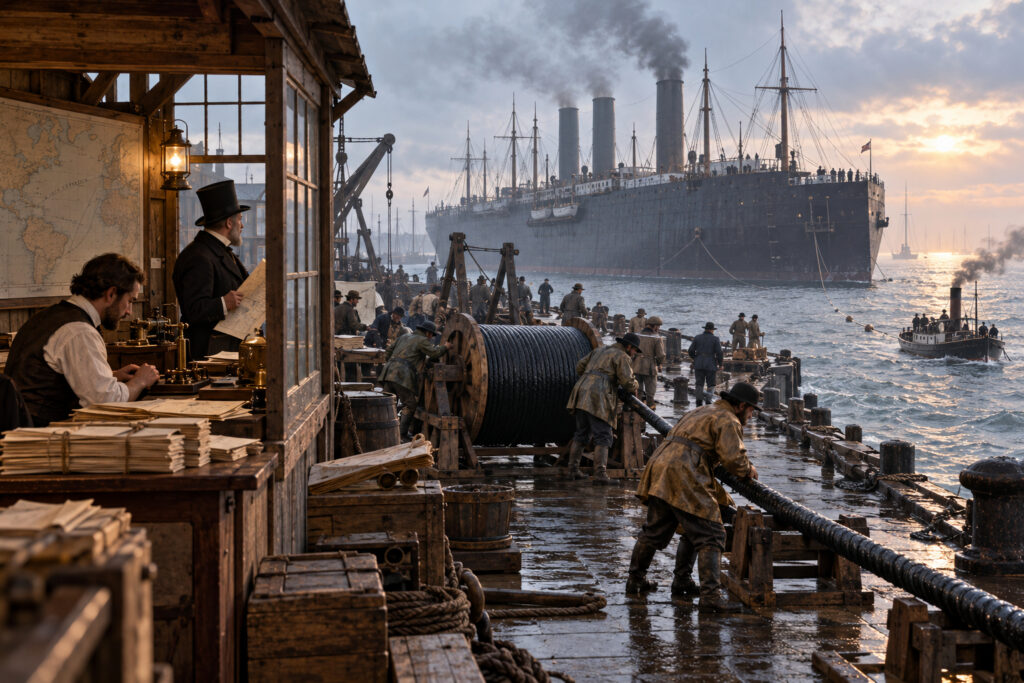
Before the telegraph, news crossed oceans by ship and rumors by mouth. In the 1840s, electric signals sent over wire changed that. Inventors and entrepreneurs—most visibly Samuel Morse in the United States—turned dots and dashes into a language for commerce and statecraft. A single line linking two cities meant a message that once took days or weeks could now travel in minutes. For newspapers, insurance underwriters, and merchants, that was nothing short of revolutionary: information stopped being local and began to move like capital.
The cable that refused to wait
Connecting continents was both a technical feat and a test of will. Private firms and financiers backed expeditions to lay undersea cable across the Atlantic. The first 1858 transatlantic cable transmitted a burst of messages but failed quickly; it was the 1866 cable, laid with the help of the steamship Great Eastern and organized by figures such as Cyrus Field, that proved durable. With a working ocean link, governments could exchange dispatches, newspapers could print foreign bulletins the same day, and business travelers stopped being the sole carriers of market intelligence. The speed of diplomacy changed: negotiators, warrooms, and stockbrokers all had to reckon with news that arrived almost instantly.
Everyday rhythms, costs, and limits
The telegraph did not make communication free or universal. Messages were billed by the word; brevity became a virtue and a style. That economy of language shaped headlines, telegram etiquette, and even how tragedies or celebrations were reported. At the same time, telegraph lines enforced new uniformities: railroads and telegraph companies worked together to standardize clocks across regions, a step toward the time zones that rail schedules later cemented.
Practically, telegraphy remade organizations. News agencies pooled wiring costs; the Associated Press and Reuters expanded their reach because the telegraph let them distribute dispatches quickly and widely. Armies and colonial administrations used telegraph lines for command and control, which made centralized decisions faster but also introduced dependencies—cut a line and an entire front could be blinded.
Conclusion
By turning distance into latency rather than isolation, the telegraph rewired nineteenth-century life. It accelerated commerce, hurried diplomacy, and reframed what counted as up‑to‑date. It was neither democratic nor instantaneous by modern standards, but it laid the physical and organizational groundwork for the global networks that followed: telephone, radio, and, eventually, the internet. The nineteenth century’s long wires were the first threads of a world that would learn to move its news, money, and power at the speed of electricity.