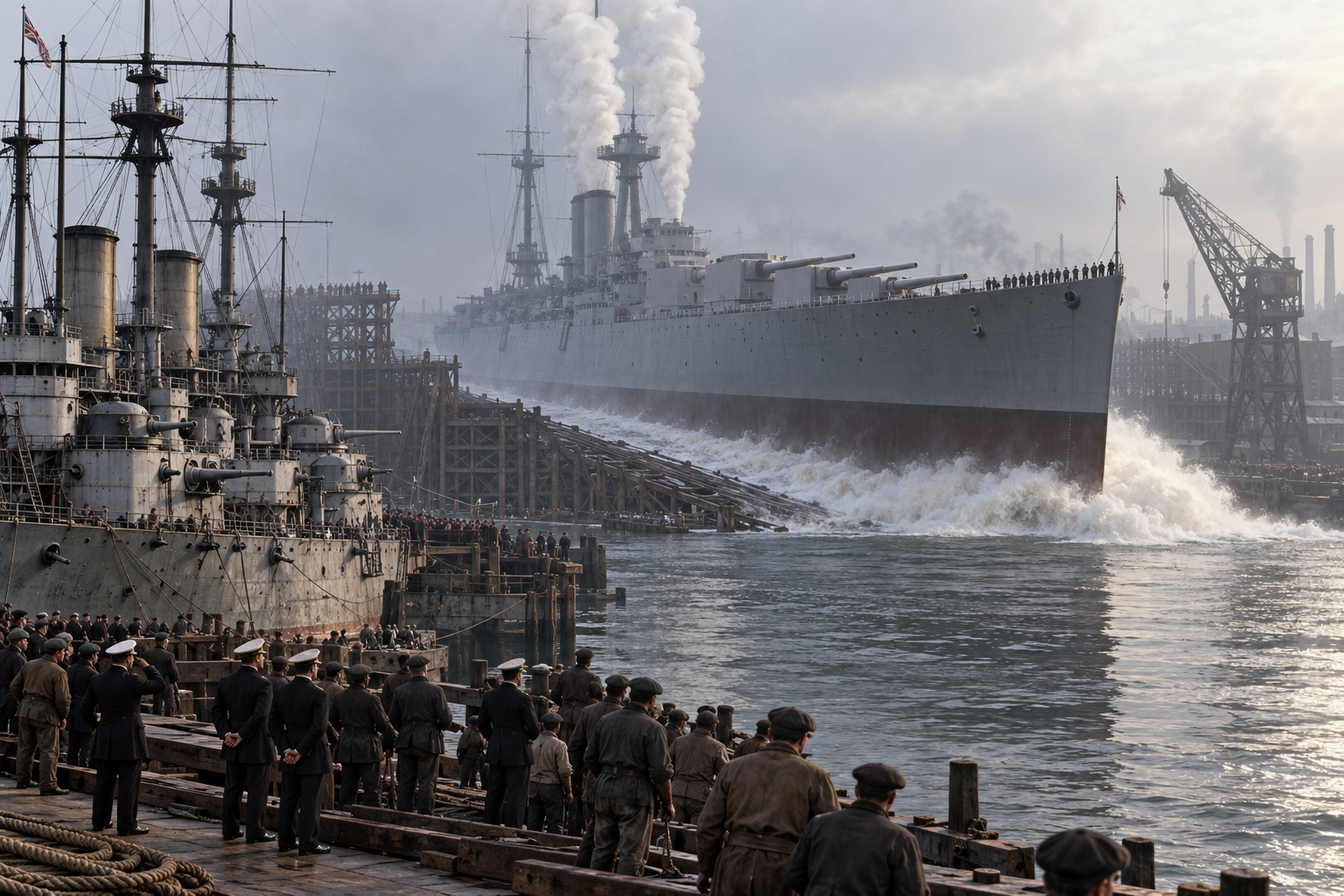
When the Royal Navy put HMS Dreadnought into service in 1906, it was not merely another new battleship; it represented a sudden jump in what a capital ship could do. Two design choices mattered most. First, Dreadnought adopted steam turbines instead of older reciprocating engines, giving her sustained speeds that outpaced nearly all existing battleships. Second, she embraced the “all-big-gun” layout: a uniform main battery of heavy guns, optimized for long-range gunnery rather than a mixed array of calibers. Those changes let Dreadnought fire heavier broadsides at longer range and close with or outrun opponents on different tactical terms.
Obsolescence and an arms race
The practical effect was immediate. Overnight, pre-dreadnought battleships—workhorses built to a slower, mixed-gun formula—were declared functionally outmoded. Navies from Tokyo to Rio scrambled to build their own dreadnoughts or risk falling behind. The new standard shifted the center of naval planning: speed, gun range, gunnery accuracy, and armor distribution replaced older concerns about a ship’s mixed-caliber punch.
That scramble had political and economic consequences. Building a modern dreadnought was expensive and symbolically potent: numbers mattered as much as capability. In Europe, the Royal Navy’s lead and Germany’s desire to match it fed into a wider strategic rivalry that helped make sea power a public obsession—parades, newspapers, parliamentary debates, and budget fights all focused on who could display the most dreadnoughts.
Limits, lessons, and legacy
Yet the dreadnought’s triumph did not settle naval history forever. The First World War showed both the strengths and the vulnerabilities of big-gun fleets. Fleet engagements such as Jutland confirmed that dreadnoughts dominated traditional line-of-battle thinking, but submarines, mines, and later aircraft revealed new threats that heavy armor and big guns could not easily defeat. After the war, the sheer cost and continuing threat posed by new technologies pushed governments toward arms-control efforts—most notably the Washington Naval Conference of 1921–22, where tonnage limits and building freezes sought to cap the dreadnought race.
Even as battleships faded from frontline supremacy in the mid-20th century, the term “dreadnought” survived as shorthand for decisive naval power. The era it named reshaped navies’ procurement, training, and strategy, and it altered how states measured prestige and security at sea.
Conclusion
The Dreadnought era was brief but decisive: a single ship’s configuration remade fleets, budgets, and national ambitions. It taught navies that technological leaps could render whole inventories obsolete almost overnight—and that sea power, like much else in the modern age, would be defined as much by industrial capacity and political will as by tactics at sea.