Uncover History’s Secrets with Daily Updates!
Daily News Entertainment
  • Home
  • History
  • Biographies
  • Eras
  • Regions
  • Timeline
No Result
View All Result
History Ours
  • Home
  • History
  • Biographies
  • Eras
  • Regions
  • Timeline
No Result
View All Result
History Ours
No Result
View All Result
Home History

Domestic Thresholds and Community Ties in Market Towns

in History
Domestic Thresholds and Community Ties in Market Towns

Doorways, windows, and shopfronts acted as everyday thresholds that shaped how residents experienced market towns. These material edges mediated trade, conversation, and privacy in streets where domestic life and commerce overlapped. Studying thresholds reveals routines of arrival, display, and retreat that historians often overlook. Paying attention to these small architectural moments helps explain how communities negotiated public and private worlds.

Thresholds as Material Borders

Physical thresholds—steps, lintels, and thresholds themselves—marked transitions between house and street and signaled social expectations. Craftspeople customized entrances to communicate status, occupation, or kinship, while simple repairs could indicate economic strain. In many towns thresholds also served practical functions: they kept out mud and animals or offered space for short-term exchanges. Over time these material features accumulated meaning beyond their functional use.

Because thresholds were fixed and visible they shaped interactions predictably. Neighbors learned where to pause, whom to address, and how to leave goods for pickup without entering a home. These routines became part of a town’s social grammar.

Negotiating Visibility and Privacy

Windows and shopfronts created overlapping sightlines between domestic interiors and public ways, producing a managed visibility. Shopkeepers adjusted displays to attract customers while family life continued immediately behind glass or curtains. Residents developed signals—curtains, lamps, or positioned benches—that regulated exposure without shutting communities off. Such practices allowed households to balance economic necessity with a desire for privacy.

This negotiation extended to movement patterns: children played close to thresholds, couriers timed deliveries for quieter hours, and acquaintances used doorway greetings to limit intrusion. These small protocols kept social order in busy marketplaces.

Markets, Homes, and Communal Care

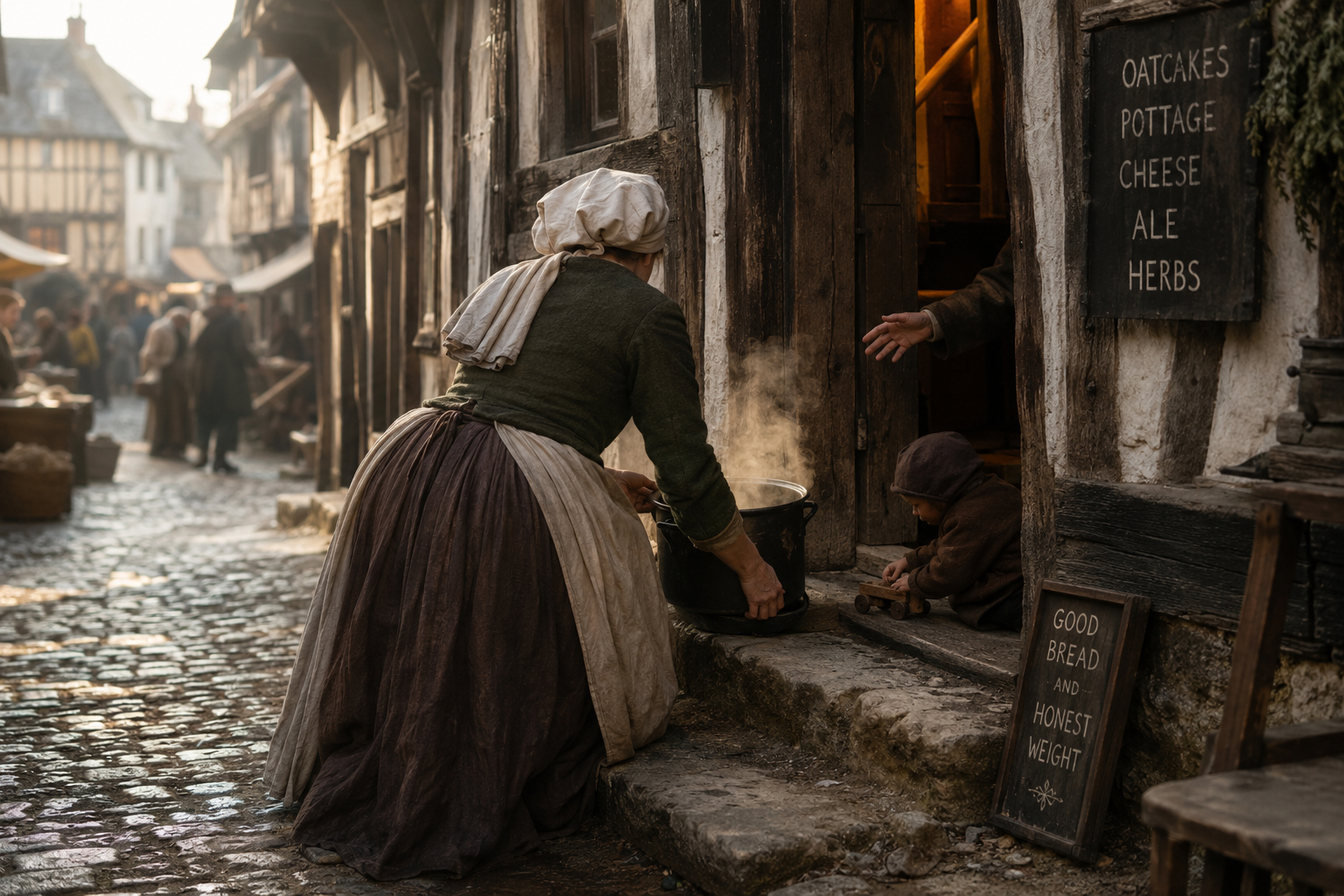
Market days intensified the role of thresholds as places of exchange and mutual aid, where surplus, gossip, and information passed between households. Domestic spaces doubled as staging areas for goods, hospitality, and informal credit, binding households in reciprocal networks. When neighbors left a pot of stew or took in a sick child, it was often through the ease of a familiar doorway. The architecture of thresholds thus supported practical forms of care.

Over years, rituals around entrances—seasonal decorations, shared repairs, or collective street cleaning—reinforced neighborhood ties. These small collective acts sustained resilience in times of shortage and shaped communal identity.

Conclusion

Thresholds were more than architectural details; they structured daily life and social relations. By tracing how people used doorways, windows, and shopfronts we recover hidden dynamics of community. Small thresholds reveal big stories about belonging and everyday cooperation.

Previous Post

Rhythms of Shared Spaces in Historic Town Life

Next Post

Mapping Lives from Sparse Historical Evidence

Related Posts

John Snow, the Broad Street Pump, and Cholera’s Fall
History

John Snow, the Broad Street Pump, and Cholera’s Fall

October 29, 2026
The Vasa: Sweden’s Giant Ship That Couldn’t Sail
History

The Vasa: Sweden’s Giant Ship That Couldn’t Sail

October 29, 2026
The Ghost Army: How Artists Fooled Hitler’s Front
History

The Ghost Army: How Artists Fooled Hitler’s Front

October 24, 2026
How Iceland’s 1783 Laki Fissure Eruption Chilled an Age
History

How Iceland’s 1783 Laki Fissure Eruption Chilled an Age

October 24, 2026
Next Post
Mapping Lives from Sparse Historical Evidence

Mapping Lives from Sparse Historical Evidence

Search..

No Result
View All Result

Recent Articles

The Salon Era: How Conversation Shaped the Enlightenment

The Salon Era: How Conversation Shaped the Enlightenment

October 31, 2026
Tenement New York: Life in Vertical Slums, 1870–1910

Tenement New York: Life in Vertical Slums, 1870–1910

October 31, 2026
Mary Seacole: The Jamaican Nurse Who Went to War

Mary Seacole: The Jamaican Nurse Who Went to War

October 30, 2026
Ada Lovelace: The Poet Who Helped Imagine Modern Computers

Ada Lovelace: The Poet Who Helped Imagine Modern Computers

October 30, 2026
John Snow, the Broad Street Pump, and Cholera’s Fall

John Snow, the Broad Street Pump, and Cholera’s Fall

October 29, 2026

Subscribe Us

By clicking submit, I authorize History Ours and its affiliated companies to: (1) use, sell, and share my information for marketing purposes, including cross-context behavioral advertising, as described in our Terms of Service and Privacy Policy, (2) supplement the information that I provide with additional information lawfully obtained from other sources, like demographic data from public sources, interests inferred from web page views, or other data relevant to what might interest me, like past purchase or location data, (3) contact me or enable others to contact me by email with offers for goods and services from any category at the email address provided, and (4) retain my information while I am engaging with marketing messages that I receive and for a reasonable amount of time thereafter. I understand I can opt out at any time through an email that I receive, or by clicking here

Subscribe To Our Newsletter

By clicking submit, I authorize History Ours and its affiliated companies to: (1) use, sell, and share my information for marketing purposes, including cross-context behavioral advertising, as described in our Terms of Service and Privacy Policy, (2) supplement the information that I provide with additional information lawfully obtained from other sources, like demographic data from public sources, interests inferred from web page views, or other data relevant to what might interest me, like past purchase or location data, (3) contact me or enable others to contact me by email with offers for goods and services from any category at the email address provided, and (4) retain my information while I am engaging with marketing messages that I receive and for a reasonable amount of time thereafter. I understand I can opt out at any time through an email that I receive, or by clicking here.

© 2026 History Ours | All Rights Reserved

  • Contact Us
  • Privacy Policy
  • Terms of Service
  • Unsubscribe
  • Privacy Choices
  • Contact Us
  • Privacy Policy
  • Terms of Service
  • Unsubscribe
  • Privacy Choices

© 2026 History Ours | All Rights Reserved

No Result
View All Result
  • Home
  • History
  • Biographies
  • Eras
  • Regions
  • Timeline

© 2026 History Ours | All Rights Reserved

Skip to content
Open toolbar Accessibility Tools

Accessibility Tools

  • Increase TextIncrease Text
  • Decrease TextDecrease Text
  • GrayscaleGrayscale
  • High ContrastHigh Contrast
  • Negative ContrastNegative Contrast
  • Light BackgroundLight Background
  • Links UnderlineLinks Underline
  • Readable FontReadable Font
  • Reset Reset