
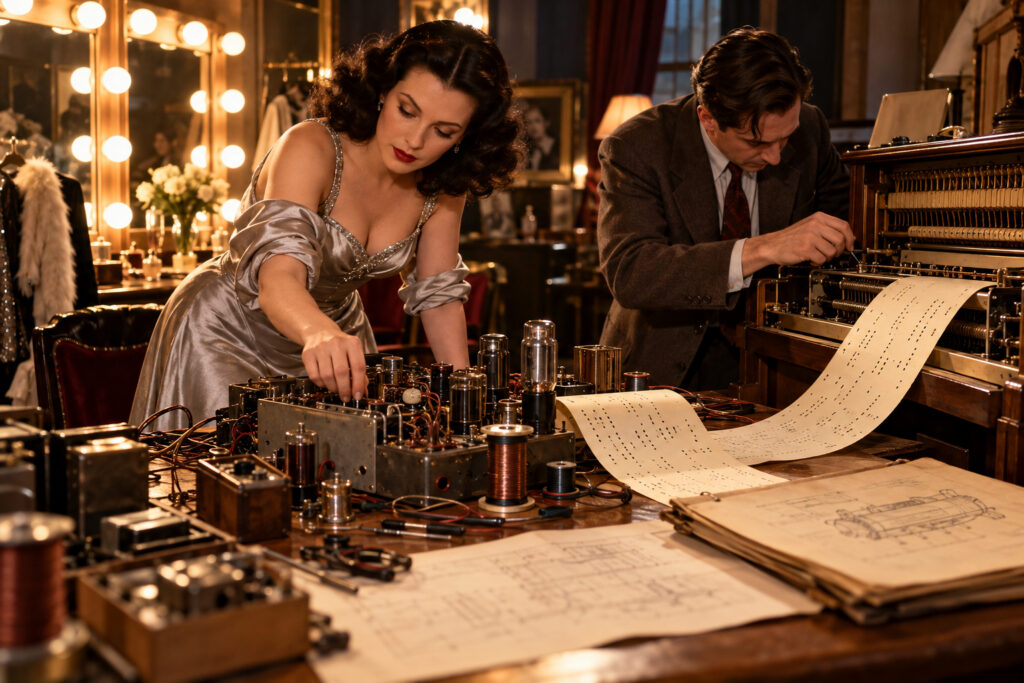
Born Hedwig Eva Maria Kiesler in Vienna in 1914, Hedy Lamarr became one of cinema’s most photographed faces while carrying a far less visible talent: a hunger for mechanical puzzles and engineering tricks. Her early stardom came after the controversial European film Ecstasy (1933), and by the late 1930s she was a fixture in Hollywood—films like Algiers and Ziegfeld Girl made her internationally known. Yet the studio gloss didn’t exhaust her restlessness. Behind the gowns and coiffure, she collected ideas and tinkered with gadgets when work was slow.
The unlikely inventor and a wartime idea
In 1940 Lamarr met George Antheil, an American composer famed for noisy avant-garde experiments with player pianos. The two found common ground: Antheil’s knowledge of synchronized mechanical systems and Lamarr’s interest in radio control led them to a practical problem of the time—radio-guided torpedoes could be jammed or intercepted. Together they conceived a transmitter and receiver that would hop between frequencies in sync, following a prearranged pattern. That way an enemy trying to jam one frequency would be left guessing the next.
Their proposal was technical and unusual: use a synchronized sequence—drawing on player-piano roll ideas—to change channels rapidly and keep both ends on the same page. Lamarr and Antheil filed for a patent in 1941; the U.S. patent for a “Secret Communication System” was granted in 1942. The Navy showed some interest but wartime electronics and bureaucracy meant the idea went largely unused at the time.
Legacy beyond the silver screen
That patent might have gathered dust if its core principle—spread-spectrum frequency hopping—hadn’t resurfaced decades later. Engineers refining secure and robust wireless systems in the 1950s and beyond found that Lamarr and Antheil’s concept addressed exactly the problems modern radio designers faced. Spread-spectrum techniques became important in military communications and later in consumer technologies; they are one conceptual ancestor of the methods that make Bluetooth and Wi‑Fi reliable in crowded airwaves.
Lamarr lived to see partial recognition. In 1997 she received an Electronic Frontier Foundation Pioneer Award, and institutions have since acknowledged her dual legacy: one as a glamorous film star, the other as an inventor whose idea outlived the era that first ignored it. She died in 2000, leaving a story that complicates the familiar Hollywood silhouette.
Conclusion
Hedy Lamarr’s life resists tidy categorization. She was both a product of studio glamour and an imaginative problem-solver who translated an unlikely pairing—composer and actress—into a concrete technical proposal. Her fame helped mask the fact that a woman in the movies had, in a modest patent, sketched a path toward technologies that now keep our phones and networks talking.