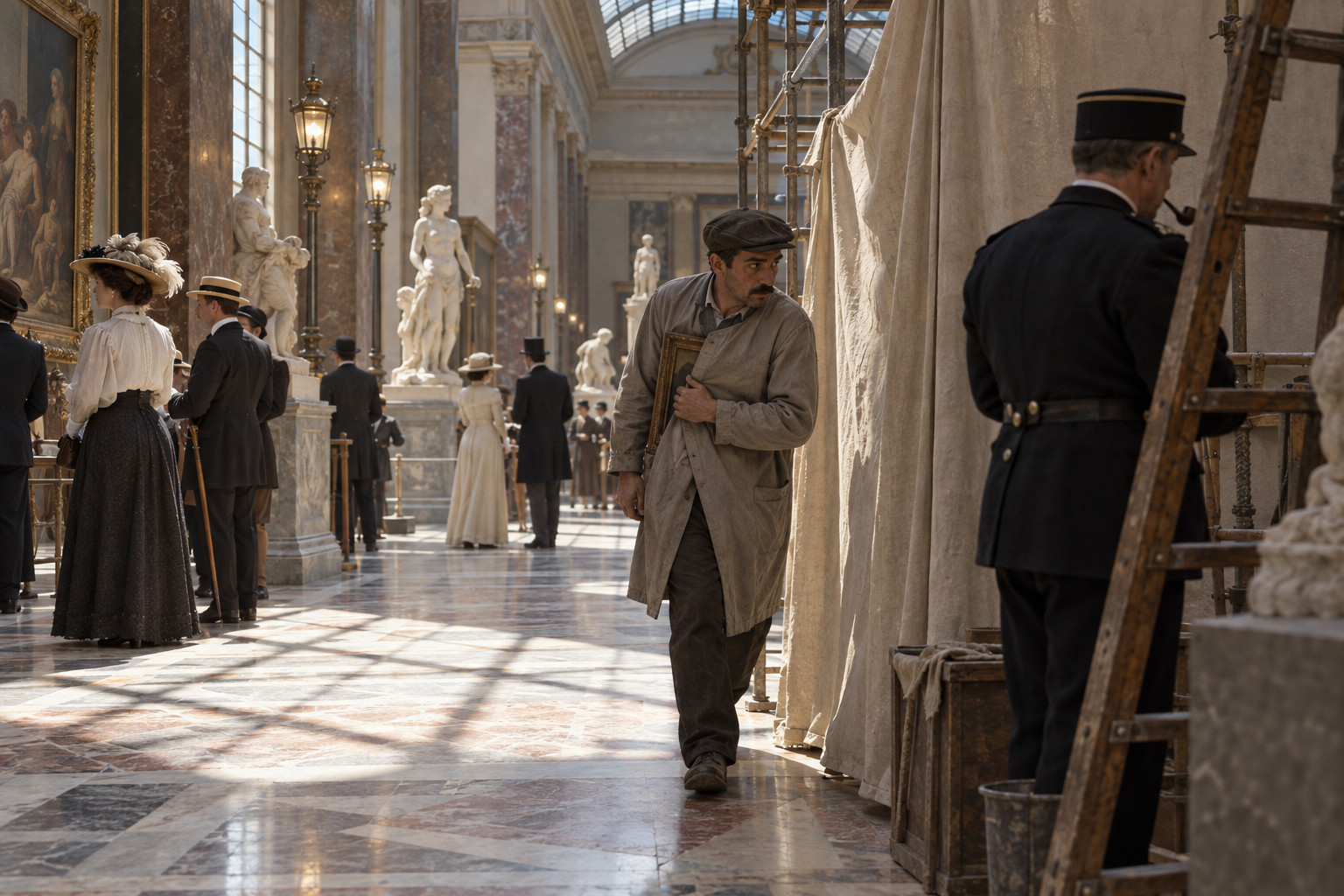
In 1911 the Mona Lisa was just another attraction among many in the Louvre’s vast galleries. Visitors admired Leonardo da Vinci’s small portrait, but it wasn’t yet the global icon it is today. The painting hung unprotected on a wall—not behind thick glass or a climate-controlled case—and the museum’s sprawling layout and routine practices left opportunities that a determined insider could exploit.
The Theft and the Usual Suspects
On a summer day in August 1911 an Italian glazier who had once worked at the Louvre slipped in and carried the painting away under a worker’s smock. The man, Vincenzo Peruggia, understood the building’s rhythms: where guards took smoke breaks, how curtains and scaffolding could hide a removal, what would look normal to a passerby. For two years he kept the panel in plain sight—hidden in his Paris lodgings—until he tried to sell it to an art dealer in Florence.
News of the disappearance ricocheted around Europe. Suspicion swept through Parisian artistic circles; poets and painters were dragged into police interviews. Guillaume Apollinaire and Pablo Picasso were questioned because of loose associations with a smaller, earlier theft. The confusion only magnified public fascination, and the Louvre’s reputation for complacent security was on full display.
Recovery, Trial, and the Making of a Myth
When Peruggia walked into an Italian dealer’s shop offering what he claimed was a repatriated Italian masterpiece, authorities were waiting. The painting returned to France amid headlines and a melodrama that the Louvre could not have purchased. Peruggia later framed his act as patriotic—he said he wanted the Mona Lisa to be in Italy —and Italian public opinion was unexpectedly sympathetic. At his trial he received a lighter sentence than many expected and returned home to something like popular notoriety.
More important than the legal aftermath was what the theft did to the painting’s reputation. While the Mona Lisa had always been admired by connoisseurs, its sudden disappearance and theatrical recovery turned it into a celebrity object. Newspapers reproduced photos and sketches; crowds flocked to see the painting when it returned, and museums around the world tightened security. The theft rewired how the public perceived art: the story surrounding an object could transform its cultural value almost overnight.
Conclusion
The Mona Lisa’s theft reads now like a plot twist in the biography of a work of art. A modest portrait became the world’s most famous painting not because Leonardo suddenly painted better, but because a daring theft, bungled investigations, and a hungry press rewrote its story. The episode left a practical legacy—improved museum security—and a lasting lesson: fame is often made as much by events around an object as by the work itself.