
On the morning of August 27, 1883, the volcanic island of Krakatoa in the Sunda Strait produced a sequence of explosions that remains one of the most violent events of the modern era. Columns of ash and hot gas collapsed back down the island, generating pyroclastic flows and enormous tsunamis. Entire coastal villages were overwhelmed; contemporary accounts and later estimates put the death toll in the tens of thousands, with many historians citing roughly 36,000 victims—caught by waves, surging hot clouds, or buildings collapsed beneath ash.
A sound travelers still talk about
Residents on shorelines within tens of miles reported blasts like cannon shots. Farther away the blast took on almost mythic scale. Contemporary observers described the explosion as deafening; scientists later called it one of the loudest sounds recorded in human history. Sensitive instruments—barographs—measured the enormous pressure wave produced by the blast. That wave was detected at stations around the globe, repeatedly passing by as it traveled, dissipated, then circled the Earth several times before fading.
Skies that painted the world
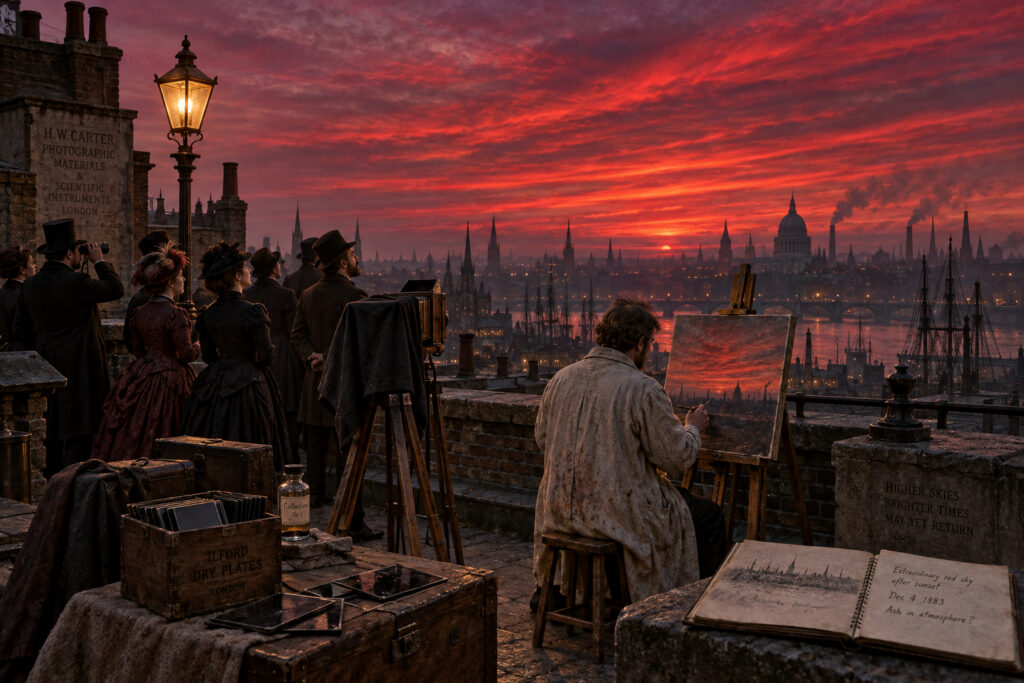
The eruption hurled ash and fine particles high into the stratosphere. These aerosol clouds scattered sunlight in unusual ways for months afterward. People from London to New York and across Europe began noticing strange twilight colors: deep crimsons, electric purples and long-lasting afterglows not seen since before color photography became common. Artists and photographers recorded dramatic skies; writers and scientists alike remarked on the global optical spectacle. Meteorological records show measurable changes in atmospheric opacity, and climate records indicate that global temperatures dipped for a few years as sunlight was partially blocked—enough to alter harvests and weather patterns in places far from Indonesia.
Aftershocks and a new island
Krakatoa’s 1883 explosions left a devastated caldera where an island had been. In 1927 a new volcanic cone—Anak Krakatau, “child of Krakatoa”—began to rise from the sea. It continues to be active, a living reminder of the drama that reshaped the region in 1883. The eruption’s legacy is both local and planetary: immediate human tragedy and a clear demonstration that a single geological event can ripple through atmospheres, oceans, and human communities around the globe.
Conclusion
The Krakatoa eruption is often remembered for spectacle—the roar that seemed to circle the planet, the sunsets that lit up continents. Yet it was also a hard lesson about vulnerability. In the space of hours a familiar landscape disappeared, entire towns were swept away, and the sky itself changed. More than a century later, Krakatoa remains a touchstone in our thinking about how quickly the Earth can remind us of its power.