
Uncover History’s Secrets with Daily Updates!
Daily News Entertainment
  • Home
  • History
  • Biographies
  • Eras
  • Regions
  • Timeline
No Result
View All Result
History Ours
  • Home
  • History
  • Biographies
  • Eras
  • Regions
  • Timeline
No Result
View All Result
History Ours
No Result
View All Result
Home History

Mary Anning and the Coast That Revealed Lost Worlds

in History
Mary Anning and the Coast That Revealed Lost Worlds

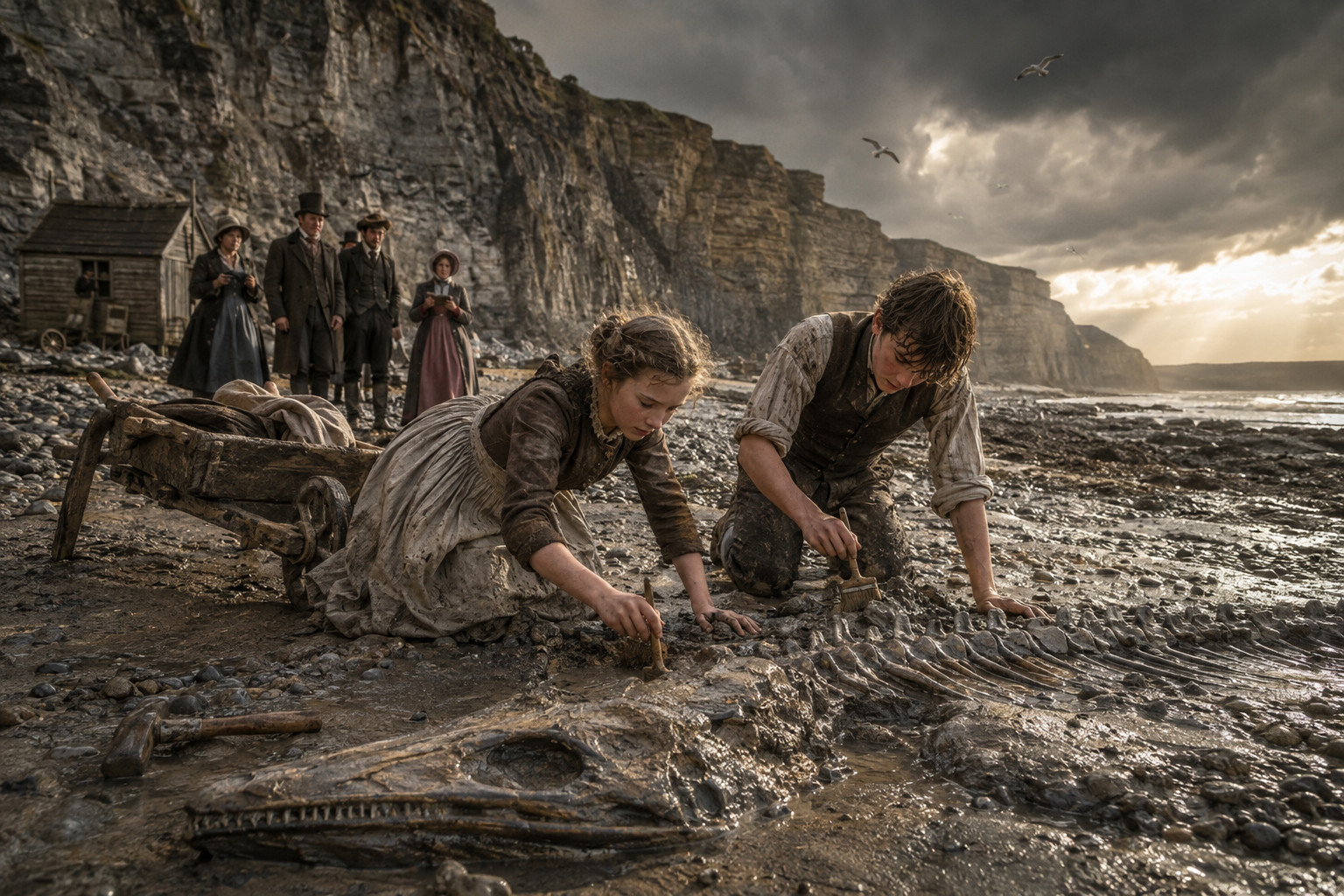
Mary Anning grew up among the collapsing cliffs of Lyme Regis on England’s Jurassic Coast. Her family sold fossils to tourists to make ends meet, and as a child she began combing the strandline for oddly shaped bones. After a storm in 1811 she and her brother uncovered a large skull—what would turn out to be an ichthyosaur. That discovery, made when she was still a girl, pulled her into a world of collectors, naturalists, and the brittle business of selling curiosities to survive.

Plesiosaurs, pterosaurs, and scientific ripples

Mary kept working the cliffs. In 1823 she found a nearly complete skeleton of a long-necked creature that astonished Victorian scientists: a plesiosaur. Later she uncovered one of Britain’s first pterosaur fossils. The specimens themselves were spectacular, but their real consequence was intellectual. These finds supplied tangible evidence that Earth had hosted animals very different from anything alive today—a hard, visible contribution to early debates about extinction and the deep history of life.

Because Mary was a working-class woman without formal scientific training, the names attached to those fossils were often the male geologists who described them in print. Still, the experts relied on her skill: she prepared bones, recognised unusual anatomy in the field, and knew where the cliffs would yield the next specimen. Artists and scientists used her discoveries as raw material; Henry De la Beche’s influential watercolor Duria Antiquior was inspired by fossils she brought to light and helped popularise ancient scenes reconstructed from her finds.

Recognition, hardship, and a lasting legacy

Fame never meant comfortable security. For most of her life Mary continued to sell fossils and weathered chronic illness and poverty. In 1838 the government granted her a small pension, a rare official nod for someone of her background and gender, but broad professional recognition lagged behind. The Geological Society excluded women from its meetings; much of the credit for discoveries landed in publications written by men.

After her death in 1847 the scientific value of the fossils she had unearthed only grew. Museums kept the bones she found; they became reference points for paleontology as the discipline matured. Today Mary Anning is remembered not as a quirky curiosity hunter but as a central figure whose careful collecting on a dangerous stretch of coast materially changed how scientists understood Earth’s ancient past.

Conclusion

Mary Anning’s story sits at the intersection of grit, curiosity, and social limits. The cliffs of Lyme Regis supplied her objects of study; her work helped build a new story of life on Earth. That combination—practical skill plus discoveries that forced scientists to rethink long-held assumptions—explains why her name endures in the history of science.
Previous Post

When Mount Pelée Erased Saint-Pierre, 1902

Next Post

Chien‑Shiung Wu: The Physicist Who Proved Parity’s Failure

Related Posts

Anne Bonny: The Pirate Who Broke Rules and Expectations
History

Anne Bonny: The Pirate Who Broke Rules and Expectations

September 15, 2026
How the Crystal Palace Turned Glass and Iron into a Modern Stage
History

How the Crystal Palace Turned Glass and Iron into a Modern Stage

September 15, 2026
When Mount Pelée Erased Saint-Pierre, 1902
History

When Mount Pelée Erased Saint-Pierre, 1902

September 15, 2026
When London Walked on the River: Thames Frost Fairs
History

When London Walked on the River: Thames Frost Fairs

September 15, 2026
Next Post
Chien‑Shiung Wu: The Physicist Who Proved Parity’s Failure

Chien‑Shiung Wu: The Physicist Who Proved Parity's Failure

Search..

No Result
View All Result

Recent Articles

The Disguise That Broke Chains: Ellen and William Craft

The Disguise That Broke Chains: Ellen and William Craft

September 15, 2026
Bass Reeves: The Marshal Who Hunted Outlaws in Indian Territory

Bass Reeves: The Marshal Who Hunted Outlaws in Indian Territory

September 15, 2026
How the Crystal Palace Turned Glass and Iron into a Modern Stage

How the Crystal Palace Turned Glass and Iron into a Modern Stage

September 15, 2026
Anne Bonny: The Pirate Who Broke Rules and Expectations

Anne Bonny: The Pirate Who Broke Rules and Expectations

September 15, 2026
How Haiti Broke Its Chains: A 1791–1804 Timeline

How Haiti Broke Its Chains: A 1791–1804 Timeline

September 15, 2026

Subscribe Us

By clicking submit, I authorize History Ours and its affiliated companies to: (1) use, sell, and share my information for marketing purposes, including cross-context behavioral advertising, as described in our Terms of Service and Privacy Policy, (2) supplement the information that I provide with additional information lawfully obtained from other sources, like demographic data from public sources, interests inferred from web page views, or other data relevant to what might interest me, like past purchase or location data, (3) contact me or enable others to contact me by email with offers for goods and services from any category at the email address provided, and (4) retain my information while I am engaging with marketing messages that I receive and for a reasonable amount of time thereafter. I understand I can opt out at any time through an email that I receive, or by clicking here

Subscribe To Our Newsletter

By clicking submit, I authorize History Ours and its affiliated companies to: (1) use, sell, and share my information for marketing purposes, including cross-context behavioral advertising, as described in our Terms of Service and Privacy Policy, (2) supplement the information that I provide with additional information lawfully obtained from other sources, like demographic data from public sources, interests inferred from web page views, or other data relevant to what might interest me, like past purchase or location data, (3) contact me or enable others to contact me by email with offers for goods and services from any category at the email address provided, and (4) retain my information while I am engaging with marketing messages that I receive and for a reasonable amount of time thereafter. I understand I can opt out at any time through an email that I receive, or by clicking here.

© 2026 History Ours | All Rights Reserved

  • Contact Us
  • Privacy Policy
  • Terms of Service
  • Unsubscribe
  • Privacy Choices
  • Contact Us
  • Privacy Policy
  • Terms of Service
  • Unsubscribe
  • Privacy Choices

© 2026 History Ours | All Rights Reserved

No Result
View All Result
  • Home
  • History
  • Biographies
  • Eras
  • Regions
  • Timeline

© 2026 History Ours | All Rights Reserved

Skip to content
Open toolbar Accessibility Tools

Accessibility Tools

  • Increase TextIncrease Text
  • Decrease TextDecrease Text
  • GrayscaleGrayscale
  • High ContrastHigh Contrast
  • Negative ContrastNegative Contrast
  • Light BackgroundLight Background
  • Links UnderlineLinks Underline
  • Readable FontReadable Font
  • Reset Reset