
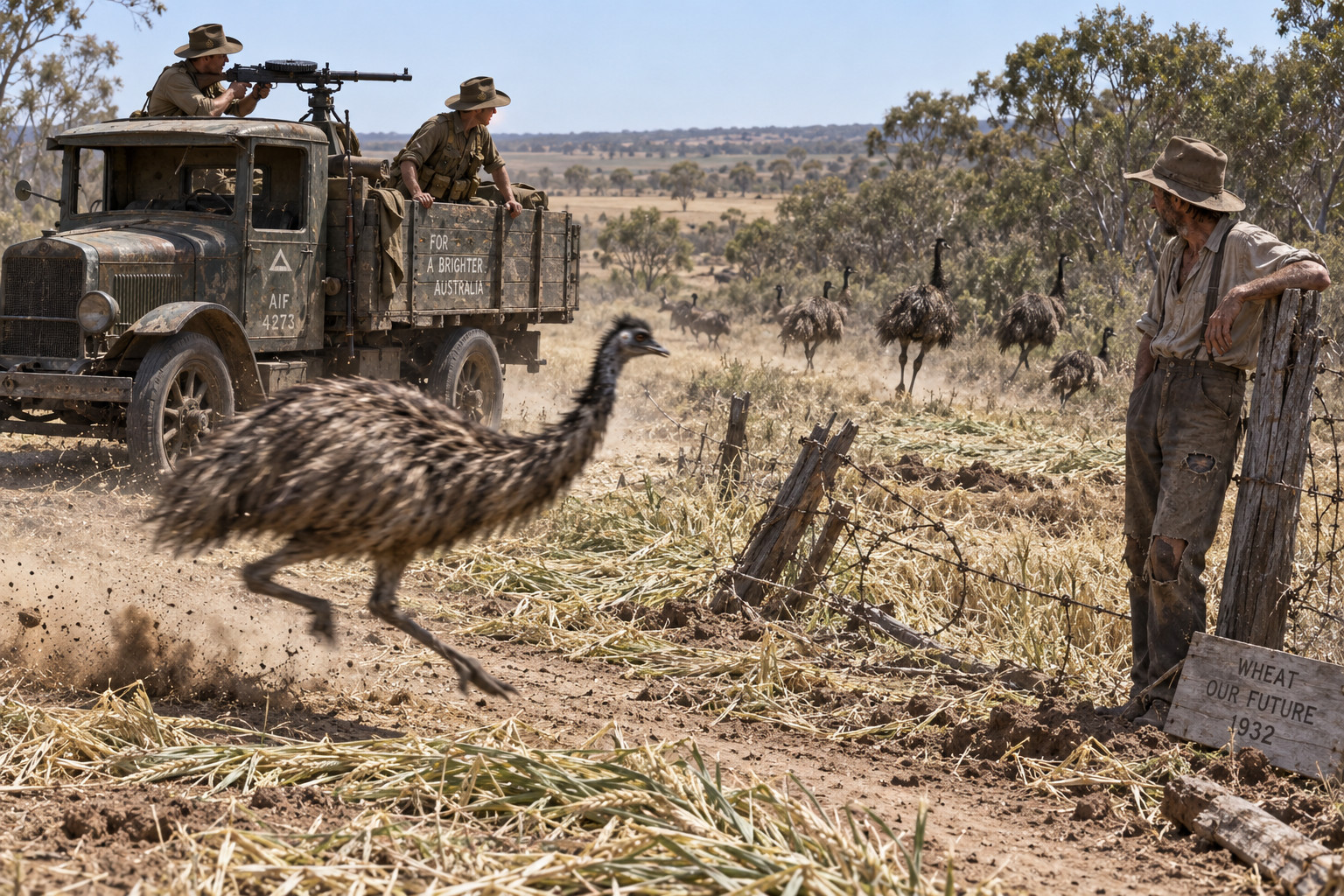
In late 1932, Western Australia’s wheat belt looked less like a farming region and more like a migration highway. After a dry season and the first rains, bands of emus — large, flightless Australian birds — moved inland from the coast in search of water and newly sown grain. Returned servicemen-turned-farmers, already squeezed by the Depression, found crops trampled and fences smashed. Frustration mounted: local pleas to the government asked for help to protect harvests that might otherwise fail.
A military solution that misfired
The response was extraordinary. The Minister of Defence authorised a small military operation, and soldiers armed with Lewis machine guns were dispatched to the Campion and Walgoolan districts of Western Australia. The idea was simple — disperse the emus and reduce their numbers. The reality was chaotic. Emus move in loose groups and can sprint at surprising speed; they proved elusive targets. Guns were mounted on trucks, but the birds scattered into scrub where the vehicles could not follow. Weapons jammed, visibility on dusty roads was poor, and estimates of birds killed varied widely. Contemporary reports recorded some successful engagements, but they also recorded embarrassment and ridicule: newspaper cartoons and letters mocked the idea of soldiers losing a campaign to a flock of birds.
Aftermath and an unexpected legacy
The military withdrew after a few weeks and the operation was widely judged a failure. The government shifted tactics, offering bounties and encouraging local control measures instead of further armed intervention. Over time, fences were repaired and shooting parties and bounty systems reduced the most immediate damage to crops — but the story did not disappear. The episode became shorthand for a mismatch between machine and milieu: modern weaponry and disciplined tactics could not easily be forced onto a migratory animal that had evolved to survive harsh, changeable landscapes.
Conclusion
The so-called “Emu War” is a peculiarly modern parable. It is a reminder that human solutions — military, bureaucratic, or technological — can stumble when they meet a stubborn, different set of instincts and environments. Farmers in 1932 needed protection, and they received it in an unexpected and theatrical form; history remembers an improvised campaign that, for a time, put men and machines up against one of Australia’s most resilient native animals. The result was neither a clear victory nor a simple defeat, but an odd chapter that still prompts a smile and a question: who really won?