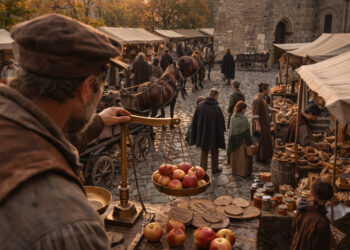


Market streets were the arteries of small towns, shaping daily patterns of work, family life, and sociability in ways that endure in historic records and material traces. Vendors, customers, and passersby negotiated space and status as much through gestures and rhythm as through transactions, creating a social texture that linked household economies with broader trade. These thoroughfares hosted news, rumor, and the visible markers of hierarchy, while also offering opportunities for cooperation and informal support among neighbors and merchants. Understanding market streets helps us see how economic action and everyday social life were deeply interwoven in pre-modern and early modern communities.
Economic Life Along the Rows
Stalls, shops, and open-air traders formed a layered economy that accommodated both specialized craftspeople and itinerant sellers, so that goods moved from countryside producers to urban consumers through a mix of permanent and temporary arrangements. Prices, credit, and reputation all circulated in public view, and many small firms relied on repeated face-to-face exchanges to sustain trust and predictability. Market days condensed economic activity into predictable pulses, intensifying labor, social exchange, and the flow of information about crops, prices, and politics.
These commercial routines shaped household strategies, with families timing chores, child care, and food preparation around market rhythms. The physical arrangement of stalls and shops also reflected social hierarchies, as prime locations reinforced status while more marginal spaces supported the flexible work of newcomers and the poor.
Domestic Spaces and Public Exchange
Homes and workshops frequently opened onto market streets, blurring distinctions between private and public spheres in ways that influenced gender roles and family labor. Women often managed retail fronts or produced goods for sale at the threshold of their houses, while men handled larger-scale trade and transport beyond the street. This permeability also meant that social obligations—lodging travelers, arranging credit, or negotiating disputes—were handled informally in shopfronts and doorways, creating a web of mutual dependencies.
As a result, daily life in market towns cannot be understood apart from the material settings where people worked and met, since the built environment structured both opportunities and constraints for economic survival and social interaction.
Rituals, Time and Seasonal Patterns
Market life followed a calendar of fairs, religious festivals, and harvest cycles that regulated demand and provided occasions for renewal and display, from special tariffs to communal entertainments. These rhythms created predictable peaks in labor and consumption, and towns adapted through temporary infrastructure, such as raised stalls or storage depots, to handle surges in activity. The interplay of sacred and secular time also made markets moments of civic performance, where officials asserted order even as vendors sought to maximize profit.
- Annual fairs drew regional traders and rare commodities.
- Weekly markets set local consumption patterns and credit cycles.
- Religious observances influenced scheduling and spatial use of streets.
Seasonal patterns thus reinforced social ties and economic strategies, binding townspeople together through recurring obligations and shared opportunities.
Conclusion
Market streets wove economic exchange, social life, and built form into a single urban fabric that shaped how people lived and worked. Studying those streets reveals the everyday mechanisms of community cohesion and economic resilience across time. Recognizing these patterns helps us appreciate the complex, human scale of historic towns.