

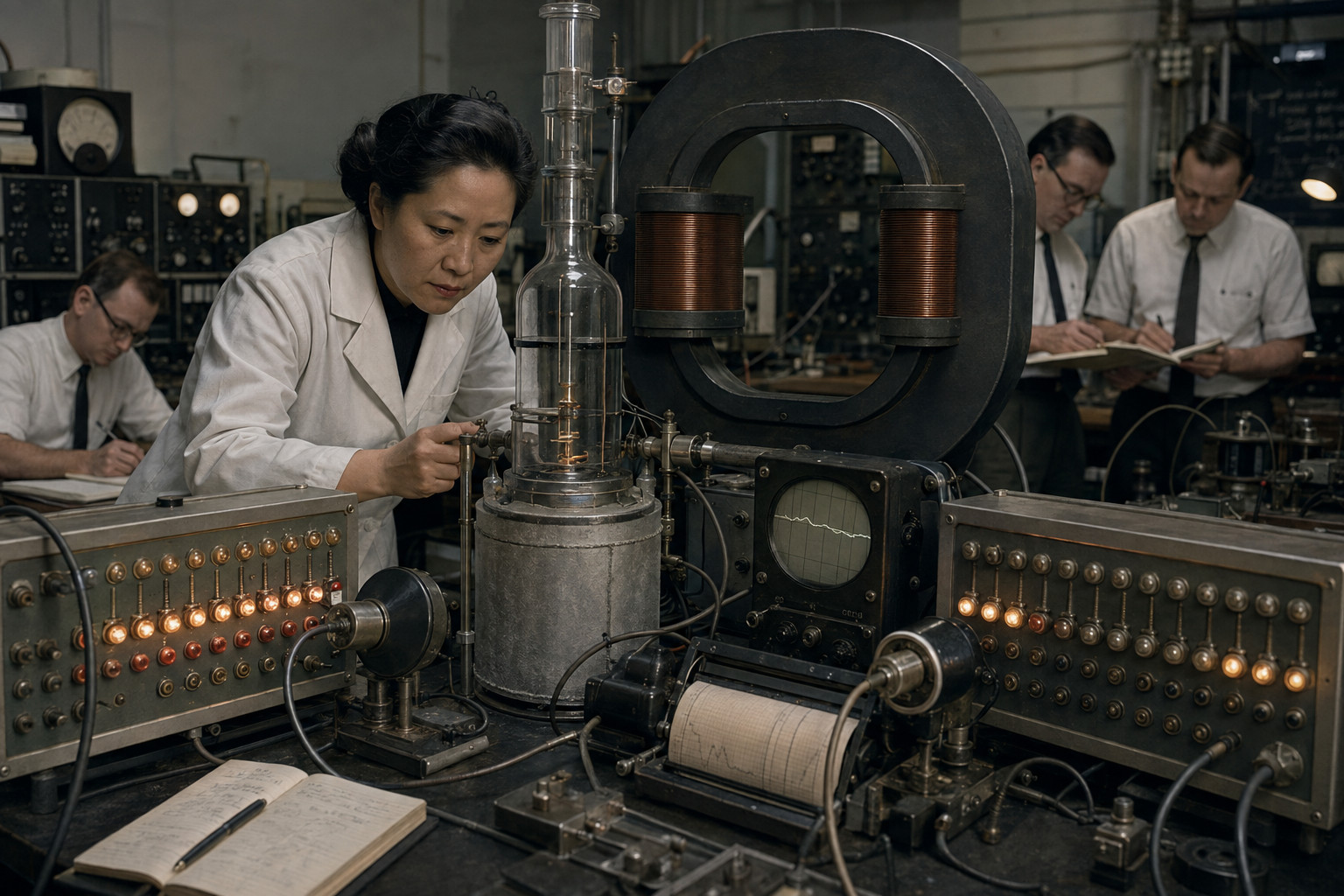
Chien‑Shiung Wu arrived in the United States as a young physicist with a gift for hands‑on work. Trained in both theoretical ideas and the messy art of the laboratory, she gravitated to problems where precise measurements mattered. By the time she joined Columbia University, Wu had built a reputation for designing careful experiments around radioactive materials and delicate detectors — not glamorous, but essential.
Her colleagues admired a combination of patience and ingenuity: she could keep a cryostat steady at low temperature for days, tune a detector to pick up a whisper of signal, and spot a systematic error others missed. Those skills would matter more than anyone expected.
The cobalt‑60 test that shook physics
In the mid‑1950s, two theorists suggested that one of physics’ sacred symmetries — parity, the mirror‑image equivalence of left and right — might not hold for the weak force. The idea was startling, and it begged for an experimental check. Wu accepted the challenge.
Her team used an isotope, cobalt‑60, cooling the sample to very low temperatures and applying a strong magnetic field to align the nuclear spins. Then they measured the direction of emitted beta particles (electrons) as the nuclei decayed. If parity were conserved, electrons would fly out symmetrically; if not, they would favor one direction over the other.
Wu’s measurements showed a clear asymmetry: more electrons were emitted in one direction relative to the nuclear spin. That asymmetry was unambiguous experimental evidence that nature, at least in the weak interaction, distinguishes left from right. A theoretical speculation became a reproducible fact because someone in the lab knew how to eliminate every sneaky source of error.
Recognition, omission, and a lasting legacy
The result transformed particle physics. Theoretical frameworks had to reckon with an interaction that violated mirror symmetry, and subsequent work led deeper into the structure of the weak force. Wu herself remained a towering figure in experimental physics, admired for exacting standards and for training students who carried precise measurement techniques into new fields.
Public attention and prizes fell mainly on the theorists who had proposed the possibility; she did not share the Nobel that followed. That omission has become part of her story, a reminder of how credit in science can be uneven. Yet among experimentalists and students, Wu is remembered for what matters most in the lab: the ability to turn an abstract question into a definitive measurement.
Conclusion
Chien‑Shiung Wu’s cobalt‑60 experiment is one of those rare moments when a compact laboratory setup rewrites our understanding of the universe. She did more than confirm a surprising idea; she showed how meticulous experiment — patience, clever apparatus, and ruthless checks for error — can force nature to reveal itself. The weak force’s preference for left over right remains a cornerstone of modern physics, and Wu’s work is why we know it.