
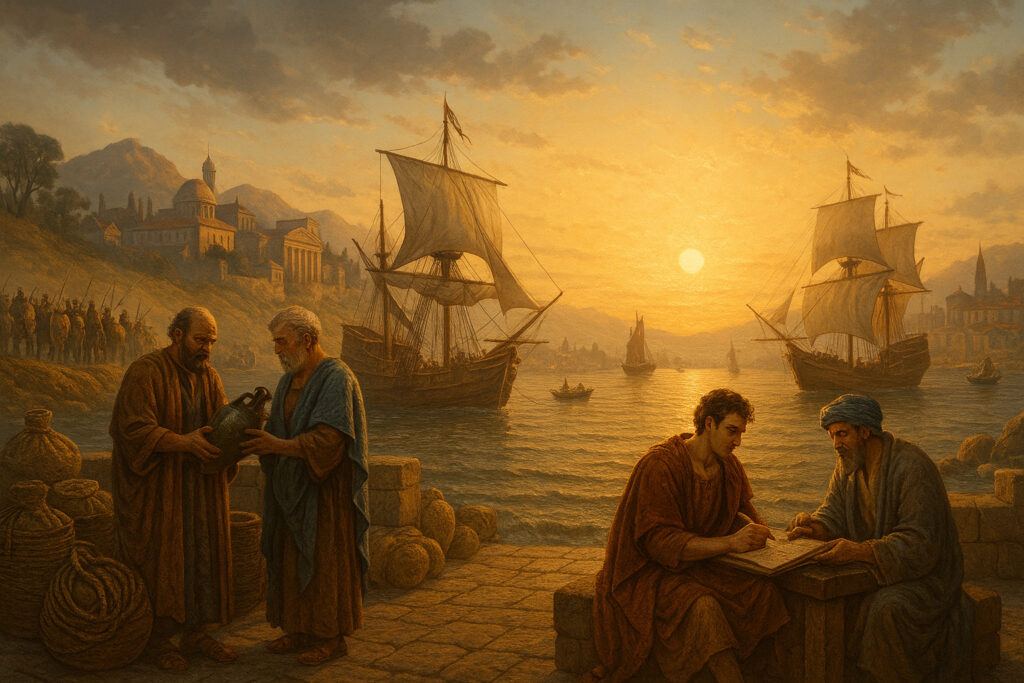
Human civilization has been shaped by three powerful forces — trade, war, and culture. From the earliest barter systems to global commerce, from tribal conflicts to world wars, and from cave art to digital media, these forces have continuously interacted to define how societies grow and connect. Together, they tell the story of human ambition, adaptation, and innovation — revealing that progress often arises from both collaboration and conflict.
Trade: The Engine of Connection
Trade has always been at the heart of civilization’s growth. Ancient trade routes like the Silk Road and the Trans-Saharan networks connected continents long before globalization. Through commerce, goods, ideas, and technologies flowed between cultures — silk and spices traveled east to west, while mathematics, astronomy, and philosophy moved in the opposite direction. Trade not only created wealth but also built bridges between distant peoples, fostering diplomacy and mutual understanding. The rise of ports, cities, and empires often followed the prosperity brought by trade.
War: The Catalyst of Change
While trade builds, war transforms. Throughout history, conflict has been both destructive and transformative, reshaping borders, technologies, and power structures. From the Roman conquests to the World Wars, nations have fought for territory, resources, and ideology. Yet, war also drove innovation — metallurgy, navigation, medicine, and engineering advanced in response to military needs. Empires rose and fell, but each war left lessons that pushed humanity toward new political systems and peace-building efforts. Paradoxically, the devastation of war often paved the way for reconstruction and progress.
Culture: The Soul of Civilization
Culture — expressed through art, language, religion, and traditions — binds societies together and defines their identity. It is culture that gives meaning to human existence beyond survival and conquest. The exchange of cultural ideas through trade and conquest has produced some of humanity’s greatest achievements — from the fusion of Greek and Eastern art under Alexander the Great to the global spread of music, cuisine, and literature in modern times. Culture evolves with every encounter, proving that diversity and creativity are the true markers of civilization’s resilience.
The Interplay of Forces
Trade, war, and culture rarely exist in isolation. The Age of Exploration, for instance, blended all three — driven by the pursuit of trade routes, fueled by imperial conquest, and resulting in vast cultural exchange. The Renaissance and the Industrial Revolution, too, were born from this intersection. Together, these forces continue to shape the modern world, influencing globalization, diplomacy, and social change.
Conclusion
Human history is a story of movement, conflict, and creation. Trade connected us, war tested us, and culture defined us. As we look toward the future, understanding how these forces have shaped our past can help us build a more connected, peaceful, and culturally rich world. The same forces that built history continue to shape the destiny of humankind.