
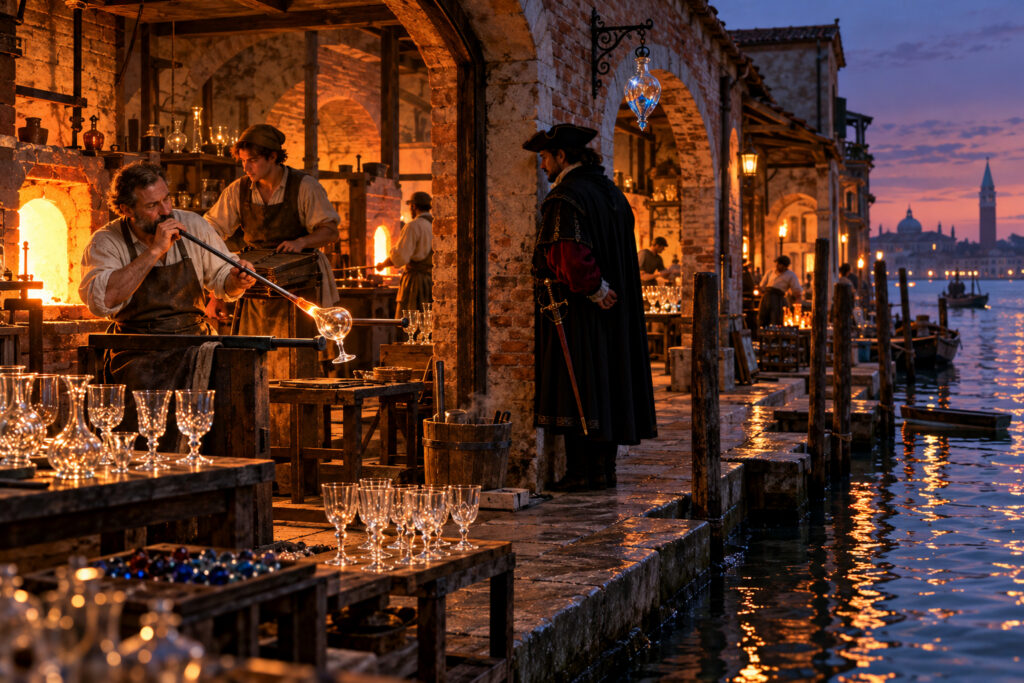
Venice didn’t always glow. For centuries the city’s skyline was ordinary until the furnaces of its craftsmen began to throw off a very particular light: clear, brilliant glass. To protect the city from fire and to keep prized techniques under Venetian control, authorities clustered the risky kilns onto nearby Murano. There they became both a visible industry and a guarded community — the heart of an export trade that sent goblets, chandeliers, beads and mirrors across Europe and beyond.
The guarded craft that made a reputation
Venetian glassmakers perfected more than thinware; they turned glass into a luxury language. Masters experimented with decolorizing to make nearly colorless “cristallo,” complex lattices and delicate enamel painting. Those innovations combined art and chemistry: specific recipes for furnace temperatures, raw sands, and mineral additives were the family jewels of the trade. The Republic treated those recipes like state secrets.
To keep them secret, the state bestowed unusual privileges on leading glassmasters. These could include exemption from certain civic duties, the right to carry a sword in a city where most artisans could not, and access to pensions or other protections that set them apart from ordinary craftsmen. At the same time, leaving the lagoon was discouraged — and accounts from later writers suggest that penalties for emigrating were harsh, reportedly even fatal in extreme cases, a sign of how seriously Venice guarded its monopoly.
Spillovers, rivals and the end of a monopoly
Secrecy slowed but did not stop imitation. Over the early modern centuries, skilled workers slipped away, techniques leaked, and European rulers eager to develop their own glass industries offered incentives. New centers in Bohemia, France and England learned to rival Venetian wares. Meanwhile, changing tastes and industrial methods altered demand. Venice remained synonymous with elegance, but its monopoly and political clout diminished as knowledge spread.
Conclusion
The story of Murano’s glassmakers is more than a tale about fragile objects. It is one about how a city turned craft into identity and how secrecy and privilege can preserve innovation for a while — but not forever. Today Murano’s workshops still make dazzling objects, but the real legacy is the way those fires once lit a global appetite for glass, teaching the world how to temper, color and mirror light itself.