
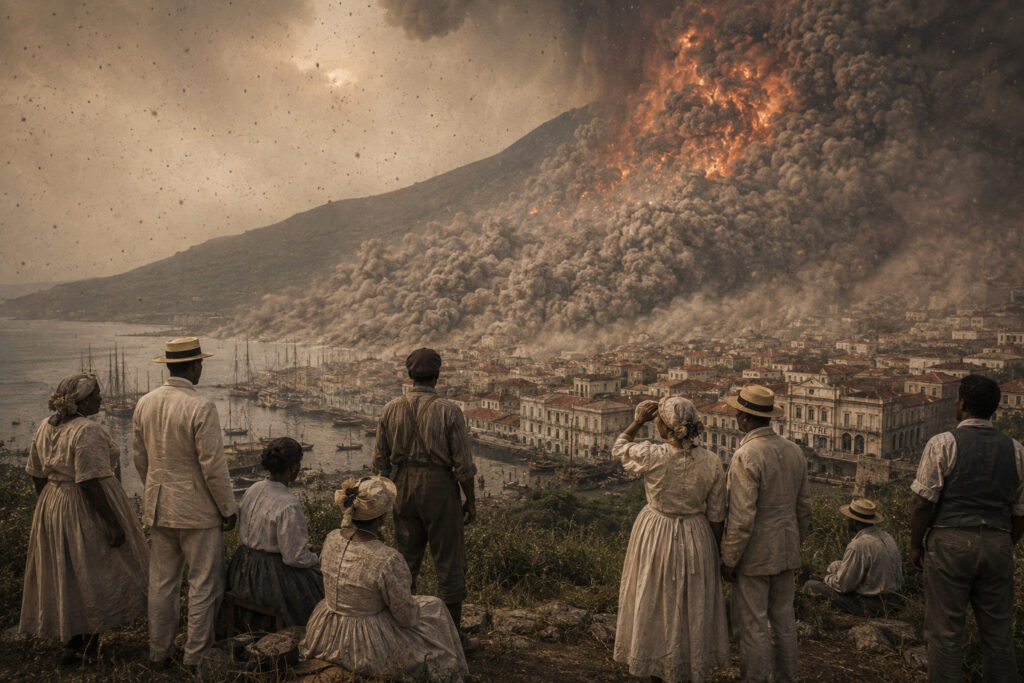
At the start of 1902 Saint-Pierre, on the Caribbean island of Martinique, looked more like a French provincial town than a volcanic hazard. Elegant theaters and pastry shops lined its streets; visitors called it the “Paris of the West Indies.” The port bustled with sugar, rum and the onward traffic of ships. Behind that veneer of commerce and creole life loomed Mount Pelée, a volcano the islanders knew by name but not, most thought, by danger.
The day the mountain came alive
In the weeks before May there were warning signs: tremors, gas and smaller eruptions higher on Pelée’s flanks. Many residents watched anxiously but few left. On the morning of 8 May 1902 the volcano produced a catastrophic blast accompanied by a high-speed cloud of superheated gas and ash that raced down the slope and into the town. The phenomenon—what scientists call a pyroclastic flow and what contemporary reports popularized as a nuée ardente—swept through streets and houses with incredible speed and heat.
Saint-Pierre did not burn in the slow way fires consume wooden towns; it was overwhelmed. Structures that survived the initial blast were gutted so quickly and with such heat that the place—home to perhaps 30,000 people across the region—was turned into an uninhabitable ruin by afternoon. Only a tiny number of individuals survived the inferno. The most famous was a prisoner who, locked in a stone cell, lived through the heat that devastated the rest of the town.
Aftermath: science, ruin and a changed island
The human cost was staggering. Estimates place the death toll in Saint-Pierre and its immediate surroundings in the tens of thousands. The wreck of the city forced a rethinking of volcanic hazards. French geologists who examined Pelée’s violence identified the destructive power of pyroclastic flows and spread the term nuée ardente into volcanology. For Martinique the consequences were more immediate: Saint-Pierre never regained its former glory. Fort-de-France, already an important port, grew in importance as the island’s commercial and administrative center while Saint-Pierre’s streets stayed pocked and quiet for decades.
Beyond buildings and commerce, the disaster reshaped memory on the island and beyond. Photographs of ruined facades, accounts of sudden devastation and the stories of the few survivors entered newspapers and scientific reports across Europe, making Pelée a cautionary example of how quickly a volcano can destroy an apparently ordinary town.
Conclusion
Mount Pelée’s 1902 eruption is one of those historical moments where a single natural event remade a place and changed a science. Saint-Pierre’s sudden disappearance—its theaters, shops and daily life vaporized in an hour—reminds us how closely ordinary human rhythms in the past could sit to raw geological power.