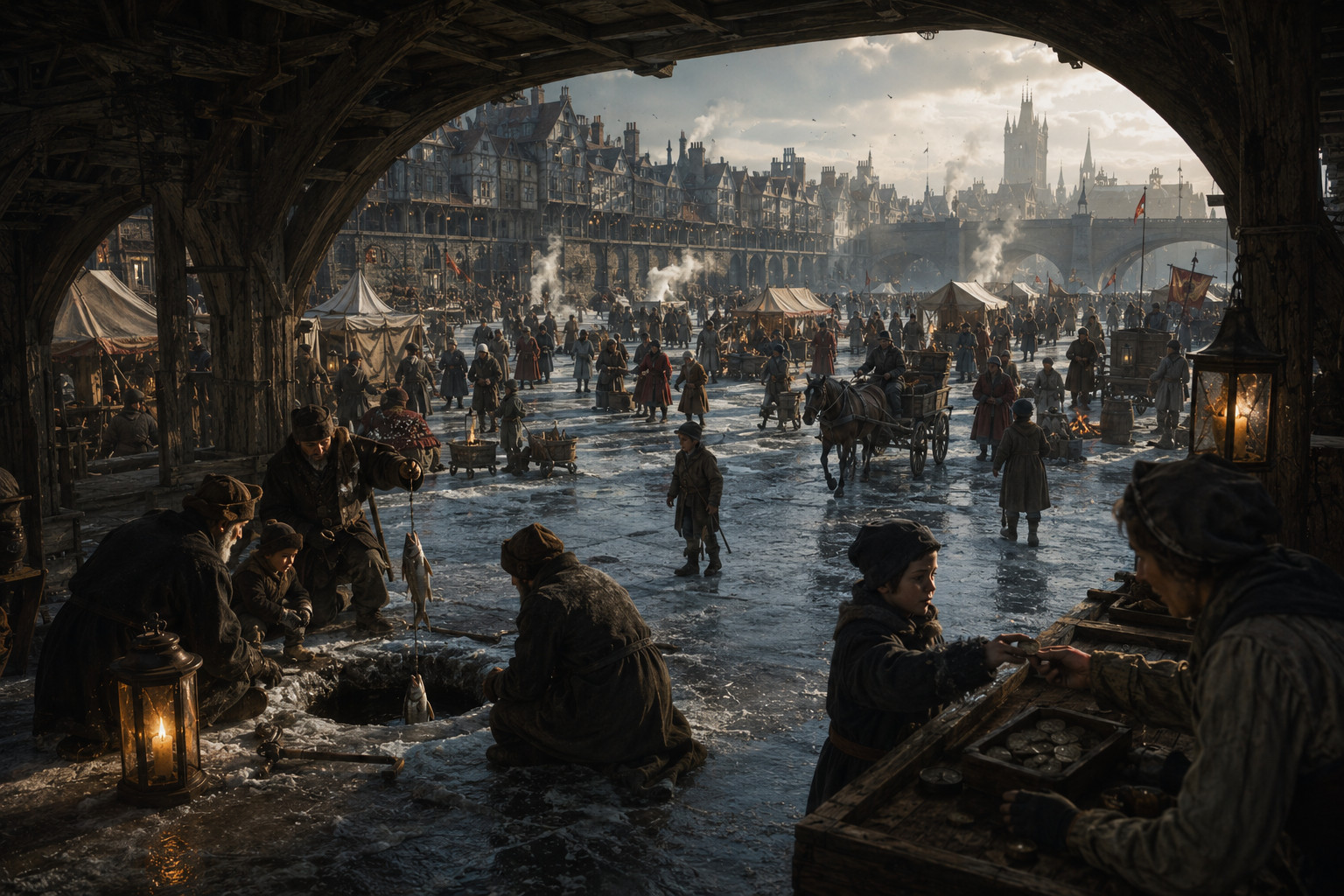
Every so often between the late medieval period and the early 1800s, winter in London did something extraordinary: the Thames froze hard enough to carry people, carts, and entire markets. For days or weeks at a time the muddy, tidal river stopped acting like a river and behaved like a wide, shifting square. Londoners crossed the ice as they might cross a crowded plaza, and for a few winters the city simply moved downstream.
A makeshift city on the ice
When frost conditions held, entrepreneurs and families hurried onto the frozen surface. They erected tents and stalls, set up alehouses and games, and sold printed tokens and trinkets as souvenirs. Sport and spectacle followed: children slid on improvised sledges, gentlemen staged races, and crowds gathered to watch feats of balance and strength. The sound was unusually close — footsteps, hawkers, the creak of wooden stalls — because the usual distance between shore and city life had vanished.
The fairs could feel both jolly and dangerous. Men bored holes through thick ice to fish or to test the surface; lanterns and bonfires were lit; and not every patch of ice held. Contemporary accounts note accidents, and the possibility of a sudden thaw meant the festivities carried a thrill of risk.
Why the Thames froze, and why it stopped
The fairs were products of two things. First, the Little Ice Age made winters colder across northern Europe for several centuries, raising the chance of sustained freezes. Second, the medieval London Bridge — an old stone span crowded with houses and narrow arches — slowed the river’s flow at its most constricted point. Slower-moving water is easier to freeze, and the combination of hard cold and obstructed current let a solid sheet of ice form where it otherwise would not.
By the early 19th century the conditions that produced the fairs were changing. Bridge design and river engineering improved, the old congested spans were altered or removed, and a general warming trend reduced the severity of winters. The result: those temporary river streets faded from living memory, and London returned to being a city built beside, rather than on, its river.
Conclusion
The Thames frost fairs survive now in prints, odd keepsakes, and a few lively descriptions that capture a city walking on water. They are a reminder of how climate, infrastructure, and improvisation combine to make the unexpected ordinary — if only for a few cold weeks.