
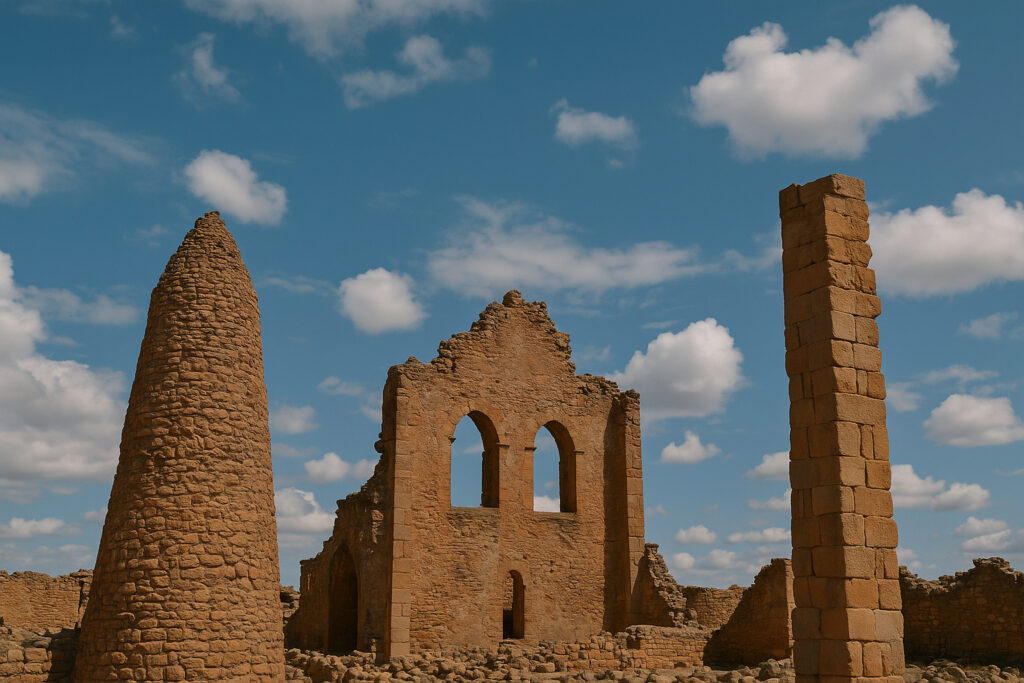
When most people think of ancient Africa, their minds turn to the grandeur of Egypt and the flow of the Nile. Yet, beyond this famed river, the continent was home to other remarkable civilizations—powerful kingdoms that thrived through trade, innovation, and culture. From the deserts of Mali to the highlands of Ethiopia, these ancient empires helped shape global history in ways that are only now gaining the recognition they deserve.
The Kingdom of Kush: Egypt’s Southern Rival
South of ancient Egypt flourished the Kingdom of Kush, centered in Nubia (modern-day Sudan). Often overshadowed by its northern neighbor, Kush was a formidable power that once ruled Egypt as the 25th Dynasty, earning its kings the title of “Black Pharaohs.” The Kushites were skilled builders, leaving behind pyramids, temples, and artifacts that rivaled those of the Nile. Their capital, Meroë, became a hub of iron production and trade, symbolizing Africa’s early industrial innovation.
The Wealth of Mali: Empire of Gold
Centuries later, West Africa saw the rise of the Mali Empire, one of the richest civilizations in history. Under the legendary ruler Mansa Musa, Mali became a center of wealth, learning, and culture. The city of Timbuktu stood as a beacon of scholarship, attracting scholars, traders, and explorers from across the Islamic world. The empire’s control over gold and salt trade routes made it an economic powerhouse that connected Africa to Europe and Asia.
Great Zimbabwe: A Monument of Stone and Strength
In southern Africa, the Kingdom of Great Zimbabwe showcased architectural brilliance. Built between the 11th and 15th centuries, its massive stone walls and towers—constructed without mortar—demonstrated advanced engineering and artistic design. Great Zimbabwe was a thriving trade hub, linking inland Africa to the Swahili coast and the Indian Ocean. It stood as proof of Africa’s complex urban societies long before European contact.
The Kingdom of Axum: A Crossroads of Cultures
In East Africa, the Kingdom of Axum (in modern Ethiopia and Eritrea) emerged as one of the great ancient powers. Axum was a major trading empire, dealing in gold, ivory, and spices. It was among the first civilizations to adopt Christianity as a state religion and minted its own coins—an early symbol of political and economic sovereignty. Its towering obelisks and written script stand as testaments to its cultural sophistication.
Conclusion
Africa’s ancient kingdoms tell a story far richer than the myths of an untamed continent. These civilizations were centers of innovation, trade, learning, and faith—each contributing to the human story in profound ways. Beyond the Nile, Africa’s legacy of greatness continues to inspire, reminding the world that civilization has many cradles, and Africa was one of its brightest.