
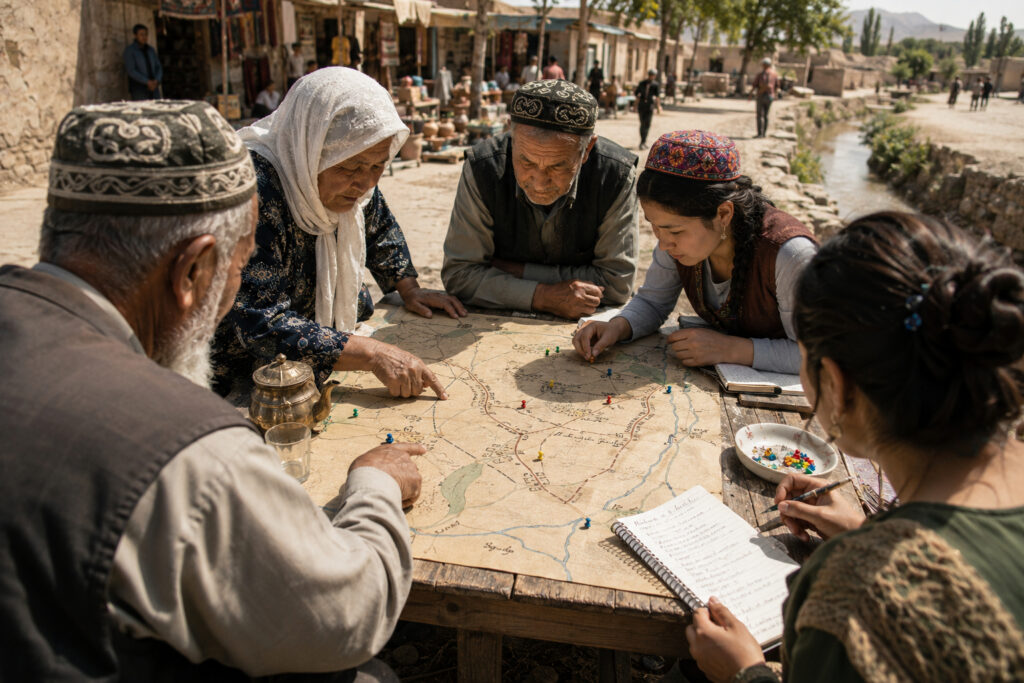
Regions are shaped by movement and routine, not only by borders or institutions.
Daily flows, including commuting, market trips, and seasonal migration, make patterns of familiarity that anchor memory and shared identity.
These collective routes leave material traces: pathways, stalls, workshops, and recurring events that shape how people remember and relate to place.
Focusing on mobility and routine shows how regional identities form through practice as much as through formal political acts.
Mobility and Daily Routines
Mobility is often mundane: it registers in repeated trips to fields, factories, or market squares, and in the rhythms of trade and care. Over time, these movements produce invisible maps of familiarity that residents use to orient themselves and others. Oral histories and local accounts frequently reference routes rather than administrative lines when describing belonging. Recording these habitual movements helps historians and regional researchers recover social practices that standard archives overlook.
Attention to routine mobility also reveals networks of exchange that sustain regional economies. Mapping such flows can change how we define a region in practice.
Material Traces and Local Networks
Physical remnants, including paths, market stalls, irrigation channels, and workshop clusters, carry memory in durable form. These traces connect households and neighborhoods into webs that outlast individual lives and political regimes. Examining repairs, reuse, and layered construction shows how communities adapt shared spaces across generations. Archaeological and archival methods together expose how material culture anchors everyday regional continuity.
By following tangible traces, researchers can link microhistories to broader regional transformations. Such work highlights the persistence of local knowledge and the practical logic of place.
Institutions, Seasons, and Regional Rhythms
Small institutions, such as schools, markets, religious houses, and cooperatives, serve as nodes that structure routines and mark time. Seasonal cycles of planting, festivals, and artisanal production synchronize dispersed communities and create a shared calendar. These institutional and seasonal rhythms reinforce memory through repetition and public practices. Studying them together reveals how social institutions mediate mobility and material continuity within a region.
Recognizing institutional rhythms helps explain why some practices endure while others fade. It also suggests methods for documenting regional life through living memory and institutional records.
Research Methods and Community Practices
Combining oral testimony, participatory mapping, and close reading of material sites yields a fuller picture of regional life across time. Digital tools can plot quotidian movements, while ethnography reveals the meanings people attach to particular routes and places. Collaboration with local archives and community groups ensures that research respects living memory and produces useful outputs. Such mixed methods create narratives that bridge micro-level practices and larger regional transformations.
Researchers should also remain attentive to power dynamics that shape whose routes are recorded and remembered. Ethical, reciprocal partnerships help ensure that recovered histories benefit the communities at their center.
Conclusion
Collective routes and repeated routines make regions visible in daily practice.
Focusing on movement, material traces, and rhythms offers a grounded approach to regional history.
This perspective complements political narratives and enriches our understanding of place.