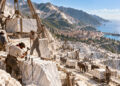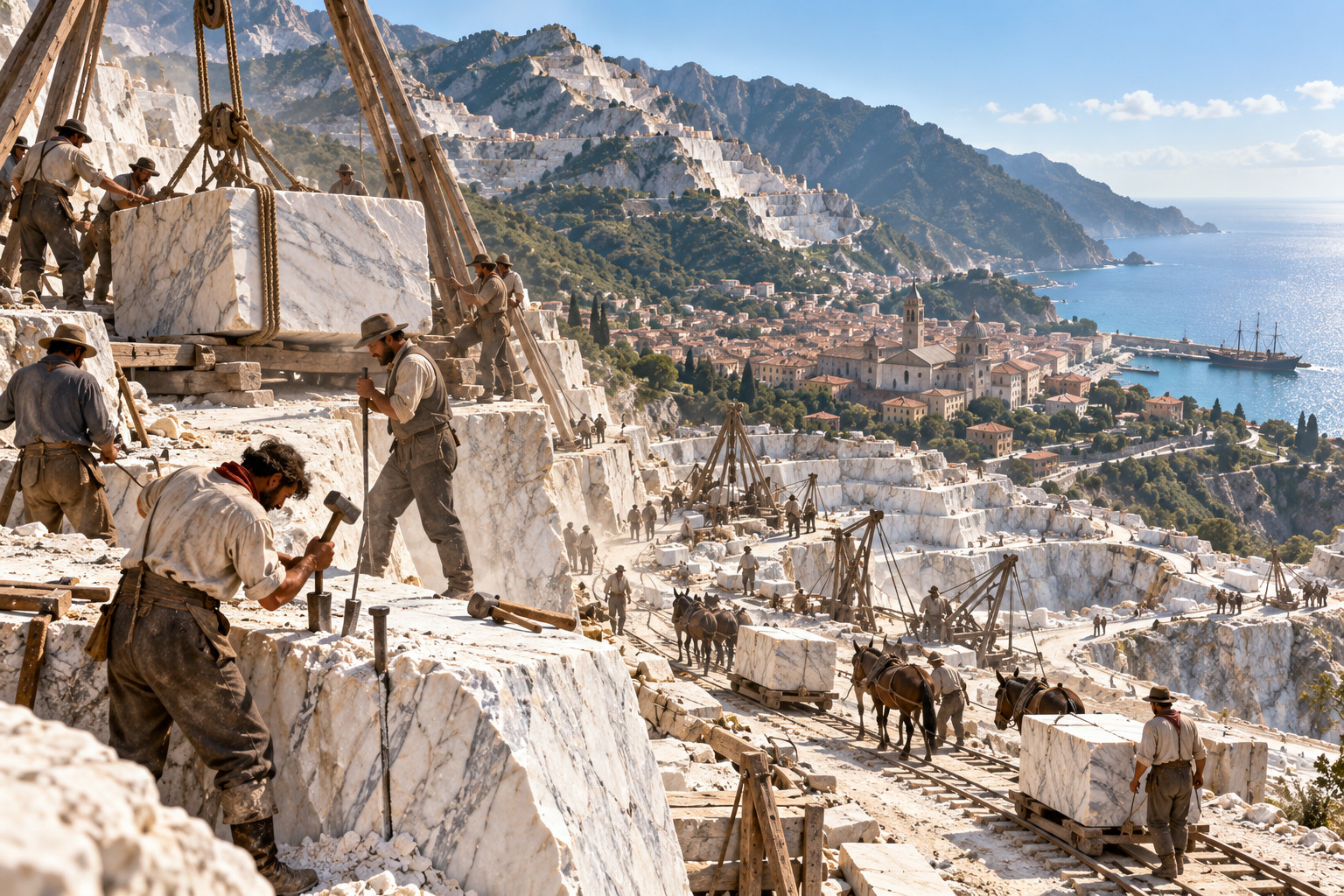
High in the Apuan Alps, great veins of marble turn cliffs into pale, almost living faces. From those seams came blocks that shaped the Renaissance and later filled palaces, monuments, and mausoleums from Italy to the Americas. The town below—streets, churches and workshops—reflects that labor: its stones glitter, façades dusted with the same luminous material as the peaks above. Carrara is not just the source of marble; the stone is the region’s grammar, its skyline and its industry braided together.
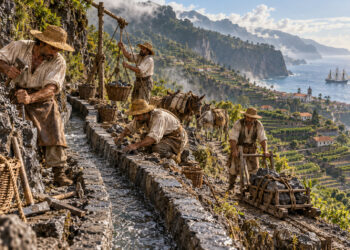
Quarrying here is older than modern maps. Roman engineers knew the value of this marble; Renaissance patrons prized it for sculpture because it carves clean and accepts a fine polish. That reputation sent merchants, sculptors and contractors up narrow mountain roads to choose blocks, and sent heavy loads down toward the Ligurian coast. The living landscape—paths, derricks, mule tracks—grew from the logistical problem of getting tons of rock out of crags and onto waiting ships.
Tools, tunnels, and the manpower of the quarries
Extraction in Carrara has always been an exacting craft. Workers split beds of stone with wedges and drills, then finished the block by hand so it would travel without splitting. Quarrymen learned to read the marble: where a vein would yield a flawless block, where it would shatter. Stonecutters, carvers and the joiners who squared the blocks developed local techniques passed down through families. Over time, narrow-gauge tracks, cable systems and saws altered labor patterns, but many of the hardest tasks remained muscle work, carried out in thin air on terraces hewn into slopes.
Because the marble itself was a global commodity, small villages in the mountains plugged into far-flung markets. Ships bound for Naples, Marseille or New York might carry a Carrara block alongside timber and grain. This made the region unusually outward-facing while geographically isolated—people here watched fashions and building trends hundreds of miles away because those tastes determined demand for their stone.
Stone and social life: politics, craft, and controversy
The danger and precarity of quarry work shaped local politics. Hard conditions, seasonal cycles of employment and the value of what laborers extracted led to sharp class contrasts. Carrara developed a reputation for militant labor organizing and a surprisingly rich political life for a mountain town: quarrymen were often at the forefront of strikes and radical movements, determined to win better pay and safer workplaces. Their activism had echoes beyond the hills because marble that built national monuments also carried the hands that made those monuments.
In the twentieth century the scars on the mountains prompted another kind of conflict. Quarrying altered watersheds and exposed slopes; tourism and heritage advocates pushed back against the relentless removal of stone. The argument is almost literal: how much of the white mountain can a region give away before it loses the very landscape that made its identity?
Conclusion
Carrara shows how a single resource can shape everything from craft to politics, from trade routes to town architecture. The region’s pale cliffs are a ledger of human ambition—blocks pried loose by hand, shipped to capitals, and turned into art and civic imagination. Walk its streets and you read that ledger: dusted doorways, tilted cranes, and people whose skills still answer to the mountain’s veins. The marble is both product and story, and for centuries the story of Carrara has been one of labor, risk and a very particular kind of beauty.